Hasselblad X2D II 100C: Practical impact of a 100MP medium format

A milestone for medium format stills
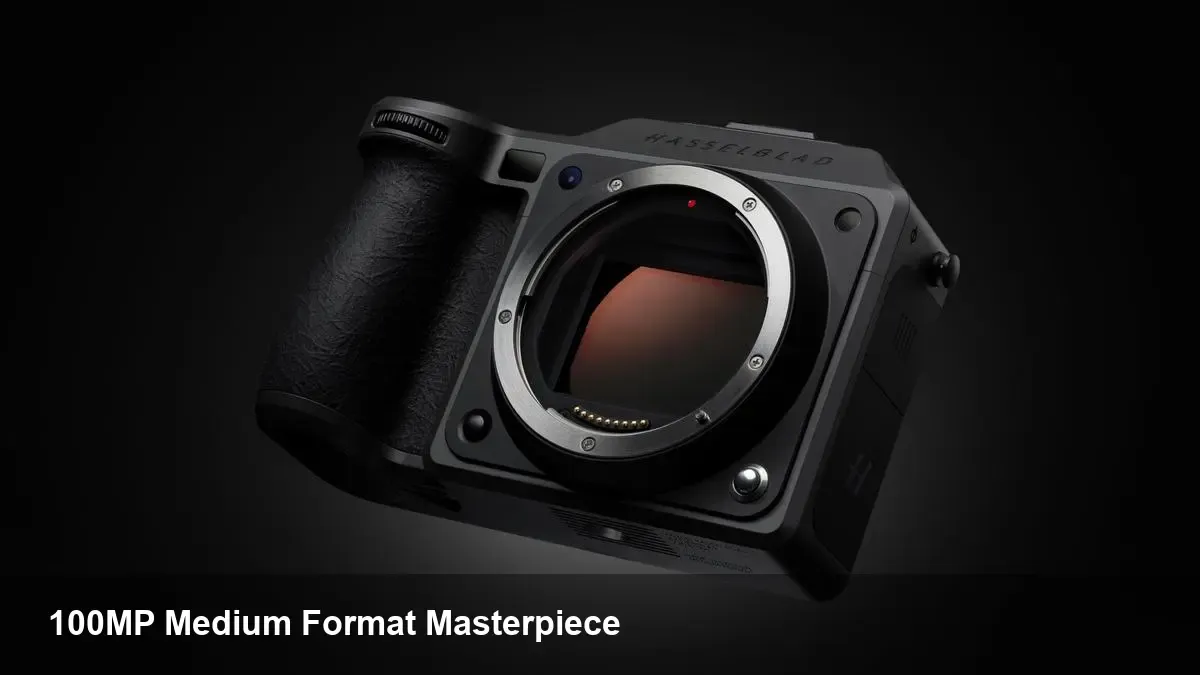
Hasselblad's X2D II 100C has just been singled out by the industry as a standout stills camera — and with good reason. Its 100MP sensor and refined engineering aim squarely at professionals who demand the cleanest files, the best color science and the kind of detail that can carry large-format advertising, fine-art prints and high-end product work.
This article looks beyond accolades: what the X2D II 100C brings to real-world shoots, how it changes workflows for photographers and studios, and what it means for businesses investing in ultra-high-resolution imaging.
What the X2D II 100C actually offers
At its core the Hasselblad X2D II 100C delivers very-high-resolution medium format imaging—100MP worth of data in each RAW capture. That matters not just for pixel counts but for noise performance, tonal gradation and the room it gives you for cropping while retaining print-quality detail.
Key practical advantages:
- Exceptional detail and color depth useful for large prints and high-end retouching.
- Improved dynamic range compared with many 35mm full-frame alternatives, which helps in tricky lighting.
- Hasselblad’s color science and rendition that many commercial clients prize for skin tones and product color accuracy.
Physically, the camera continues Hasselblad’s move toward mirrorless medium format ergonomics and portability — a balance between studio reliability and field usability.
Where this camera fits in a pro’s kit
Understanding who should consider the X2D II 100C comes down to trade-offs.
Best-fit scenarios:
- Commercial and advertising photographers shooting large print campaigns where every pixel and color nuance matters.
- Product and fashion work that demands flawless color reproduction and high detail for zoomed-in crop usage.
- Landscape and fine-art photographers who value dynamic range and finish-quality for gallery prints.
Less ideal situations:
- Fast-action photography (sports, wildlife) where high frame rates and extreme autofocus tracking are primary — medium format 100MP bodies are generally not optimized for those use cases.
- Budget-conscious shooters for whom the cost of camera, lenses, and storage for 100MP files is prohibitive.
The workflow impact: plan for the data
Shooting 100MP RAW files changes the operational profile of a job.
Storage and backup
- Expect RAW files several times larger than typical full-frame files. That increases on-shoot storage needs, backup throughput and long-term archiving costs.
- Fast cards (and card readers) and local RAID or fast NAS systems become practically mandatory for professional throughput.
Post-processing demands
- High-resolution files put pressure on processing workstations — more RAM, faster CPUs, and GPU-accelerated software reduce bottlenecks.
- Capture One, Adobe Lightroom and other pro tools already support medium format RAWs, but tethered capture and color-managed pipelines should be tested in advance to ensure speed and reliability.
Collaboration and delivery
- File delivery may push you toward cloud transfer strategies (Aspera, high-speed SFTP, or optimized cloud sync) or smart derivatives for client review if bandwidth is limited.
- In-studio color pipelines must be calibrated end-to-end: monitor profiles, soft-proofing, and print workflows need to be tuned to preserve the camera’s color fidelity.
Business value and ROI considerations
A camera like the X2D II 100C is an investment. Here are practical business questions to weigh:
- Does ultra-high-resolution output open new revenue streams? Clients in advertising, architecture, or luxury retail will often pay premiums for the quality that large prints and impeccable retouching require.
- Will it shorten project cycles? Higher base image quality can reduce time spent on noise reduction and color correction, but larger files can lengthen post-production if your systems aren’t optimized.
- Can you monetize the equipment through rentals? High-end cameras frequently have strong rental demand, helping offset acquisition cost for studios.
Pricing and total cost of ownership matter: factor in lenses, support accessories, storage, and the human hours required for handling bigger files.
Drawbacks and practical limits
No camera is perfect. Consider these trade-offs:
- Size of the RAW files and slower burst capability compared with action-focused systems.
- Increased cost for lenses and support equipment suitable to medium format sensors.
- Power consumption and battery life under heavy tethered usage can be a constraint on long location shoots.
Additionally, while the X2D II 100C’s images may require less corrective magic, achieving the best results still depends on lighting, technique and post-processing expertise.
Broader trends and implications
The X2D II 100C’s recognition highlights several industry shifts:
- High-resolution medium format is increasingly practical. Mirrorless engineering has made these systems more accessible to pro shooters who once found medium format too bulky.
- The bottleneck is less in capture quality and more in data logistics. As sensors keep packing pixels, storage, network transfer and compute will be the areas demanding innovation.
- Color fidelity and final-output quality remain differentiators. Brands that preserve excellent color science keep premium appeal among creative clients.
For vendors and startups, these trends suggest opportunities around intelligent asset management, faster cloud-based RAW processing, and optimized client delivery systems tailored for ultra-high-resolution work.
Should you upgrade or rent?
If your current work regularly requires very large prints or you’re pitching for higher-end campaigns, adding an X2D II 100C to the kit can be transformative. For many shooters, a pragmatic approach is to rent such a camera for specific jobs — it provides access to the quality boost without committing to the full cost and workflow overhaul.
If you decide to invest, treat the purchase as a systems upgrade: gear, storage, processing hardware and team training should be budgeted together.
The industry award is a nod to the X2D II 100C’s technical achievements, but its true value will be measured on client briefs, print walls and delivery pipelines. For studios aiming at top-tier commercial and fine-art work, this camera is not just a trophy — it’s a practical tool that reshapes what’s possible in high-resolution imaging.