Latvia Signs the Artemis Accords: Real-World Impacts

Why this matters now
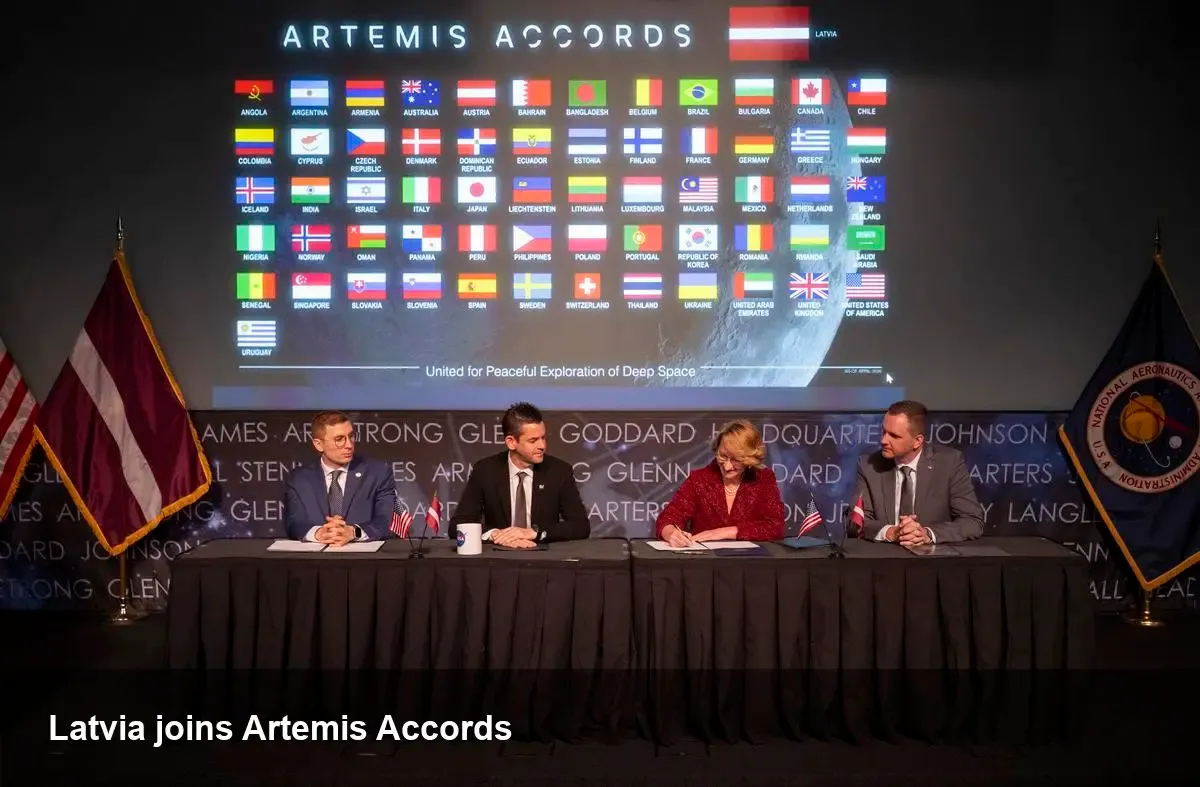
Latvia recently formalized its participation in the Artemis Accords during a ceremony hosted at NASA headquarters in Washington. The move is more than symbolic: it signals that smaller European nations are actively aligning with a set of nonbinding operating principles built around lunar exploration, space resource activities, scientific openness, and technical interoperability. For engineers, startups, and policymakers, Latvia’s signature reshapes practical opportunities and constraints in the near-term space economy.
A quick primer on the Artemis Accords
The Artemis Accords are a coordination framework developed alongside NASA’s Artemis program, which aims to return humans to the Moon and establish a sustainable presence there. The Accords don’t create binding international law, but they outline shared expectations — such as transparency around space activities, compatibility of systems, emergency assistance protocols, and approaches to the use of space resources. As more countries sign, these principles become a set of de facto norms that influence how missions are designed, procured, and regulated.
What Latvia actually gains — practical pathways
Signing the Accords gives Latvia a clearer entry ticket into multinational projects and commercial supply chains tied to lunar, cislunar, and deep-space activities. Concrete ways this could play out:
- Research partnerships and grants: Latvian universities and research institutions become more visible partners for joint payloads, instrument teams, and data-sharing agreements connected to NASA or other Accords signatories.
- Industry contracting opportunities: Local engineering firms and startups that specialize in small sensors, GNSS augmentation, communications hardware, software-defined radios, or smallsat platforms can bid into international consortia that support lunar missions or ground infrastructure.
- Standards and certification advantages: Alignment with Accords principles speeds technical interoperability work. If Latvia adopts compatible testing and certification practices, its suppliers can plug into multinational systems more easily.
- Regulatory clarity: Endorsing the Accords signals political support for principles around resource use and transparency. That helps domestic regulators craft export controls and licensing pathways that are consistent with key partners — a practical advantage for companies working on dual-use space technologies.
Two realistic scenarios where Latvian capabilities matter
1) A Latvian communications startup provides a relay node architecture for small lunar landers. Many upcoming lander missions need affordable, high-availability communications links to Earth or to a cislunar backbone. Latvia’s mature IT and electronics sectors could adapt smallsat or ground-station expertise into lunar relay services, plugging into larger missions run by NASA partners.
2) A university group in Riga develops a compact, low-power instrument for regolith analysis. Small, modular science packages are in high demand for commercial landers and rideshare payloads. By participating under the Accords’ scientific openness principles, the university could join multinational science teams and receive data from other instruments — accelerating calibration and validation work.
What startups and engineers should consider next
- Prioritize interoperability: Design interfaces and data formats that follow international practice (and are compatible with popular NASA/European standards when possible). That lowers barriers to joining multinational missions.
- Review export and compliance rules early: Even with Accords alignment, export controls (e.g., ITAR or equivalent domestic rules) and licensing remain key constraints. Early legal review prevents late-stage surprises on shared hardware or software.
- Seek coalition-building over solitary bids: Small firms are more competitive when they join cross-border consortia that combine domain expertise (navigation, power systems, payload integration) rather than competing solo for entire contracts.
Broader implications for space governance and the market
Latvia’s accession contributes to two larger dynamics in space policy and industry:
1) Norm consolidation without treaty negotiations: The Artemis Accords are shaping operational expectations faster than multilateral treaty processes. As more states agree to these norms, procurement and commercial behavior will increasingly assume them as baseline practice.
2) Democratization of the space supply chain: In contrast to earlier eras dominated by a few large aerospace incumbents, a growing list of signatories encourages niche suppliers worldwide. That fragmentation can reduce costs and accelerate innovation, but it also raises coordination and quality-control challenges.
Constraints and open questions
Signing the Accords is not a fast track to missions. There are practical limits:
- Funding and capabilities: National budget priorities determine how much hardware, personnel, or launch access a small country can provide.
- Legal ambiguity on resources: Although the Accords set out approaches for resource activities, ultimate legal resolution about extraction rights and revenue models remains unsettled in binding international law.
- Dependence on larger partners: Latvia’s access to lunar missions will likely be through partnerships with larger space agencies, prime contractors, or commercial firms — which can limit control over mission design or IP arrangements.
Three near-term implications to watch
- Niche suppliers will get more opportunities: Expect specialized components (e.g., thermal sensors, compact comms, AI-enabled autonomy tools) from small-state firms to find their way into multinational payload manifests.
- EU-level coordination may accelerate: Latvia’s signature could encourage EU bodies and neighboring states to harmonize on standards and joint procurement, making a European cislunar strategy more coherent.
- Standards-first engineering becomes a market differentiator: Companies that bake interoperability, open-data sharing, and emergency-assistance protocols into their product roadmaps will be preferred partners on Accords-aligned missions.
Practical recommendation for Latvian stakeholders
If you’re a founder, researcher, or policymaker: map your core competencies to mission needs (communications, payload miniaturization, ground systems), find a complementary partner in an Accords signatory with active lunar plans, and start small — testbeds, cubesat demos, and university payloads are the fastest routes to credible participation.
Latvia’s accession to the Artemis Accords is a pragmatic step toward integrating more countries into the emerging lunar economy. For engineers and startups, it creates a clearer policy backdrop and fresh technical opportunities; for policymakers, it’s a nudge to align domestic regulations, funding, and education pipelines with a fast-evolving space marketplace.