When a Fast Patch Changed the War: Crimson Desert’s Update

Why this patch mattered
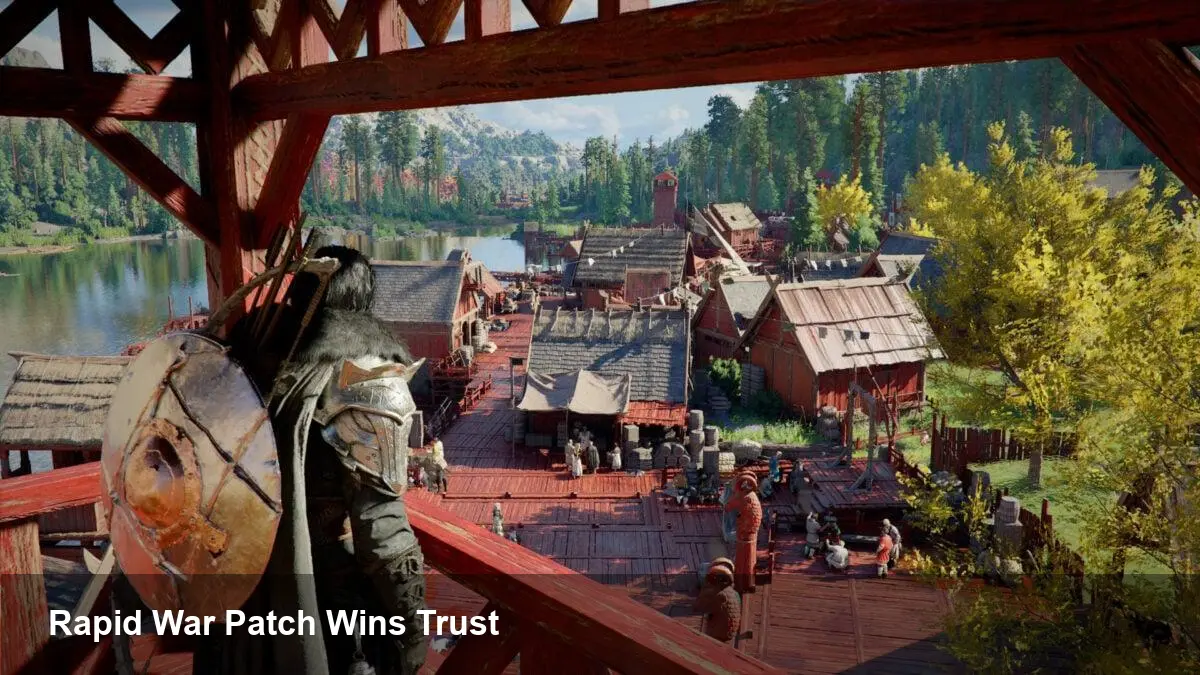
Pearl Abyss pushed a surprisingly quick update to Crimson Desert that altered how in-game wars operate. For a live-service MMORPG, war systems are not just mechanics — they shape guild strategy, server economies, peak-time activity and long-term player retention. The speed and focus of this deployment is what caught attention: rather than waiting for a big quarterly update, the studio shipped targeted changes in days.
That agility is notable. Big online worlds tend to move slowly because changes to conflict systems are risky. A small tweak can cascade through matchmaking, reward loops, and player expectations. Delivering that kind of change quickly without causing chaos is a feat of ops, QA, and community management.
Quick recap for readers new to Crimson Desert
Crimson Desert is Pearl Abyss’s open-world online title that mixes single-player narrative and multiplayer live systems. Its war mechanics — contests between player groups for territory, resources or bragging rights — are central to the social loop. Because wars create concentrated peaks of activity, they are also a major source of player feedback, and frequent flashpoints for frustration when things feel unbalanced.
What changed and why players reacted
The studio’s recent patch adjusted core war behavior. Although the update was narrowly scoped, it touched an important part of competitive gameplay, so its impact was immediate. Players reacted positively and with surprise at how quickly the team shipped a fix — many commented on how responsive the developers appeared to be, and speculated about the team’s around-the-clock work.
From the community side, the reaction split into two clear threads:
- Relief: groups who felt the previous system favored a narrow set of strategies noticed immediate improvements. Short-term annoyances were reduced.
- Caution: competitive guilds said they needed to retool tactics and schedule scrims to learn the new timing and interactions.
That combination—brief pain followed by meaningful improvement—illustrates the trade-offs when a live game changes rules that underpin player coordination.
Real-world scenarios: how the change plays out in practice
- Guild scheduling becomes more flexible. If the update shortened or smoothed war timers, smaller guilds can reallocate players from evening activities without losing competitiveness. That increases participation and reduces the “all-or-nothing” pressure on raids.
- Economy and supply lines shift. Territory control typically influences resource flow. Tweaking capture mechanics can shift the value of crafting materials and change what players farm or trade, which in turn affects prices and player-driven markets.
- Competitive meta refresh. Top-tier guilds must reassess. When you alter the parameters of conflict, established strategies lose some of their edge and newer approaches can surface. That creates a fresh period of strategic experimentation — which is healthy for long-term engagement.
Why this matters for developers and live games
A fast, visible fix to a sensitive system is a communication signal as much as a technical achievement. It tells players two things: the team is listening, and the team can act. That trust currency can reduce churn faster than most marketing campaigns.
However, speed has costs:
- Regression risk: rapid changes increase the odds of introducing new bugs elsewhere. For systems tightly coupled to player interaction, that can mean cascading incidents.
- Expectations shift: once players see fast interventions, they may expect the same cadence forever, which can strain resources and harm long-term planning.
Practical recommendations for studios planning similar fixes
- Use feature flags and staged rollouts. Toggle-based deployments let you limit exposure and gather telemetry before a global push.
- Invest in real-time telemetry for behavioral signals. Track not just crashes but engagement patterns, matchmaking times, and economic metrics so you can confirm a fix worked.
- Keep a public changelog and developer notes concise but transparent. Quick, honest communication softens blowback when something does go wrong.
- Have a rollback plan and automated tests around high-impact flows (matchmaking, reward distribution, loot economy).
Business implications
For Pearl Abyss, shipping a focused war update quickly buys goodwill. That goodwill converts into higher engagement, stronger community content (streams, guild recruitment), and a PR narrative that the studio cares about player experience. For subscribers or microtransaction ecosystems, that can translate into stabilized spending and reduced cancellations.
On the other hand, if speed becomes the new expectation, operational costs go up. Studios must balance agile reaction with sustainable engineering rhythms — otherwise you end up patching the same pain point repeatedly instead of addressing root causes.
Three forward-looking insights
- Telemetry-first balancing: Expect more studios to adopt live A/B testing and player-behavior signals to guide balance decisions in near real-time rather than relying solely on internal QA or large balance passes.
- Community-driven design will increase: Rapid-response patches reinforce a feedback loop where player communities influence design. Studios that set clear boundaries for when community input is advisory versus when it’s decisive will manage expectations better.
- Ops and wellbeing matter: Faster patches can win short-term praise, but only teams with healthy on-call practices, automated safety nets and feature flags can sustain that pace without burnout or technical debt.
When quick fixes help — and when they don't
Rapid patches make sense for regressions, exploit mitigation and timing shifts that unblock player activity. They are less suited for systemic redesigns that require new UI, a rework of reward flows, or deep changes to economy logic. In those cases, a deliberate, predictable roadmap with public signalling is a better choice.
Watching how Crimson Desert’s community adapts will be instructive for other live teams. Rapid responsiveness is a powerful tool when used judiciously; overuse turns it into a bandage rather than a cure. For players, the immediate benefit is clearer gameplay and renewed incentive to participate. For developers and publishers, the lesson is operational: move fast where it matters, but do so with the telemetry, testing and communication practices that keep the whole world running.
If you run a guild or manage in-game economies, now’s a good moment to review your strategies — and to ask your studio how it plans to balance speed with stability going forward.