Why 27-inch 5K OLEDs Change the Monitor Game

A sharper milestone for desktop displays
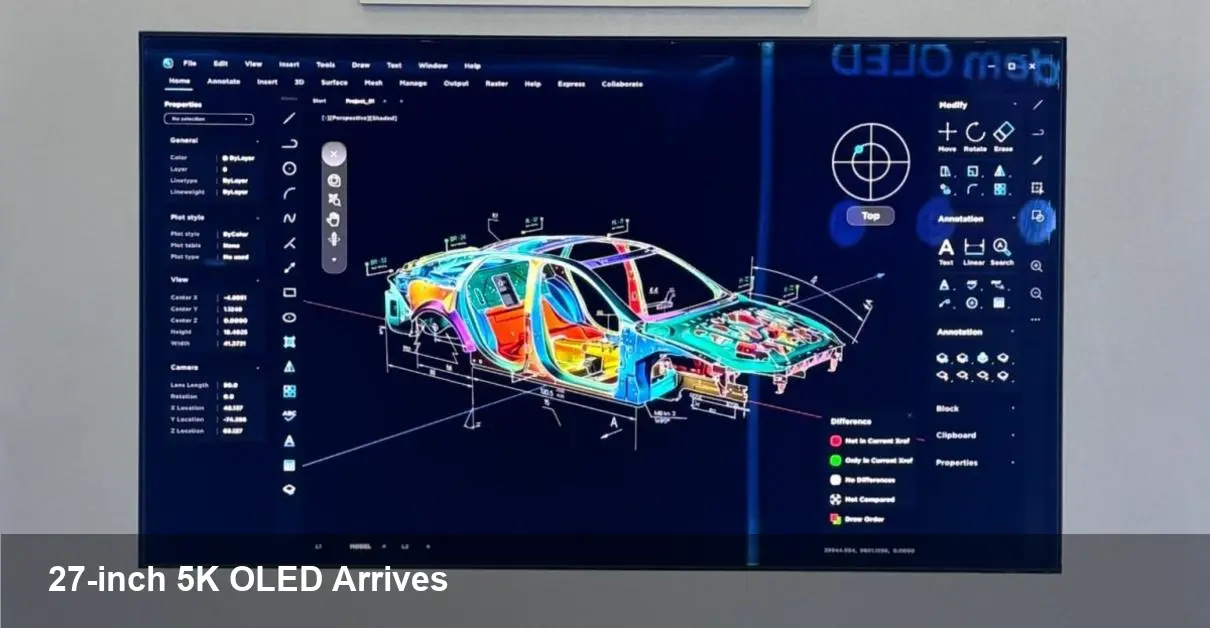
At SID 2026, LG Display unveiled a 27-inch OLED panel pushing beyond the common 4K plateau: a 5K (5120×2880) panel at roughly 220 pixels per inch, running at 120Hz with a quoted full-screen brightness of 250 nits. Samsung Display has a comparable 27-inch 5K OLED in the wings, making this a clear industry direction rather than a one-off prototype.
This matters because for years many believed 4K at 27 inches (around 166 ppi) was the practical ceiling for desktop monitors. Moving to 5K at the same screen size raises pixel density enough that text, UI elements, and high-resolution images look noticeably crisper without relying on aggressive scaling.
What the panel specs actually mean
- Size & resolution: 27 inches, 5K (5120×2880) ≈ 220ppi. That’s a significant bump in pixel density over common 4K 27-inch panels.
- Refresh rate: 120Hz. Smooth motion for UI interactions, games, and VR-adjacent workflows.
- Brightness: 250 nits full-screen. OLED can deliver higher small-area peak brightness, but full-screen HDR will remain limited compared with high-end mini-LEDs that advertise full-screen hundreds of nits.
- Subpixel design: LG’s new RGB stripe structure increases aperture ratio (more light per pixel) which helps efficiency and color uniformity compared with pentile layouts.
Those numbers point to a panel tuned for color-critical workloads and fluid on-screen motion more than spectacle HDR scenes. Higher local peak brightness is possible with OLED, but the full-screen spec is the practical number for sustained workflows.
Real-world use cases
- Creators and retouchers: More pixels at native scale mean you can preview print-size details and 1:1 pixels more accurately. Color accuracy and OLED’s deep blacks are helpful for grading, compositing, and UI design.
- Developers and UI designers: High-DPI at a regular desktop size reduces the need for scaling and makes typography and interface micro-details crisp. That said, testing for multiple DPI targets remains essential (Windows scaling, Electron apps, and older toolkits still stumble).
- Gamers and simulation: 120Hz plus OLED pixel response creates a pleasing feel for fast action, but running modern titles at 5120×2880 requires robust GPUs — expect to lean on top-tier cards or lower in-game render resolution.
- Multi-tabbers and analysts: Higher effective workspace with denser pixel packing keeps spreadsheets and dashboards readable without having to zoom out or use tiny fonts.
Developer and workflow implications
High-DPI desktop displays are great until toolchains and apps don’t handle them. Teams should plan for:
- UI scaling validation: Verify layouts across common scaling factors (100%, 125%, 150%, 200%). Look for fractional-scaling issues in webviews and cross-platform frameworks.
- Asset pipeline readiness: 5K screens make it easier to abuse low-resolution artwork. Ship layered source files (SVG, vector UI, @3x assets for mobile where needed) and add a step in CI to spot low-res raster assets.
- GPU budgets: Building for 5K at 120Hz doubles or triples GPU work compared with 1440p. It’s worth testing how the app performs on integrated graphics and mid-range cards to avoid excluding typical office hardware.
Hardware ecosystem: connectors, bandwidth, and HDR nuance
Driving 5120×2880 at 120Hz requires a lot of bandwidth. That has practical knock-on effects:
- Cables and ports: Look for DisplayPort 2.1 or USB4/Thunderbolt 4 docks with DP passthrough. HDMI implementations may be limited unless a vendor supports the newest specs.
- GPU compatibility: Older GPUs and many laptops won’t be able to output this resolution and refresh rate natively; expect adoption to trail panel availability.
- HDR reality: OLED’s contrast is exceptional, but a quoted 250 nits full-screen brightness constrains traditional HDR mastering. Small-window peak luminance might still be high, but for consistent HDR across an entire frame, mini-LED and full-array local dimming panels can still have an edge.
Trade-offs and limitations
- Burn-in concerns: OLED remains vulnerable to image retention in long-term static UI use. Manufacturers mitigate this with pixel-shifting and software refresh routines, but heavy dashboard or UI work increases risk.
- Cost and yield: Higher-density RGB stripe OLEDs are more complex to manufacture. Expect initial prices to be premium and availability to be limited to pro/enthusiast monitors first.
- Power and thermal: Driving more pixels at higher refresh rates increases power draw, which matters for integrated displays (laptops) and thermally constrained designs.
Market and business impact
Multiple major suppliers showing 27-inch 5K OLEDs signals product-class maturation. For niche markets:
- Monitor makers: Opportunity to differentiate pro lines (photo/video editing, color-critical work) from mass-market 4K panels.
- Laptop OEMs: While 27-inch is desktop territory, the pixel-density trend will push portable devices too; expect 5K-class OLED possibilities in 14–16-inch laptops down the line.
- Apple and pro buyers: Apple historically favored 5K for pro desktop use; wider supply from LG and Samsung adds flexibility for partners and potential price pressure in that premium segment.
Three implications looking forward
- Higher baseline for UI fidelity: As 220ppi becomes common at 27 inches, designers will assume crisper typography and finer UI grids — demanding higher-resolution assets by default.
- Infrastructure needs to catch up: Cable and GPU support (DisplayPort 2.1, USB4) and OS-level scaling improvements will be required for mainstream adoption.
- Competitive product segmentation: OLED’s contrast and color will push more pro devices to adopt OLED, while mini-LED will remain attractive for headline HDR brightness — users will choose based on workflow priorities.
A 27-inch 5K OLED isn’t a single-feature novelty. It’s the kind of hardware update that nudges software practices, GPU requirements, and product roadmaps. For content creators and anyone who cares deeply about on-screen detail, these panels offer a meaningful upgrade; for the rest of the market, they mark the start of a broader shift toward higher pixel density and OLED as a serious desktop contender.