DJI Lito Series: Lidar Meets Beginner-Friendly Drones

Why DJI’s Lito Series matters
DJI has a track record of turning advanced aerial tech into consumer-friendly products. The new Lito Series takes that approach further by introducing lidar-based obstacle sensing to an entry-level line of drones, with base models priced under $400. For new pilots, educators, and small-business users, that combination of affordability and active depth sensing changes what a cheap drone can do.
A quick primer on lidar in consumer drones
Lidar (light detection and ranging) uses pulsed laser light to measure distances. Unlike single-camera vision systems that infer depth from images, lidar produces direct distance measurements. On consumer drones this means more reliable obstacle detection in tricky lighting, better low-altitude performance, and cleaner data for simple mapping tasks.
Historically lidar has been confined to higher-end models because of cost and weight. Putting reduced-size lidar into an entry-level package is notable: it offers active sensing where previously only cameras and ultrasonic sensors handled obstacle awareness.
What the Lito Series brings to everyday users
- Safer first flights: Beginners make the most mistakes during takeoff, landing, and tight turns. Active lidar gives the drone real-time distance readings that help avoid crashes against walls, trees, or people. That reduces repair bills and the anxiety many newcomers feel.
- Better indoor and low-light performance: Camera-based obstacle avoidance relies on contrast and texture. Lidar remains effective in dim light or monotone surfaces, making indoor practice sessions and twilight flights less risky.
- Easier automated tasks: Short-range lidar improves the reliability of simple point-to-point missions and altitude-hold maneuvers. For creators shooting B-roll or small-business owners scanning a rooftop, you get steadier results with fewer aborted flights.
Lito X1: why the lidar upgrade makes sense
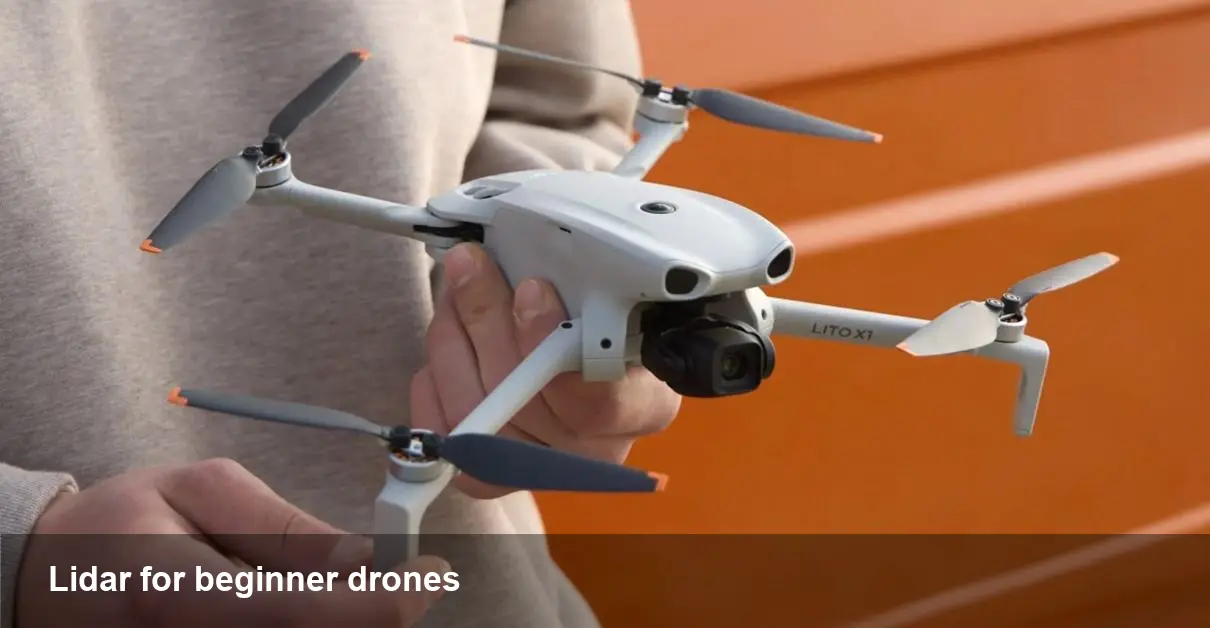
Within the lineup, the Lito X1 stands out because it includes a dedicated lidar sensor for obstacle awareness. If you’re deciding whether to spend a little more, consider these scenarios:
- You plan lots of indoor flights (classes, film sets, showrooms).
- You’ll fly at dawn/dusk or in shaded areas where camera sensors struggle.
- You need consistent altitude holding for inspection or mapping of small spaces.
If your use is mostly casual outdoor flying in well-lit, open spaces, the base Lito model (which keeps the package under $400) may be perfectly adequate.
Real-world scenarios
- Hobbyist learning to fly: A teenager practicing hovering and simple maneuvers in a backyard benefits from lidar’s gentle corrections when they drift toward trees or fences.
- Small architecture studio: A studio owner documents small interior finishes and needs repeatable camera passes inside tight rooms. The Lito X1’s lidar lets them automate these passes with fewer errors.
- Local contractor doing basic inspections: For a contractor checking gutters or low rooftops, lidar-equipped drones reduce the chance of scraping against eaves and provide more stable altitude awareness for photos.
Trade-offs and limitations to be aware of
- Weight and battery life: Adding lidar increases payload weight and may shave a few minutes off flight time compared with the absolute lightest models. For many users the safety gains outweigh slightly shorter flights, but if endurance matters, check the specs.
- Range and resolution: Consumer lidar modules are short-range compared with industrial laser scanners. They work best for nearby obstacles (meters, not tens of meters) and might miss thin objects like power lines or leaf strands.
- Not a replacement for good piloting: Lidar is an assist, not a guaranteed crash-proof system. It helps prevent many common accidents but won’t compensate for risky behaviours like flying over people or ignoring local regulations.
What developers and tinkerers should consider
For makers, educators, or startup teams evaluating the Lito Series as a platform, lidar opens new possibilities:
- More reliable sensor fusion for hobbyist autonomy projects. Lidar can be fused with vision and IMU data to improve indoor positioning without GPS.
- Small-scale mapping and point-cloud capture. While limited in range and resolution, the lidar data can seed basic 3D reconstructions for prototyping or teaching.
- Rapid prototyping of safety features. If you’re building add-on software for flight logging, safety alerts, or guided missions, lidar provides a deterministic input that’s easier to simulate and test than pure computer vision.
Before buying for a development project, verify the drone’s SDK compatibility and data access policies. Some consumer drones permit telemetry and limited sensor access, while others restrict raw sensor feeds for safety or commercial reasons.
Buying checklist for non-experts
- Flight time: Confirm real-world minutes per battery and whether extra batteries are available.
- Sensor limitations: Ask whether lidar is single-direction or multi-directional and its effective range.
- Repairability and spare parts: Entry-level drones are affordable, but being able to replace props, shells, and motors keeps long-term costs low.
- Software ecosystem: Look for stable mobile apps, firmware update cadence, and whether the drone supports automated missions you need.
- Regulations: Even budget drones can require registration or have local restrictions—check your jurisdiction before flying.
Broader implications for the hobby and small-business markets
The Lito Series suggests a trend: advanced sensing trickling down into affordable devices. As lidar becomes standard at lower price points, expect:
- Faster adoption of drones in training and education due to reduced risk.
- New micro-business workflows for photography, asset checks, and small-scale mapping that were previously cost-prohibitive.
- Competitive pressure on other manufacturers to include active depth sensors in entry models.
That doesn’t mean every drone needs lidar. But for buyers prioritizing safety, indoor capability, or reliable automation, it’s an increasingly accessible option.
If you’re shopping for your first capable drone, the Lito lineup deserves a look. For beginners who value safety and educators running supervised flight sessions, the lidar-equipped Lito X1 could be the practical upgrade that reduces crashes and streamlines training. For open-sky hobbyists on a budget, the base Lito model still delivers the core flying experience at a friendly price point.
Which of those profiles fits you will determine whether lidar is a must-have or a nice-to-have on your next drone purchase.