Apple Watch-style Smartwatches That Run a Week on a Charge

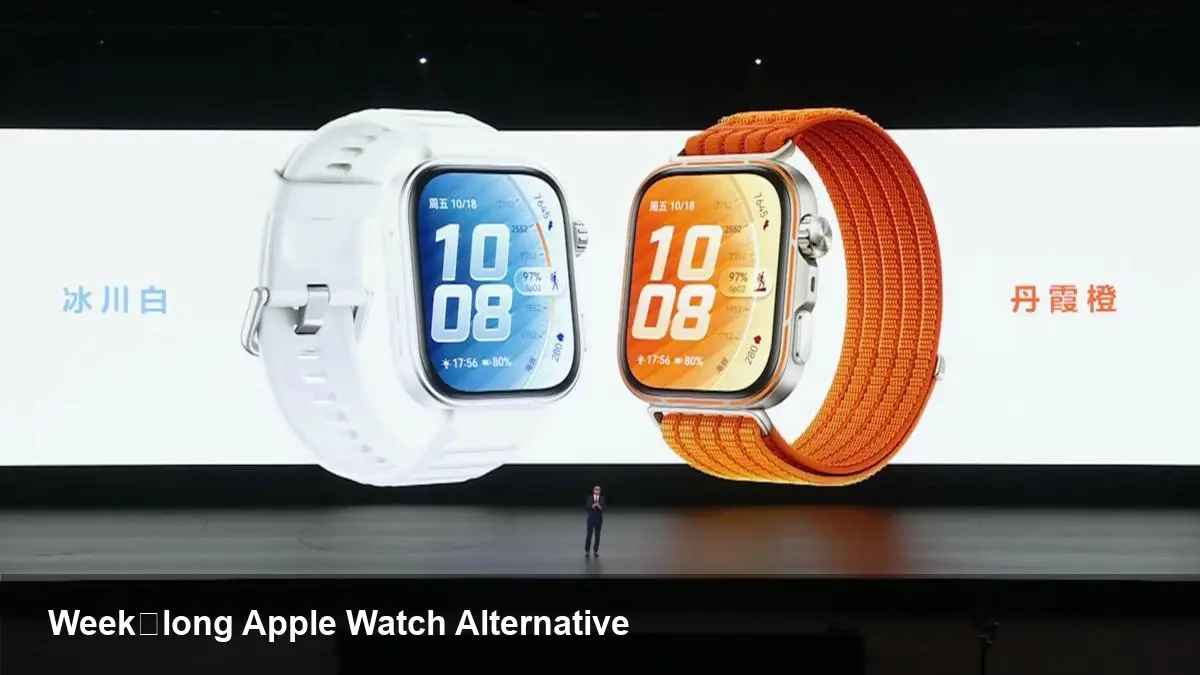
Why a familiar look is getting a very different battery life
The rectangular smartwatch silhouette that Apple popularized is now ubiquitous across brands. But while the design cues are similar — a flat, rounded rectangular screen and a single crown or button — the engineering trade-offs underneath the case vary widely. A growing group of devices from companies such as Amazfit (Huami), Oppo, Huawei and others pair that Apple Watch-style aesthetic with a focus on long battery life: think five to 14 days instead of a daily top-up.
That shift matters. For many buyers, battery life is the bottleneck for smartwatch adoption: shorter runtimes mean more friction, less continuous health data and battery anxiety. Brands have responded by rethinking hardware, software and use cases so a familiar form factor can feel reliably disposable-free.
How manufacturers stretch a single charge into a week
There are three practical levers companies use to deliver multi-day battery life while keeping an Apple Watch-like shape:
- Hardware choices: Bigger cells, efficient SoCs and display trade-offs (tuned AMOLED or low-refresh modes) give a larger energy budget. Some models sacrifice screen brightness or refresh rate to gain days of runtime.
- Lightweight software: Instead of full Wear OS or watchOS-level multitasking, many of these watches run purpose-built OSes or RTOS-like firmware that minimize background work and radios. Less complex app stacks mean lower power draw.
- Feature profiling: Continuous heart-rate sampling, GPS, and always-on displays are throttled or moved into low-power modes. Manufacturers offer “endurance” or “power-saving” modes that reduce functions while preserving key alerts and health tracking.
Together, these choices let a watch keep the Apple Watch look without inheriting its hourly charging habit.
Real-world scenarios where week-long battery changes the equation
- Long trips and outdoor use: Hikers, bikers and travelers don’t need to carry extra cables or a power bank just to avoid losing step/heart-rate data. Even with occasional GPS use, these watches can record multi-day adventures.
- Shift work and healthcare: Nurses and paramedics who can’t easily recharge during a shift benefit from uninterrupted tracking and notification delivery across multiple work days.
- Enterprise deployments: Companies that provision wearables at scale for field teams lower support costs when devices need charging less often.
Concrete example: a sales rep on a multi-city trip can rely on notifications, step and sleep tracking for an entire week. If they occasionally use GPS for navigation, the watch still stretches battery with aggressive low-power networking and scheduled sensor sampling.
What users give up (and what they keep)
Expect trade-offs. Long-runtime models often limit: third-party app ecosystems, complex animations, high-frame-rate always-on displays and some advanced sensors. What remains strong is the core: notifications, step counters, heart-rate sensing, basic GPS and long-term sleep tracking. For many users those basics are the main draw.
If you want a watch as an extension of a smartphone with a large app catalog, deep third-party integrations (payment apps, advanced mapping), or heavy on-device machine learning, a full-featured Wear OS or watchOS device might still be the better fit.
For developers: opportunities and constraints
If you build for wearables, these devices change the calculus:
- Focused apps win: Simple utilities — watch faces, activity shortcuts, notifications and single-purpose fitness apps — perform best on lighter OSes. Design for brief interactions and minimal background activity.
- Battery-aware design is essential: Use event-driven sampling, batch network operations, and prefer server-side processing to reduce on-device CPU and radio time.
- Test across ecosystems: Many long-battery watches run proprietary OSes with limited SDKs. Verify your app or watch face works on the ecosystems your users actually use (Zepp OS, RTOS-based platforms, Lite versions of Wear OS).
Enterprise developers should note that devices with long battery life often support simpler device-management APIs and longer provisioning cycles — useful for remote device fleets.
Buying guide: which questions to ask
When choosing one of these long-running, Apple Watch-style wearables, evaluate by use case, not just runtime:
- How much continuous sensor sampling is required? Frequent GPS or high-resolution heart-rate monitoring reduces runtime.
- Which third-party apps do you rely on? Check the platform’s app library and developer tools.
- How important is display quality vs battery life? High-brightness, high-refresh displays are expensive in energy terms.
- What are update and security practices? Proprietary OSes sometimes lag in security fixes and feature parity.
A pragmatic approach: pick a watch that meets your daily core needs (notifications, heart-rate, sleep) and then examine how well it performs in a week-long real-world test under your typical usage.
Business and product implications
For startups and businesses, these watches open several possibilities:
- Lower operational friction: In logistics, field services or healthcare, having devices that don’t require daily charging reduces support calls, lost data and device downtime.
- New product tiers: Brands can offer “prolonged battery” variants at slightly lower cost and target users who prioritize uptime over app ecosystems.
- Privacy and edge processing: With fewer cloud roundtrips and simpler local stacks, some vendors emphasize on-device processing for sensitive health data, which creates a different trust profile for enterprise customers.
Three forward-looking signals
- On-device AI will reshape trade-offs: As low-power neural accelerators become common, future models may run lightweight health inference locally without sacrificing battery life.
- Cross-platform standards may rise: Expect initiatives to standardize basic wearable APIs (notifications, sensors, watch faces) so developers can hit multiple long-battery platforms with less friction.
- Charging convenience will matter less than ever: Improved chemistry, better power gating and smarter OS-level power management will keep the charge anxiety at bay — but designers must still balance feature richness against energy budgets.
Choosing the right watch for your life
If you value continuous tracking and convenience over an expansive app ecosystem, the new wave of Apple Watch-style smartwatches that last a week are worth considering. For developers and product teams, these devices demand battery-aware design and more focused feature sets — but they also unlock new real-world use cases where uptime and reliability matter more than micro-app ecosystems.
Whether you’re outfitting a team, building a fitness product, or just want a wrist companion that doesn’t need nightly charging, these watches are a pragmatic option that trade a little flash for a lot of uptime.