What Claude’s New Lifestyle App Integrations Mean

Quick background: Anthropic and Claude
Anthropic is one of the leading startups building large language model products and safety-focused agent features. Claude is their conversational AI assistant designed for work and everyday tasks — from drafting and summarization to multimodal prompts and assistant-style workflows. Recently, Anthropic expanded Claude’s list of connected services to include consumer-facing lifestyle apps such as Spotify, Instacart and AllTrails.
That change is more than a vanity directory update: it points to a practical shift in how conversational AIs are being embedded into daily, commerce-adjacent experiences.
What these integrations actually enable
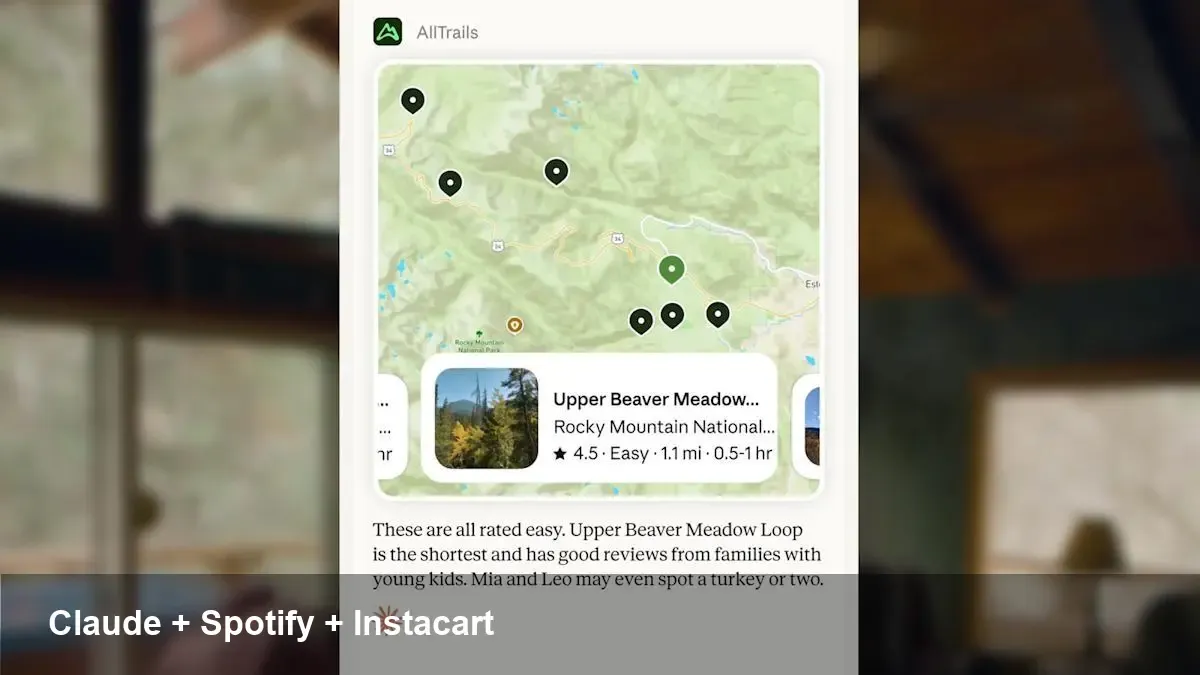
At a basic level, connecting Claude to a service means the assistant can access that service's capabilities or content (subject to permissions), and then act on your behalf or use that data to make recommendations. With Spotify, for example, Claude can surface or curate music suggestions. With Instacart, the assistant can build shopping lists or begin purchase flows. With AllTrails, Claude can fetch trail reviews, suggest routes and recommend gear.
Because these are end-user lifestyle apps rather than enterprise-only tools, the integrations emphasize consumer convenience and cross-service orchestration — not just simple Q&A.
Concrete scenarios: how you might actually use this
- Weekend hike planning: Ask Claude for a one-day hike within two hours of your city. It examines AllTrails results, proposes a trail with difficulty and elevation details, builds a packing checklist (water, sunscreen, snacks), then uses Instacart to add missing items to your cart. To set the mood, it creates a 45-minute pre-hike playlist on Spotify.
- Dinner party prep: Describe the cuisine and guest dietary restrictions. Claude drafts a menu, generates a shopping list, and kickstarts Instacart orders while offering a short background playlist on Spotify and tips on table setup from a lifestyle blog it can access.
- Training and recovery: Ask for a trail run training plan. Claude pulls route suggestions from AllTrails, recommends pacing and shoes based on trail surface, and suggests protein-rich grocery items you can add to an Instacart order.
These multi-step, cross-app workflows are where the integrations provide tangible productivity gains: you move from planning to execution inside a single conversational flow.
For developers and product teams: opportunity and tradeoffs
- Opportunity: Brands and app developers get a new distribution channel. Being included in Claude’s connected services directory can surface content and commerce opportunities (playlists, bookings, product adds) directly in conversational UI.
- Product design: Developers should design APIs that expose safe, purposeful actions (e.g., create playlist, build cart, fetch trail metadata). Clear, narrowly-scoped endpoints that return structured data make it easier for conversational logic to remain reliable.
- Instrumentation: Logging successful actions, capturing user intent signals, and measuring fall-through rates will be critical. If Claude suggests adding items to Instacart but users frequently cancel, that’s feedback for improving recommendation quality or prompt design.
- Partnership mechanics: Firms that want deeper integration should think beyond simple read-access. Transactional hooks, webhooks for status updates, and account linking UX will determine conversion rates.
Risks, trust and UX considerations
- Permissions and transparency: Users must explicitly grant access to accounts (Spotify playlists, Instacart carts, AllTrails bookmarks). The UX should make clear what data the assistant can read and what actions it can take.
- Data scope and retention: Developers and Anthropic need clear policies on what conversation history or third-party responses are stored and for how long. This matters for GDPR-like compliance and user trust.
- Accuracy and hallucinations: When Claude stitches information across services, errors can cascade — a wrong trail name plus an incorrectly sized shopping item can spoil a plan. Verification steps ("Confirm order?" or "Is this the trail you meant?") are essential.
- Rate limits and state management: Cross-service orchestration increases the number of API calls and edge cases. Systems must handle partial failures gracefully and be able to resume or rollback actions.
Business implications
- Direct commerce: For Instacart and similar services, conversational triggers reduce friction between discovery and purchase. That can increase average order values and conversion, especially for impulse or planning-driven buys.
- Engagement and retention: Spotify playlists and AllTrails route suggestions keep users in a longer loop with their accounts and the Claude assistant, which is valuable for platform stickiness.
- New monetization vectors: There’s potential for referral or affiliate economics: curated shopping lists, sponsored trail guides, or promoted playlists presented inside a trusted assistant flow.
Limitations to watch
- Not every user will want a single assistant to orchestrate so many account actions. Some prefer manual control for purchases or privacy reasons.
- Integration quality is uneven: how deep the assistant can act depends on each partner's APIs and the work Anthropic and partners do to build safe action mappings.
- Competition and fragmentation: Other AI assistants and plugin ecosystems are chasing the same use cases. Fragmentation of assistant capabilities across vendors could confuse users unless UX patterns converge.
Where this trend leads next
- Composable journeys: Expect more multi-step, multi-service workflows where the assistant is the glue — e.g., booking a trip (itinerary via a travel service, packing list via a retailer, commute planning via a maps app).
- Greater commerce integration: As trust and permissions mature, assistants will handle more transactional responsibility. That will change how marketers think about discovery and checkout.
- Policy and standardization: We’ll likely see more industry norms around permission UI, data sharing contracts and audit trails for assistant-initiated transactions.
If you build consumer apps or work on product strategy, this is a moment to evaluate how your service fits into conversational flows. For end users, it’s a practical step toward smoother planning and execution — provided you pay attention to permissions and keep an eye on how recommendations are generated.