How Anker’s Thus Chip Brings AI to Headphones and Wearables

A quick primer on Anker and the Thus chip
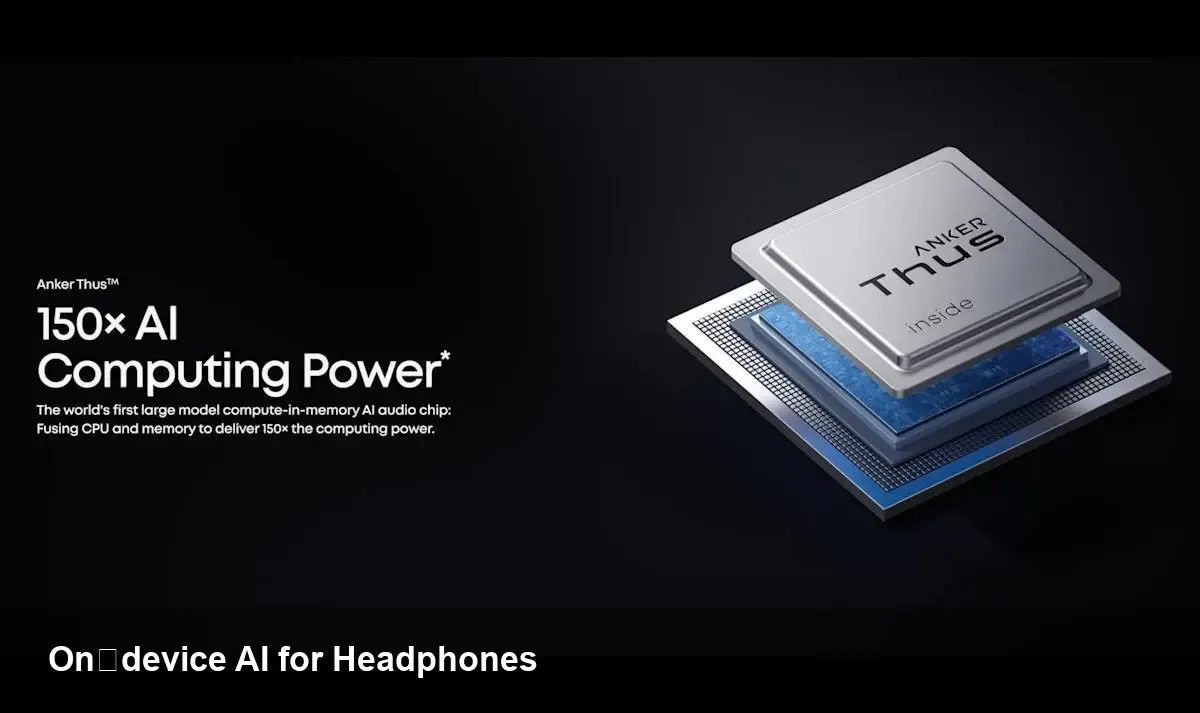
Anker has built a reputation for making well-priced consumer hardware — from power banks and chargers to audio devices under its Soundcore label. Recently it unveiled a custom silicon effort called the Thus chip, aimed at putting AI capabilities directly into small, battery-powered products like earbuds and portable speakers.
This is not about offloading workloads to the cloud. The Thus chip is designed for on-device inference: running voice models, noise suppression, personal sound tuning, and other machine learning features without needing a constant internet connection. That makes it attractive for products where latency, battery life, and privacy matter.
What on-device AI changes for headphones and wearables
Think of traditional headphones: they stream audio, offer passive or ANC noise cancellation, and maybe expose a companion app for EQ or firmware updates. With a purpose-built AI coprocessor like Thus, those devices can do things they simply couldn’t before — or could only do with cloud assistance.
Concrete capabilities enabled by on-device models:
- Real-time, adaptive noise cancellation that learns your environment and hearing profile locally. No cloud round-trip, lower latency.
- Local voice commands and offline speech recognition for basic assistant tasks or device control, improving privacy and reliability.
- Live translation or transcription for short snippets, useful for travel or meetings where network connectivity is flaky.
- Personalized sound signatures that are tuned by an embedded model to your hearing test data and listening habits.
- Context-aware battery management where the device predicts and adjusts power draw based on active ML features.
For consumers, this translates into less reliance on smartphones or cloud services for everyday smart features. For businesses and developers, it opens a new frontier for product differentiation.
Two short scenarios: how Thus changes real-world use
Scenario A — The commuter A frequent commuter uses earbuds to block train noise and listen to podcasts. On-device adaptive filtering powered by Thus isolates voices and instruments while keeping battery usage lean. When the commuter asks for the time, a local wake-word detector and small speech model respond instantly — no waiting for the cloud and no audio leaving the device.
Scenario B — The hybrid worker In a hybrid meeting, a user enables live captions on their earbuds. Because the transcription runs on-device, private or sensitive remarks aren’t uploaded to third-party servers. The captions appear with lower latency than cloud-based services, and the earbuds can automatically lower the microphone gain to mute side conversations when a private moment is detected.
Developer workflows and product strategies
Anker’s move toward custom silicon has two important knock-on effects:
1) Product teams can design new UX patterns around reliable, low-latency inference. Examples include instant voice feedback, interactive audio effects, and privacy-first transcription.
2) Third-party developers and OEM partners could (potentially) leverage toolchains or SDKs for model deployment to Thus-based devices. Even if Anker starts closed, historical precedent shows ecosystem expansion when hardware scales.
A practical developer workflow might look like this:
- Train a compact model (speech, classification, or signal processing) optimized for edge deployment.
- Quantize and prune the model to match the chip’s memory and compute envelope.
- Use a vendor toolchain to package and sign the model, test on-device, and iterate performance vs. accuracy trade-offs.
This workflow highlights an important reality: edge AI demands a different mindset from cloud-first ML. Model size, energy per inference, and robustness to audio conditions become first-class constraints.
Business implications for startups and manufacturers
Small audio brands and accessory makers now have a clearer path to embedding AI without investing in large datacenter costs. Key business opportunities include:
- Differentiated feature sets for premium tiers (e.g., “on-device assistant” or “privacy transcription”).
- Lower long-term costs by reducing cloud compute and bandwidth for user-facing features.
- New monetization via subscriptions offering advanced on-device models or periodic model updates.
However, companies must weigh the cost of designing hardware around a specific SoC versus using commodity silicon plus cloud APIs. Integrating a chip like Thus is more appealing when the device’s selling points (privacy, offline use, latency) match user needs.
Trade-offs and limitations to consider
Custom chips solve many problems, but they’re not magic. Trade-offs include:
- Limited model complexity: on-device models are smaller and may lag cloud models in raw accuracy for tasks like full conversational AI.
- Update logistics: shipping improved models to millions of devices requires safe OTA pipelines and versioning strategies.
- Hardware fragmentation: if each vendor exposes different toolchains, third-party developers face portability challenges.
- Power and thermal constraints: more computation generally means more power draw; balancing features against battery life is critical.
Designers should build fallback strategies: graceful degradation of features, hybrid cloud/offline modes, and settings that let users opt in to higher-power behaviors.
Where this leads next: three implications for the industry
1) Privacy-first products become a commercial differentiator. Consumers are increasingly sensitive about audio data. Devices that can promise on-device processing for core features have a clear trust advantage.
2) Edge-first ML tooling will accelerate. Expect to see better quantization tools, model compilers, and standard runtimes that make it easier to move models between chips while preserving performance.
3) New service tiers and business models will appear. Hardware makers can combine on-device capabilities with occasional cloud boosts (e.g., offloading heavy tasks when the user is on Wi‑Fi) to offer hybrid experiences.
What developers and product teams should do now
- Start thinking “edge-first” when designing audio features: prioritize compact models and test early on-device.
- Plan for lifecycle management: how will you update models, roll back bad releases, and measure on-device performance metrics?
- Build clear privacy opt-ins that explain what runs locally vs. what goes to the cloud.
If you’re building audio products or accessories, Anker’s Thus chip is a reminder that compute is moving outward — and that putting intelligence directly where users interact with devices can unlock meaningful UX and business advantages.