Why People Stick with Windows (Even When Linux Is Free)

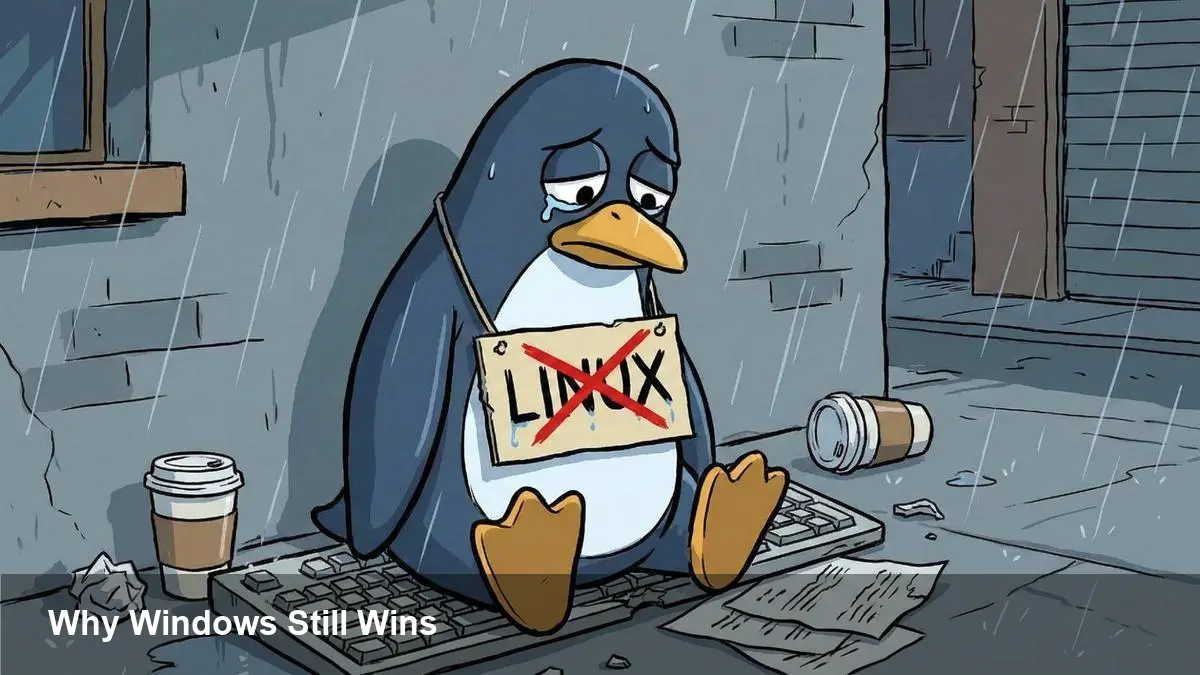
A short background on Windows and Linux
Windows is Microsoft's flagship desktop operating system and the default environment for hundreds of millions of home and corporate PCs. It pairs a large ecosystem of commercial software, device drivers, management tools and vendor support that organizations know how to buy and manage.
Linux is an open-source family of kernels and distributions (Ubuntu, Fedora, Debian, CentOS/Rocky, and others) that powers everything from phones and cloud servers to embedded systems. It's free to download and modify, with a vibrant community and strong presence in server and cloud infrastructure.
So if Linux is free and flexible, why do so many individuals and businesses keep buying, deploying and standardizing on Windows? The answer is practical: the cost and risk of changing a platform often outweigh the price tag of the OS itself.
Three pragmatic reasons people don’t switch
1) Application and hardware compatibility
The simplest blocker is software. Many industries rely on Windows-only applications: AutoCAD, SolidWorks, industry-specific ERP and lab software, legacy line-of-business apps built for Win32, and several specialist utilities. Replacing or re-certifying those apps for Linux can be expensive or technically infeasible.
Hardware support matters too. Printers, scanners, multifunction devices and some specialized peripherals ship with Windows drivers first or exclusively. Even when open-source drivers exist, features like vendor-provided color profiling, security dongles, or firmware utilities may be Windows-only.
Concrete example: A design studio that uses a CAD package validated for Windows will face downtime, retraining and possible geometry or rendering changes if it tries to run the app in emulation, virtual machines, or replacement tools.
2) Enterprise management and governance
In large organizations the OS is part of a managed ecosystem. Active Directory, Group Policy, Microsoft Endpoint Manager (Intune), System Center Configuration Manager (SCCM), and a host of monitoring, logging and security tools assume Windows endpoints. Those systems provide centralized patching, policy enforcement, inventory and compliance reports that IT teams depend on.
Migrating thousands of endpoints to a different OS is more than a desktop swap—it’s a rework of identity, access, compliance checks, remote support, backup processes and procurement. The transition can create regulatory risk in sectors like healthcare and finance where audit trails and certified configurations matter.
Concrete example: A university that issues Windows laptops to students can push exam lockdown tools, anti-cheating software and course-specific lab images via an imaging pipeline. Recreating that pipeline for a dozen Linux distros adds complexity and cost.
3) User familiarity and productivity
For non-technical users, the OS is invisible until something breaks. People invest time learning workflows, shortcuts, and software behaviors. Migrating to Linux often means a different file manager, different keyboard shortcuts, and sometimes different versions or alternatives of familiar apps.
Productivity loss from retraining — especially across a large user base — is real. For small firms, losing a few productive hours per person per week during a migration can eclipse years of OS licensing costs.
Practical example: Help-desk volume spikes after a change; more tickets and slower resolution reduce overall business throughput. For customer-facing teams, that can directly translate into lost sales.
How organizations mitigate the lock-in while gaining Linux benefits
You don’t have to choose one side exclusively. Many organizations adopt hybrids that exploit Linux where it makes the most sense and keep Windows where needed.
- Servers and cloud: Linux dominates here. If you’re running web services, containers, or cloud infrastructure, Linux frequently provides better control and a lower license cost.
- Development workflows: Developers often use Linux servers, Docker containers or WSL (Windows Subsystem for Linux) on Windows desktops to get the best of both worlds.
- Virtualization and VDI: Run Windows in a virtual machine for legacy apps while switching day-to-day tasks to Linux or thin clients.
- SaaS and browser-first apps: Moving critical workloads to web apps reduces desktop OS dependence because the browser becomes the platform.
Migration checklist for teams that want to try Linux
If you’re evaluating a move, think beyond the OS price. A practical pilot should include:
- An application inventory and compatibility matrix (which tools are Windows-only, which have web versions or Linux ports).
- A hardware audit for drivers and firmware tools.
- User segmentation: migratable roles (developers, sysadmins) vs locked roles (CAD designers, specialist engineers).
- A support plan: SLAs, training materials, and a rollback strategy.
- Cost modeling that includes training, support headcount, productivity delta, and any app replacement licenses.
Start small: pick non-critical users or a single dev team, iterate on tools and support processes, and measure ticket volume and productivity impacts before a broader rollout.
Three future-facing implications
1) Desktop OS matters less over time. As more apps move to the cloud and browsers become the primary runtime, the desktop OS becomes a thinner layer. That pushes the competition toward identity, security, and browser compatibility rather than kernel features.
2) Microsoft’s approach has changed. Tools like Windows Subsystem for Linux, better PowerShell cross-platform support, and Microsoft's investments in cloud Linux tooling blur the lines. That makes mixed environments easier to manage and reduces one reason to abandon Windows entirely.
3) Containerization and orchestration shift compatibility testing upstream. When application behavior is packaged into containers, developers can standardize runtime environments regardless of host OS, lowering the migration barrier for server workloads and some desktop apps.
Practical recommendations
- For businesses: Treat the OS decision like any procurement problem. Quantify TCO, run pilots, and prioritize where the switch delivers measurable operational gains.
- For developers: Use containers and CI/CD to make your applications portable. That protects you from desktop lock-in while keeping choice.
- For individuals: If your workflows are Windows-native (gaming, creative suites, engineering tools), Linux can coexist but might not fully replace Windows day-to-day.
Switching an entire organization’s desktop OS is rarely about the sticker price of the OS. It’s about compatibility, manageability, and minimizing business disruption. With hybrid approaches, targeted migration, and the ongoing shift to cloud-native apps, teams can extract Linux’s advantages without forcing a disruptive wholesale swap.