QNX Self-Hosted Developer Desktop Brings QNX 8.0 to Wayland

- Key Takeaways:
- QNX now offers a Self-Hosted Developer Desktop running QNX 8.0 with an Xfce session on Wayland.
- Toolchains include GCC and LLVM/Clang, plus Python and common build utilities for on-device development.
- Distributed as a QEMU virtual machine (tested on Ubuntu); Raspberry Pi native image exploration is planned.
What the release delivers
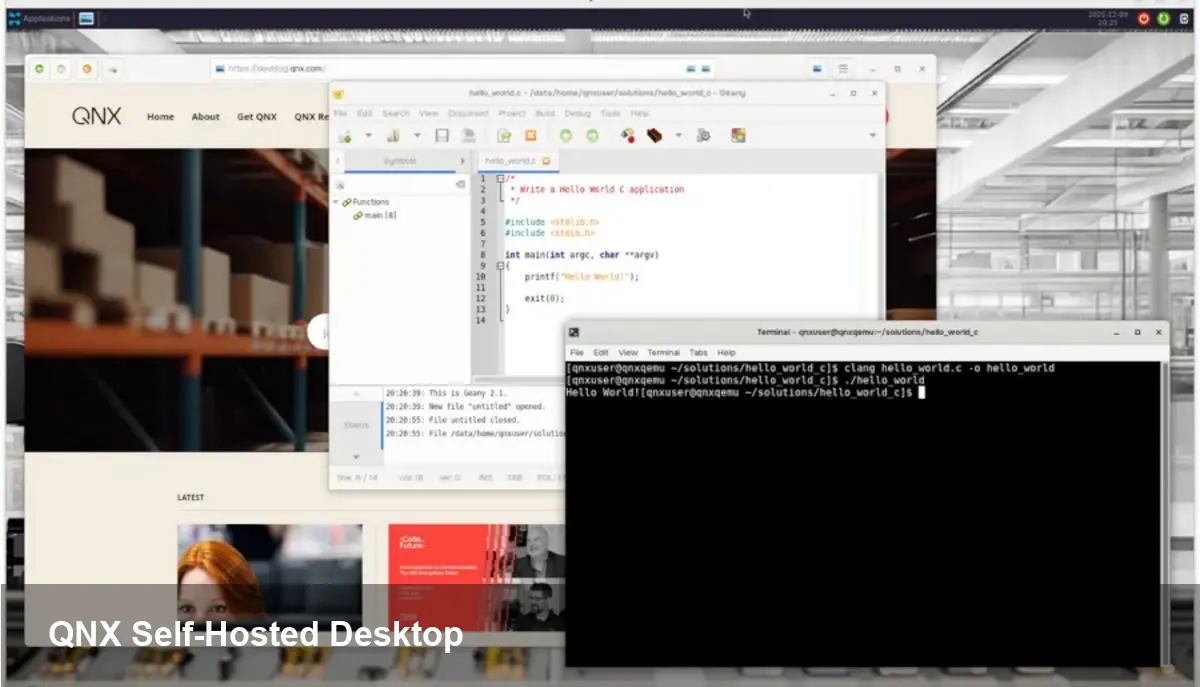
QNX has introduced a Self-Hosted Developer Desktop to let developers build and test directly on QNX 8.0 rather than cross-compiling to embedded targets. The desktop stacks Xfce on top of a Wayland compositor, offering a familiar, lightweight GUI for development workflows.
The distribution is aimed at hobbyists, students, and professionals using the free personal QNX license for non-commercial work. It reduces friction for developers who want to prototype, run toolchains, and debug on the same OS they target.
Included tools and environment
The initial image ships with both GCC and LLVM/Clang toolchains, Python, and standard build utilities. Popular editors and IDEs such as Emacs, Geany, and Neovim are available out of the box, enabling a near-native development experience.
Running editors and compilers directly on QNX can simplify iterative development for real-time and embedded applications by removing cross-compilation complexity and easing local testing of runtime behaviors.
How it runs: VM-first approach
For its initial release, QNX provides the Self-Hosted Desktop as a QEMU virtual machine image. Phoronix tested it running inside a virtual machine on Ubuntu, which sidesteps hardware compatibility issues since QNX traditionally targets specific embedded platforms.
The VM-first strategy means most desktop and developer tooling will function consistently across host systems. It also makes the image accessible to a wider audience without specialized hardware.
Raspberry Pi and native support
QNX has indicated plans to explore a native image for Raspberry Pi hardware. If delivered, a Pi-ready image could make low-cost, self-hosted QNX development more accessible for labs, classrooms, and makers.
Where to get it and next steps
Developers interested in trying the Self-Hosted Developer Desktop can find details and download information on the QNX developer blog. Expect updates that expand hardware support and polish the desktop experience as feedback arrives.
This release signals QNX’s push to lower barriers to entry for embedded developers by offering a full, on-device development environment featuring Wayland, Xfce, and modern compiler toolchains.