When Switch 2’s Handheld Boost Mode Is Worth the Battery

A quick primer: Nintendo's new handheld boost
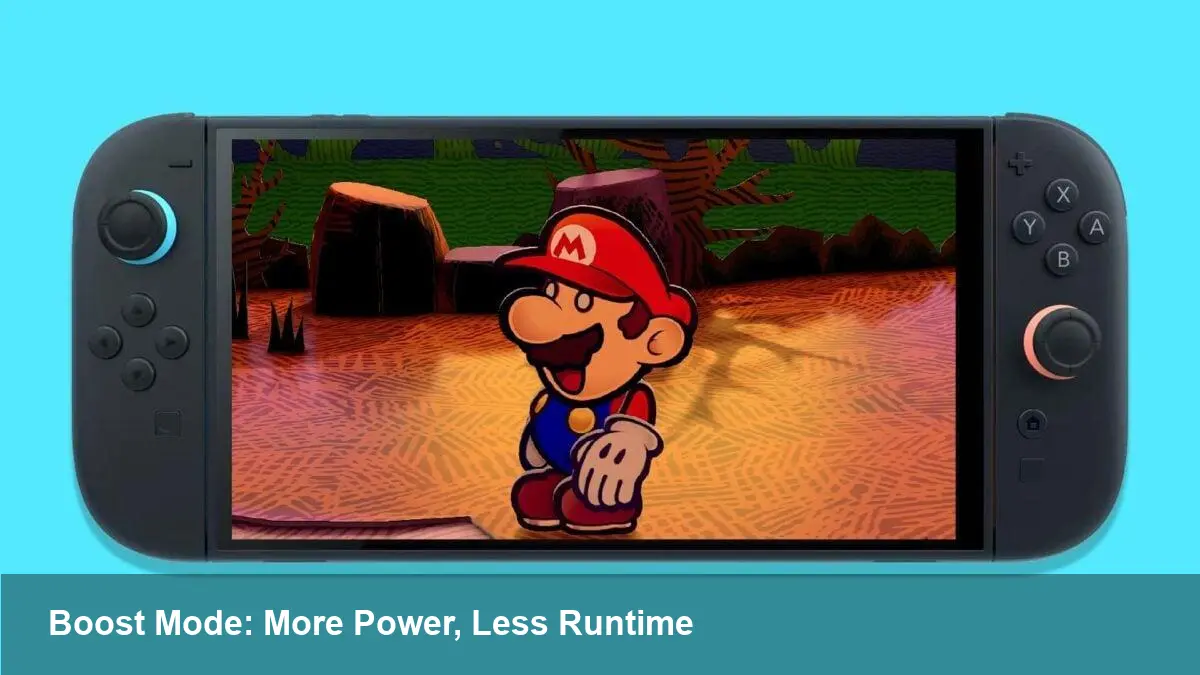
Nintendo’s next-gen portable, commonly called the Switch 2, introduces a feature that’s already shaping conversations among players: Handheld Boost Mode. In short, it lets the system push more GPU/CPU power while in handheld form to improve framerates, resolution, or visual effects on games — including many titles originally built for the first Switch.
That sounds like an unalloyed win, but there’s a catch: the mode consumes noticeably more battery. For buyers, developers, and studios that still support Switch libraries, the central question becomes one of priorities: is the extra smoothness and polish worth shorter play sessions away from an outlet?
How Handheld Boost Mode actually behaves
From Nintendo’s demonstrations and early hands-on reports, the feature is not a brute-force overclock. Instead, the system dynamically reallocates thermal and power budget to the GPU/CPU when the mode is enabled. For backward-compatible games this commonly results in:
- Higher and steadier frame rates (e.g., 30fps titles moving closer to 40–60fps)
- Increased internal rendering resolution or reduced shader/texture compromises
- Optional visual toggles enabled by the system without developer intervention
Importantly, Boost Mode is designed to work out-of-the-box for many existing titles. That means you don’t always need a patch to see improvements — though some games get bigger wins if developers ship targeted updates that optimize for the new hardware profile.
Real-world scenarios: where it helps most
Here are practical examples of when Boost Mode changes the experience:
- Open-world exploration (Breath of the Wild, Zelda-like games): Smoother camera movement and fewer frame dips make traversal, combat, and camera-based puzzles feel significantly better. The sense of immersion improves when animations and physics are more consistent.
- Competitive and local-multiplayer racers (Mario Kart-style titles): Higher frame rates reduce input lag and make split-second steering corrections feel more precise — valuable for both casual encounters and tournament play.
- Ports that rely on post-processing effects: Games that had to dial back effects on the original Switch can regain bloom, higher-quality shadows, or improved draw distances, making them look closer to their console counterparts.
Conversely, games that already ran solidly on the original Switch or titles that are pixel-art or turn-based will show little perceptible difference, so enabling Boost Mode there is often unnecessary.
The battery tradeoff: realistic expectations
Every watt spent on the GPU is a watt not available for battery longevity. Early testing suggests that enabling Boost Mode reduces uncoupled battery runtime by a meaningful margin — expect fewer hours per charge depending on the game intensity and screen brightness.
A useful way to think about it: Boost Mode is a situational performance plan, not a default always-on setting. For short sessions, commuting, competitive matches, or showing off a remaster, the tradeoff can be worth it. For long flights, travel, or extended battery-only play, sticking to the standard mode is more practical.
Simple user rule of thumb:
- If your session is under 1–2 hours, try Boost Mode. The immediate improvement is tangible.
- If you need multi-hour endurance away from charging, leave it off.
What this means for developers and studios
Handheld Boost Mode changes both QA priorities and potential monetization/value strategies for publishers:
- Legacy game relaunches get a low-cost visual uplift. Studios can reissue catalogs with optional patches that leverage the extra power for higher framerates, enhanced assets, or quality-of-life tweaks.
- Staggered optimization path: developers should test three profiles — original Switch, Switch 2 standard, and Switch 2 Boost — to ensure consistent gameplay across modes. Edge cases like thermal throttling, battery drain warnings, and save-consistency need validation.
- Marketing and UX opportunities: offering an in-game toggle that explains the battery/performance tradeoff gives players control, and can be used as a selling point in trailer comparisons or store pages.
From a business perspective, Boost Mode lowers the bar for “definitive” editions. Instead of expensive remasters, many games can gain renewed sales by enabling upgraded performance on the newer hardware.
Practical tips for players
A few hands-on suggestions to get the most from Boost Mode:
- Toggle it intentionally. Don’t auto-enable for every game; use it where the payoff is visible.
- Pair Boost Mode with adaptive power settings: lower screen brightness, enable airplane mode, and close background downloads to temper battery drain.
- Bring a power bank or detachable charger for longer sessions if you plan to use Boost frequently on the go.
- Watch thermals: extended high-performance handheld gaming will make the unit warmer. A case with passive cooling and ventilation helps comfort and sustained performance.
Three implications for the near future
- Renewed value for old libraries: Many developers will revisit their Switch catalogs because a one-time optimization yields noticeable quality gains without full remasters.
- User expectations shift upward: Once players experience higher framerates in handheld mode, they’ll expect similar responsiveness in new releases, nudging developers to prioritize performance scaling.
- Power management becomes a UX battleground: Companies will differentiate by how gracefully a device balances performance and runtime. Expect smarter adaptive systems, clearer in-game communication, and accessory ecosystems (power banks, docks) tailored around boost-style modes.
Handheld Boost Mode is a pragmatic design choice: it gives players a toggleable path to better visuals and smoother gameplay while keeping battery conservation an option. For developers, it’s a strategic lever to refresh older titles. For most players, it will come down to when and how often they’re willing to trade a little uptime for a noticeably better experience.
If you’re evaluating the Switch 2, think about how and where you play — short, intense sessions and competitive matches are where Boost Mode shines. For couch marathons and long trips, battery preservation will still be king.