How BlackSpace Engine Brings Ray Tracing to Crimson Desert Efficiently

A quick primer: Pearl Abyss, Crimson Desert and BlackSpace Engine
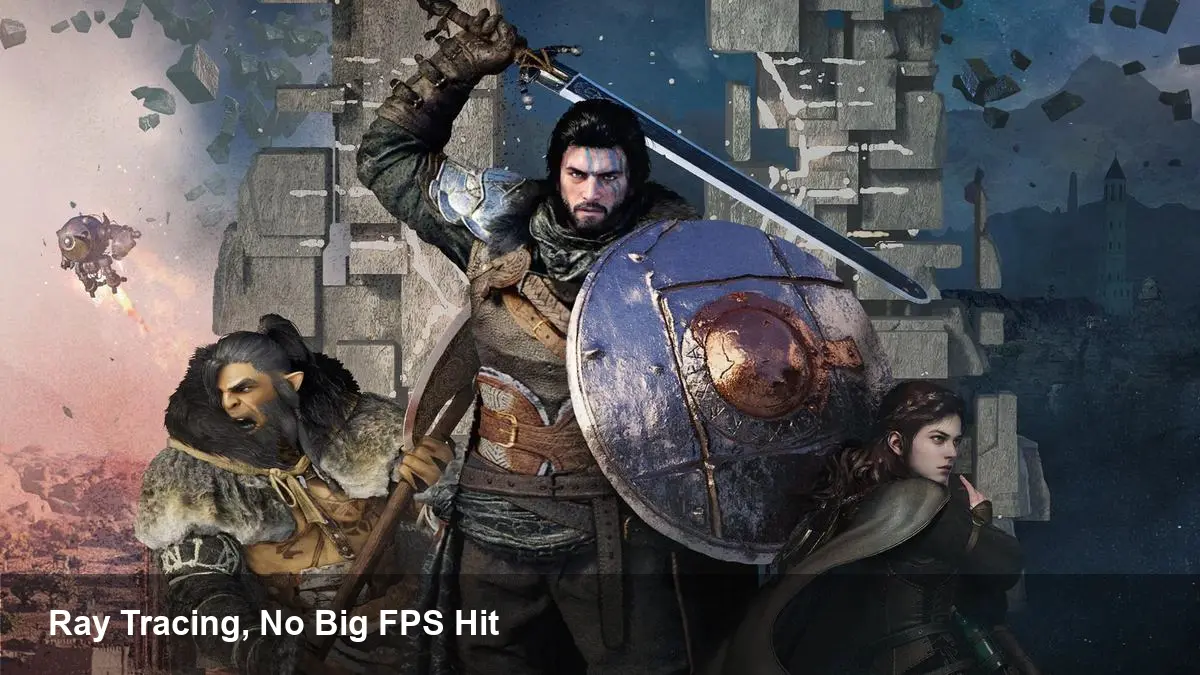
Pearl Abyss built Crimson Desert as an ambitious open-world action title, and behind it sits the studio’s BlackSpace Engine — an in-house renderer and systems stack designed to push visual fidelity on modern PCs and consoles. The engineering goal is straightforward but difficult: deliver richer real-time lighting and reflections using ray tracing while keeping frame rates playable across a range of hardware.
That ambition matters because ray tracing (RT) traditionally trades raw GPU performance for more realistic shadows, reflections, and global illumination. BlackSpace’s challenge is to capture the visual benefits without forcing players to accept large performance penalties.
Why ray tracing is expensive — and where gains matter most
Ray tracing simulates light paths more accurately than traditional raster techniques. That accuracy yields dramatic improvements in reflections, contact shadows, and indirect lighting — things our eyes notice quickly. But the computational cost is high: tracing millions of rays per frame is expensive, memory- and bandwidth-heavy, and can easily tank frame rates.
The practical counterpoint for a game studio is prioritization. Players will tolerate limited drops in fidelity if the most visible elements (water, metal, character shadows) look convincing. The BlackSpace Engine appears to adopt this prioritization: apply RT where it produces the biggest perceived improvement and use cheaper approximations for the rest.
How studios knit together quality and performance (what BlackSpace likely uses)
Pearl Abyss hasn’t published every internal detail, but we can break down the techniques that enable high-quality RT without destroying performance. These are techniques many modern engines use and are consistent with the goal of high-fidelity real-time visuals:
- Hybrid rendering: combine rasterization for primary visibility and ray tracing for selective effects (reflections, soft shadows, ambient occlusion). Hybrid approaches let you afford RT in hotspots instead of across every pixel.
- Temporal accumulation and denoising: Ray-traced results are noisy when computed per-frame at low sample counts. Accumulating samples over multiple frames and feeding them through spatial/temporal denoisers yields clean results with fewer rays.
- Selective resolution and foveated work: Run RT at a lower internal resolution or reduce samples for distant or peripheral objects while maintaining full resolution for the player’s focal area.
- Coarse BVH updates and instance-level culling: Ray traversal performance improves when geometry acceleration structures are optimized for dynamic scenes, using per-instance bounding adjustments rather than rebuilding entire BVHs every frame.
- Upscaling and smart anti-aliasing: Pairing RT with temporal upscalers (or platform-specific tools like AMD FSR or NVIDIA DLSS where available) recovers image detail while reducing the native ray count.
- Level-of-detail and material-driven RT toggles: Use simplified shading models for distant LODs and selectively disable ray-traced effects for materials where the benefit is marginal.
BlackSpace’s success depends on bringing these pieces together in a way that’s accessible to game designers and not just graphics engineers.
What this means for players and performance modes
For players that means options. Expect modes like “Quality (RT-enhanced)”, “Balanced”, and “Performance (upscaled)”. On mid-range GPUs the engine will likely rely on denoising and lower RT sampling rates plus upscaling to hit 60 fps targets. On high-end PCs and next-gen consoles, more RT features can be enabled at higher sample counts and native resolutions.
Good engine design also makes those modes context-aware. If the BlackSpace Engine can dynamically lower RT samples during complex particle scenes or boss fights, it preserves responsiveness where gameplay matters most.
Practical implications for developers and studios
If you’re a developer learning from BlackSpace’s approach, here are concrete takeaways:
- Treat RT as a feature set, not a replacement for rasterization. Identify which visuals provide the most player-perceived value and instrument them for dynamic scaling.
- Build tools to preview RT cost in the editor. Artists need immediate feedback on whether a reflective material or added geometry will cause performance cliffs.
- Invest in robust denoisers that integrate with temporal pipelines. The ability to accumulate and stabilize samples is as critical as the ray tracing backend itself.
- Expose fine-grained toggles and auto-profiles for players. Automated hardware detection and presets reduce support overhead and improve player satisfaction.
- Train QA around RT-specific artifacts — ghosting from temporal accumulation, flicker when BVHs are updated, or material mismatches between raster and RT passes.
Business value and trade-offs
Visually ambitious titles stand out in marketing, and ray tracing is a headline feature that can help a live-service game remain relevant. However, that polish comes with higher development and QA costs: more systems to maintain, more render paths to test, and greater reliance on GPU feature parity across platforms.
For studios, the decision isn’t binary. Planning a tiered feature set — where players on older hardware see enhanced but not full RT effects — widens the addressable market while still allowing premium visual options to drive engagement and potential monetization around aesthetics.
Limitations and pain points to watch for
BlackSpace’s approach reduces the raw performance cost, but it doesn’t erase other friction points:
- Hardware fragmentation: Not all players have RT-capable GPUs, and consoles differ in how they expose RT hardware features.
- Artistic complexity: Artists must reconcile different lighting models (raster vs RT) to keep a consistent look.
- Debugging complexity: Temporal denoisers and hybrid pipelines can introduce non-obvious artifacts that are hard to reproduce.
Where this moves the industry next
1) RT will keep shifting from a “premium” checkbox to an integrated quality tier in modern engines — more games will ship with hybrid RT by default.
2) Engine modularity and runtime profiling will become standard: real-time performance steering (dynamically enabling/disabling RT features) will be a staple of AAA and live-service titles.
3) Cloud and server-side rendering could offload heavier RT passes for streaming services or remote play, making richer visuals available to weaker devices.
BlackSpace’s public-facing results in Crimson Desert show how thoughtful engineering can deliver ray-traced richness without demanding top-tier GPUs from every player. For developers the lesson is practical: selective, well-instrumented RT combined with smart upscaling and denoising unlocks the visual benefits with manageable overhead. For players it’s simply better light, shadows and reflections — at playable frame rates.