Apple’s 2026 Turnaround: Reversing Its AI Slump

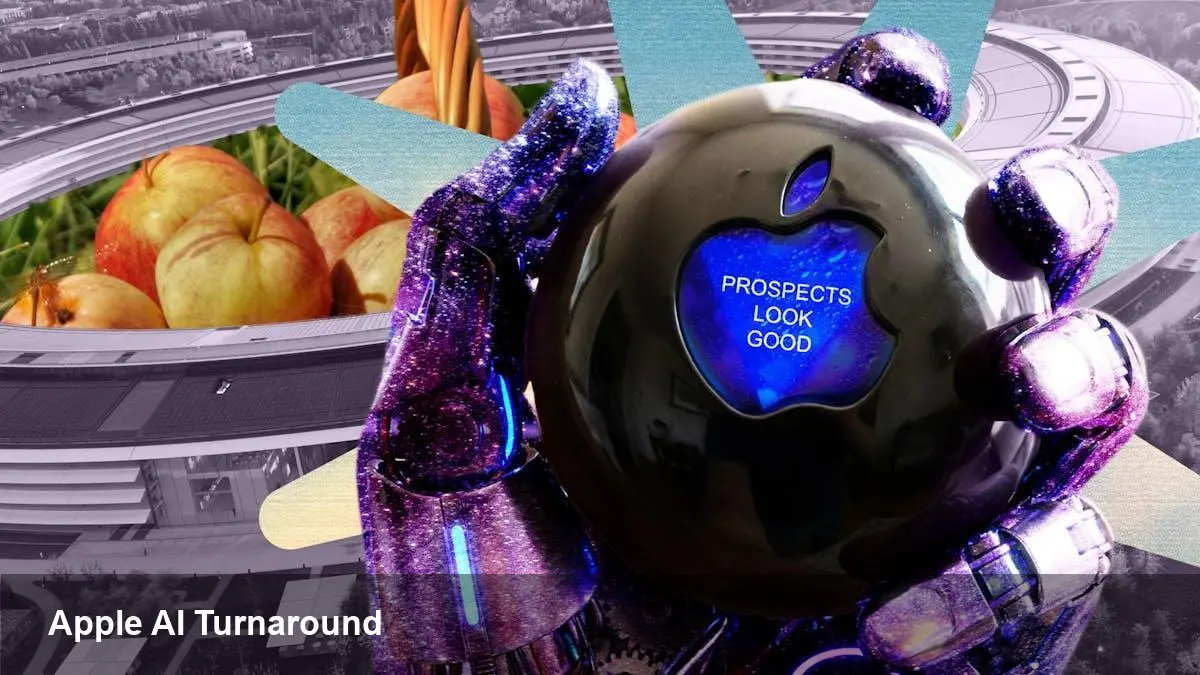
- Apple has been criticized for holding back on the large AI investments its peers made.
- Wall Street, pundits and media have flagged Apple’s apparent lack of urgency in the AI arms race.
- Analysts and commentators now predict Apple could reverse that slump in 2026 by leaning on silicon, integration and privacy.
Why Apple fell behind
Apple’s approach to AI has been measured: the company has focused on product polish, on-device performance and privacy rather than public model launches and massive cloud bets.
That restraint opened the door for competitors to headline big AI investments and generative-model announcements, and left observers calling Apple cautious — or slow — to follow the industry’s largest AI plays.
Critics and market reaction
Wall Street analysts, tech pundits and media outlets have chronicled what they call Apple’s AI stumbles: limited generative features in Siri, fewer cloud AI services and a quieter public roadmap compared with rivals.
The coverage has pressured expectations for a clearer, faster AI strategy from Apple, especially as competitors bundle AI features into search, ads and consumer apps.
How Apple could reverse the slump in 2026
Apple has several structural advantages it can deploy to accelerate AI work without abandoning its core principles.
1) Apple Silicon and on-device models
Apple’s custom chips (Apple Silicon) give it a path to run larger AI models on iPhone, iPad and Mac hardware, offering fast, private inference without always routing data to the cloud.
Scaling on-device intelligence could let Apple deliver headline AI features while preserving battery life and security.
2) Product integration and services
Tighter integration across iOS, macOS and services (iCloud, Apple Music, Apple TV+) is a natural lever for Apple to embed generative and assistant features that feel native and useful.
A phased rollout tied to software releases could show visible progress in 2026 without a sudden pivot.
3) Privacy as a competitive advantage
Apple’s privacy positioning can differentiate its AI by offering on-device defaults, data minimization, and transparent controls — appealing to users wary of big cloud-based models.
4) Strategic partnerships and hires
Rather than building everything in public, Apple may accelerate through targeted acquisitions, research hires and selective cloud partnerships to augment in-house capabilities.
What to watch in 2026
Watch for Apple announcements that signal a change: upgraded Siri functionality, explicit on-device model support in iOS/macOS, new developer APIs, and investments in Apple Silicon AI performance.
If Apple combines its hardware advantage, product integration and privacy messaging, a 2026 reversal from critics’ slump to credible AI contender is plausible — and likely to reshape expectations for the company’s next era.