Why Outlook and Email Struggle on Artemis II

A small glitch, a big lesson
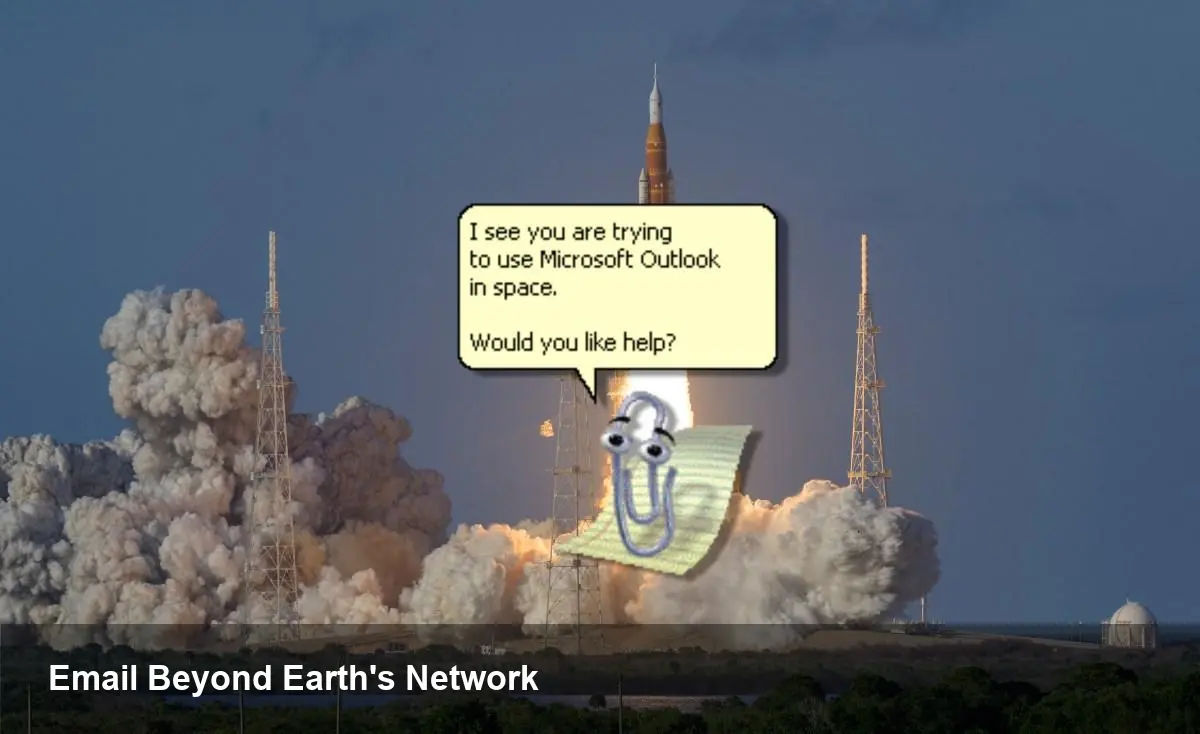
When Artemis II commander Reid Wiseman discovered that his Outlook client wasn’t cooperating in orbit, it was a reminder that everyday software assumptions break outside Earth’s familiar networks. Sending and receiving email on a spacecraft isn’t just a UX bug — it exposes deep architectural mismatches between modern mail clients and the realities of space communications.
This matters beyond astronaut anecdotes. As commercial LEO constellations, deep-space missions, and long-duration lunar operations scale up, design patterns for messaging and collaboration will affect crew efficiency, ground operations and the next generation of cloud services.
How spacecraft communications actually work
Understanding why Outlook-in-space fails requires a quick look at the plumbing. Spacecraft don’t get a continuous, flat-rate, low-latency Internet pipe. Typical mission comms use one or more of these elements:
- Relay networks (e.g., NASA’s TDRS) and ground stations with scheduled windows
- Store-and-forward systems that hold data until a downlink is available
- High latency and variable bandwidth; round-trip times can be seconds to minutes or longer
- Strict prioritization: telemetry and mission-critical commands take precedence over personal traffic
These constraints create long, variable delays and frequent disconnections — conditions that the standard SMTP/IMAP flow, and modern clients built for always-on TCP connections, weren’t engineered to handle.
Where standard email clients break
Outlook and similar clients assume fast, reliable TCP sessions, frequent server handshakes (for authentication and state changes), and quick delivery confirmations. When those assumptions fail, several problems surface:
- Timeouts and failed synchronizations: clients abort connections instead of retrying over minutes or hours
- Authentication friction: MFA, short-lived tokens and IP-based identity checks don’t work when the client hops between unknown networks
- Large attachments and inline images: they consume limited bandwidth and cause stalled transfers
- Calendar and presence signals: real-time invites or updates depend on immediate ACKs
Put simply, most desktop and mobile email apps are optimized for terrestrial networks — not delayed, disrupted, prioritized mission comms.
Practical patterns for robust messaging in space
Designing messaging systems that survive space requires both network-level and application-level changes. Here are practical approaches developers and mission planners should adopt:
- Use Delay/Disruption Tolerant Networking (DTN): DTN’s bundle protocol enables store-and-forward delivery with custody transfers and retransmission over long, intermittent links.
- Embrace offline-first clients: local mail spools, deterministic conflict resolution, and resumable uploads let users compose and queue messages without blocking.
- Prioritize and tag traffic: separate telemetry, operational communications and personal email; implement schema-driven priority so mission-critical packets preempt lower-priority mail.
- Reduce chatty handshakes: minimize round trips by batching metadata, using long-lived credentials provisioned pre-flight, and implementing token refresh strategies that don’t require repeated logins.
- Optimize attachments: automatic compression, progressive image scaling, and MIME chunking reduce dwell time on scarce links.
- Provide user-facing transparency: interfaces that indicate expected delivery delays and offer scheduling options for low-priority messages prevent confusion.
Concrete onboard scenarios
- Calendar invites: Instead of expecting an immediate “Accepted” state, onboard clients should let crews mark tentative or local-only responses and sync a canonical state when a reliable link is available.
- Large photos or experiment datasets: A mission app can automatically schedule transfer windows and split payloads into prioritized bundles. Critical metadata (timestamp, experiment ID) travels first; bulk data follows during dedicated downlink time.
- Cross-domain authentication: Pre-provisioned certificates and on-orbit key stores (HSMs) permit secure signing without live access to corporate identity providers.
These scenarios highlight that the right user experience is about graceful degradation, not feature parity with Earth-based apps.
Security, privacy, and compliance trade-offs
Protecting sensitive data in space adds complexity. End-to-end encryption is mandatory for some mission comms, but key management must account for offline operations. Considerations include:
- Offline key distribution: store keys in tamper-resistant modules before launch and rotate them during planned ground contacts.
- Least-privilege mailflows: apply domain-based routing so operational systems never need to process recreational content.
- Auditability: build locally buffered, signed audit logs that can be ingested by ground SOCs when a downlink is available.
Balancing security and usability is achievable, but it requires explicit design trade-offs rather than ad-hoc use of consumer email tooling.
What this means for enterprises and cloud providers
The Artemis II Outlook incident is a microcosm of a broader requirement: enterprise software must gracefully handle intermittent networks. That has commercial implications:
- Cloud providers will need edge and relay strategies for customers operating in remote environments (maritime, mining, polar, and orbital).
- Enterprise apps should offer a “space mode” or an offline-first configuration that toggles sync aggressiveness, token lifetimes and attachment handling.
- Managed communications for remote operations will become a market: vendors offering preconfigured, mission-hardened messaging stacks for governments and commercial space firms.
For startups building collaboration tools, the opportunity is to design for degraded networks from day one — it’s a differentiator for any organization with distributed, intermittent connectivity.
Three forward implications to watch
1) Standardization growth: Expect broader adoption of DTN and bundle protocols in satellite and space operator stacks, and incremental support from middleware vendors.
2) App-level “space modes”: Major email and collaboration vendors will likely add prioritized, offline-first modes or partner with space-relay providers for certified mission configurations.
3) New SLAs and security models: Organizations will demand SLAs that specify delivery windows and custody semantics for non-terrestrial traffic, plus hardened key management for offline scenarios.
Outlook failing in orbit is less a bug and more a wake-up call: connectivity assumptions in software must evolve alongside our reach into space. Whether you’re building mission-control systems, an enterprise mail platform, or a startup targeting remote operations, designing for delay and disruption isn’t niche anymore — it’s essential infrastructure thinking.