Apple at 50: From Garage Startup to $3.5T Powerhouse

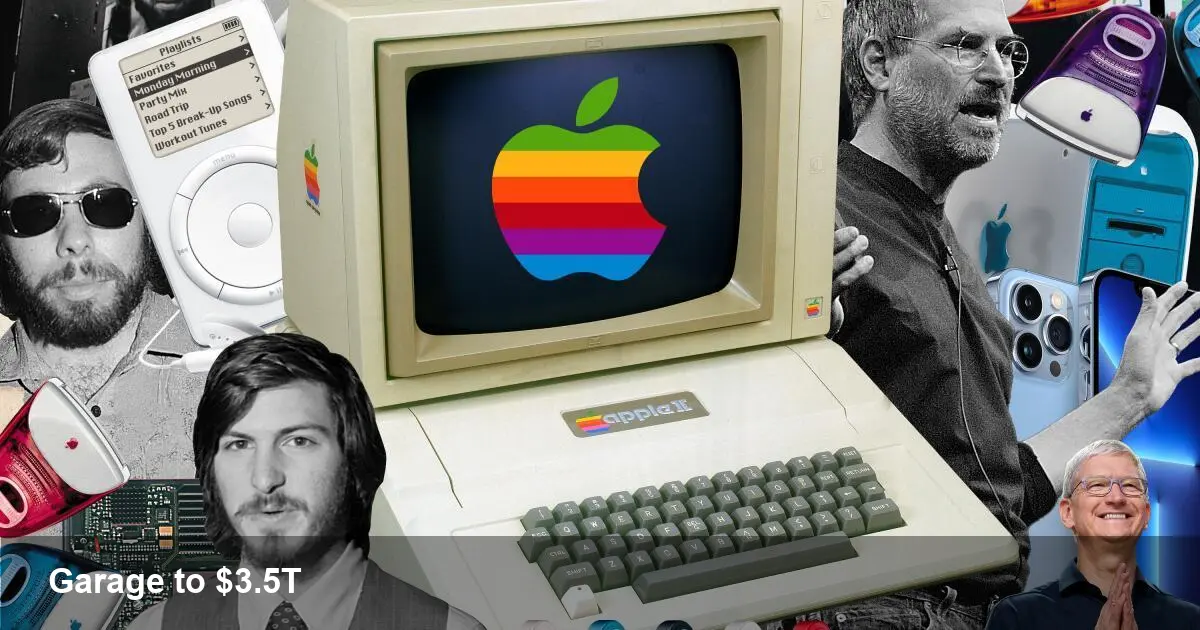
A 50-year arc in one view
In 1976, three young engineers and entrepreneurs started Apple in a California garage. Half a century later the company is a global technology leader with a market value around $3.5 trillion, a portfolio of consumer hardware, software platforms, and a fast-growing services business. That scale didn't arrive by accident — it was built through a string of product bets, tight integration of hardware and software, and an ecosystem strategy that reshaped many industries.
The critical milestones that shaped Apple
- 1976–1984: The early era — Apple I, Apple II and Macintosh introduced personal computing to broader audiences and set Apple's design-first approach.
- 2001–2007: The digital media pivot — the iPod and iTunes turned Apple into a lifestyle brand and taught the company how to sell hardware + content.
- 2007–2010: The smartphone and tablet era — the iPhone redefined mobile computing; the App Store (2008) created a new developer economy; the iPad broadened the product line.
- 2014–2021: Platform and wearables — Apple Watch and AirPods extended presence into health and everyday audio. The services segment (App Store, iCloud, Apple Music) became a consistent revenue engine.
- 2020–present: Silicon and integration — Apple Silicon (M1 onward) unified the Mac with mobile-class ARM chips, shifting developer workflows and performance expectations. New frontiers include AR/VR hardware and deeper AI features across devices.
Each milestone mattered not just for sales but for how developers, partners, and competitors behaved around Apple's platforms.
What this means for developers and startups
Apple’s evolution is a lesson in platform dynamics and product leverage. Here are practical implications:
- Product-market leverage: Building for Apple's platforms can still scale a company quickly. The App Store created multi-million dollar opportunities for indie developers. For startups focused on consumer reach, iOS remains a high-value first market because of user monetization and device homogeneity.
- Technical convergence: Apple Silicon made it simpler to target macOS and iOS with shared architectures and tools. Developers have fewer cross-architecture headaches, but also face new optimization expectations (battery efficiency, neural engines, on-device ML).
- Services as recurring revenue: Apple’s transition from device-centric to service-centric revenue shows a path for founders: combine hardware, software, and recurring services for predictable ARR. But be ready for the platform’s rules and fee structures.
- Gatekeeper dependency: The App Store and iOS ecosystem give great reach but also create operational dependencies — review policies, fee models, and platform changes can materially affect a business overnight. Diversify distribution and revenue where possible.
Concrete scenario: a startup building a health app can leverage HealthKit and Apple Watch for rich signals and per-device continuity, but must navigate privacy rules and the App Store review process — an advantage for product quality but a constraint on speed to market.
Enterprise and business effects
Apple’s hardware and software design choices influence corporate IT and product decisions:
- Device management and security: Macs and iPhones are standard in many enterprises, pushing MDM tooling and zero-trust architectures. Apple’s focus on privacy and encryption is a selling point for regulated industries but can complicate telemetry for IT.
- Productivity and collaboration: Tools optimized for Apple Silicon show strong single-user performance, and cross-device continuity features (Handoff, Universal Clipboard) improve workflows for mixed-device teams.
- Supply-chain considerations: Apple’s scale masks delicate supply chains. Companies that rely on Apple hardware should plan for component shortages, regional manufacturing risks, and periodic refresh cycles.
Strengths, limitations, and trade-offs
Strengths:
- End-to-end control: Apple’s integration of hardware, OS, and services delivers polished user experiences and performance advantages.
- Loyal user base and high ARPU: iOS users have historically higher lifetime value and engagement.
Limitations:
- Closed platform dynamics: App Store rules and limited sideloading can be restrictive for some developers and use cases.
- Regulatory and reputational risks: Antitrust scrutiny, right-to-repair debates, and privacy controversies present ongoing operational headwinds.
Trade-offs are part of the product calculus. Apple trades openness for control and polish; that benefits many users and businesses, but can constrain innovation paths that require low-level access.
Three forward-looking implications
- AI will be device-first — and Apple will emphasize on-device models. Expect more features that run locally on iPhone, Mac, and Watch using specialized neural hardware. For developers, that means optimizing models for efficiency and privacy-aware design.
- Services become the strategic moat. Devices drive adoption, but recurring revenue from subscriptions, cloud sync, and content is where margins grow. Startups should consider service hooks (subscriptions, cloud features) early in product design.
- Regulation will reshape platform economics. Antitrust actions and policy changes will push Apple to adapt app distribution and fee policies; companies that treat Apple as the only growth channel risk being affected when those rules change.
Practical recommendations for founders and engineering teams
- If you target consumers, prioritize iOS as a launch platform for reach and monetization, but design a cross-platform fallback.
- Build privacy and on-device-first features to align with Apple’s platform values; it helps with reviews and user trust.
- Monitor hardware roadmaps (Apple Silicon, neural engines) and profile apps on real devices early to avoid surprises.
- Keep distribution diversified — web, Android, and corporate partnerships can reduce single-platform dependency.
Apple at 50 is not just a corporate anniversary; it’s a roadmap for how a tightly integrated product strategy can scale from a garage to a global force. For developers and founders, that history offers both opportunity (reach, monetization, tooling) and caution (platform dependence, regulatory shifts). How you architect product and go-to-market plans around Apple’s ecosystem will be a material factor in your next five years.