Aether OS: A browser desktop built around the AT Protocol

What Aether OS is — and why it matters
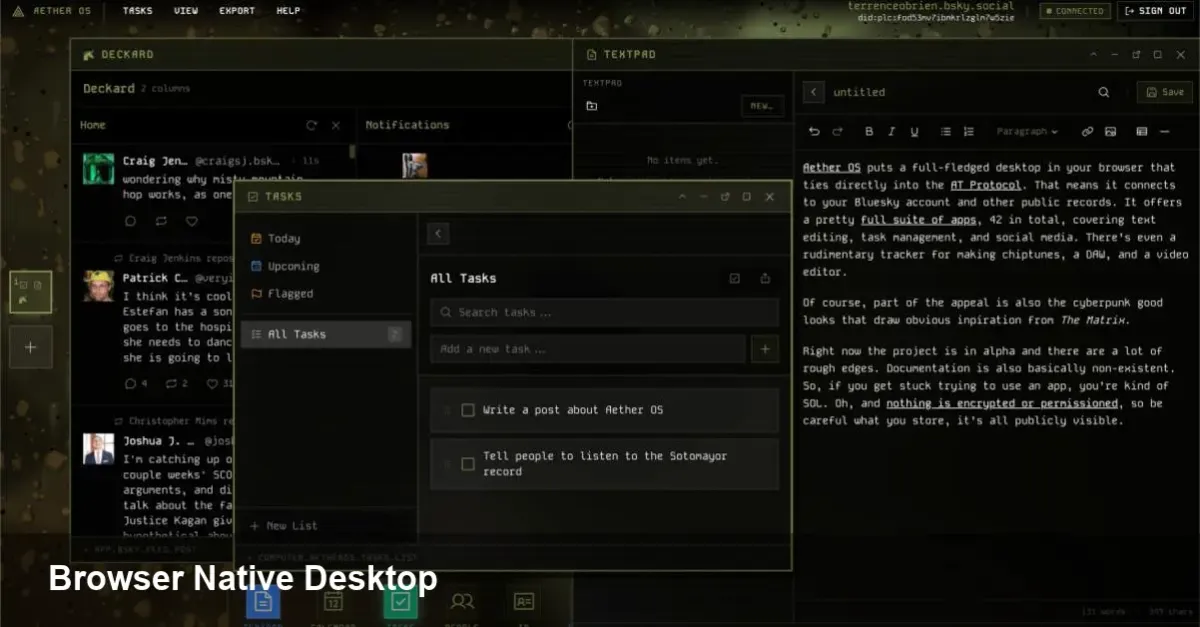
Aether OS is an experimental “computer in a browser” that maps desktop metaphors—windows, terminals, file-like views—onto the AT Protocol, the decentralized social network stack behind Bluesky. It isn’t trying to replace macOS or Windows. Instead, it’s a deliberately playful exploration of what a portable, protocol-native UI can do when your identity and data live on an open social substrate.
The project matters because it reframes a social protocol as a platform for apps and workflows, not just feeds. By creating a lightweight desktop-like layer that runs entirely in a browser, Aether OS showcases how decentralized identity, messaging, and content can be presented to users as composable, app-like experiences without installing native software.
The technical setup (in plain language)
Aether OS runs client-side in modern browsers and interacts with the AT Protocol APIs for identity, posts, and connections. Architecturally it leans on:
- Browser storage and service workers for caching and offline behavior.
- Web-based UI frameworks to emulate windowing, draggable panels, and a “file” metaphor that maps to protocol objects (profiles, posts, lists).
- Authentication that ties a browser session to an AT Protocol handle and keys, keeping control in the user’s browser rather than on a centralized server.
Because most state is stored or cached client-side, performance feels quick for UI interactions, but the experience is still gated by network latency when synchronizing with the protocol.
How people and teams can use it — practical scenarios
Here are realistic ways Aether OS could be useful beyond being a neat demo.
1) Indie developer sandbox An indie dev can use Aether OS as a fast way to prototype apps that live on the AT Protocol. Instead of wiring up a traditional backend and deployment pipeline, the developer can build small utilities (chat widgets, content curators, moderation tools) that run inside the browser and interact directly with the protocol’s APIs.
2) Community workspace for a networked publication A community-run newsletter or collective could use the desktop metaphor to organize content creation: a “drafts folder” containing posts, a “mentions” panel mapped to protocol DMs/notifications, and a shared window for editorial coordination. Because identity and ownership are anchored to AT Protocol handles, contributors bring their own identity and can carry content to other apps.
3) Investor or demo environment for startups Startups experimenting with decentralized social experiences can use Aether OS as a portable demo that investors can open in a browser—no install required. It highlights native-on-protocol features like identity portability, distributed moderation signals, and content provenance.
What Aether OS surfaces about decentralized UX
Aether OS exposes a few important truths about building user experiences on decentralized protocols:
- Users appreciate familiar metaphors. Wrapping social data in windows, folders, and a terminal lowers the cognitive barrier for exploring decentralized features.
- Portability comes from protocol ownership, not UI. Because data lives on the AT Protocol, the same profile and posts are accessible via other apps that implement the protocol.
- Client-side-first prototypes accelerate iteration. Running the UI in a browser makes it trivial to test ideas and share them with collaborators.
Trade-offs: why it’s “impractical” and where it still wins
Calling Aether OS impractical isn’t a dismissal; it highlights real trade-offs.
Pros:
- Instant access—no installation, runs on any modern browser.
- Demonstrates the composability of protocol-native apps and how identity portability enables new UX patterns.
- Low friction for hacking and prototyping new social experiences.
Cons:
- Not a full replacement for native apps—limited access to system resources and background processing.
- Security and key management challenges: storing keys or tokens in the browser opens new attack surfaces unless handled carefully.
- Discoverability and long-term data durability depend on the maturity and ecosystem of the AT Protocol.
Developer workflow tips
If you want to build or experiment with a browser desktop like Aether OS, consider these practical points:
- Design for intermittent connectivity: use service workers and local caches to make core workflows resilient.
- Keep sensitive operations cryptographically isolated: prefer in-browser crypto primitives and clear export/import flows for keys.
- Expose composable UI components: treat windows, notification lists, and “file” views as modular widgets developers can reuse.
Business and product implications
Aether OS is a proof-point for startups thinking about decentralized UX and product differentiation.
- For consumer products, browser-first desks can accelerate acquisition because users can try features without committing to an install.
- For developer tools and APIs, it reinforces the value of protocol-level primitives that enable third parties to build complementary experiences without owning user identity.
- For communities and DAOs, it shows how governance and moderation can be surfaced as app components rather than centralized admin consoles.
Three forward-looking insights
1) UI layers will become protocol-aware: Instead of designing apps that bolt onto social networks, we’ll see UI shells that understand protocol concepts (handles, threads, moderation flags) and translate them into reusable UX patterns.
2) Composable desktops for identity portability: Expect a class of browser-hosted “desktops” that let users switch between protocols or carry app state between providers while preserving their identity and relationships.
3) Onboarding will be the differentiator: As decentralized protocols mature, the winners will be the experiences that make account handling, key recovery, and data portability feel as simple as signing into a web app.
Where it makes sense to try Aether OS today
Use it for prototyping, community-building, and demos. Don’t expect it to replace production infrastructure for large-scale consumer apps. Its strength is that it translates the abstract properties of a decentralized protocol into tangible interactions people can grasp.
Aether OS is a reminder that protocols are fertile ground for interface innovation. Even if the approach is intentionally impractical in places, it points to practical building blocks—identity portability, client-side caching, and composable UI—that will matter as decentralized social ecosystems grow.