What 4K Means for Ring’s Battery Doorbells

A milestone for battery video doorbells
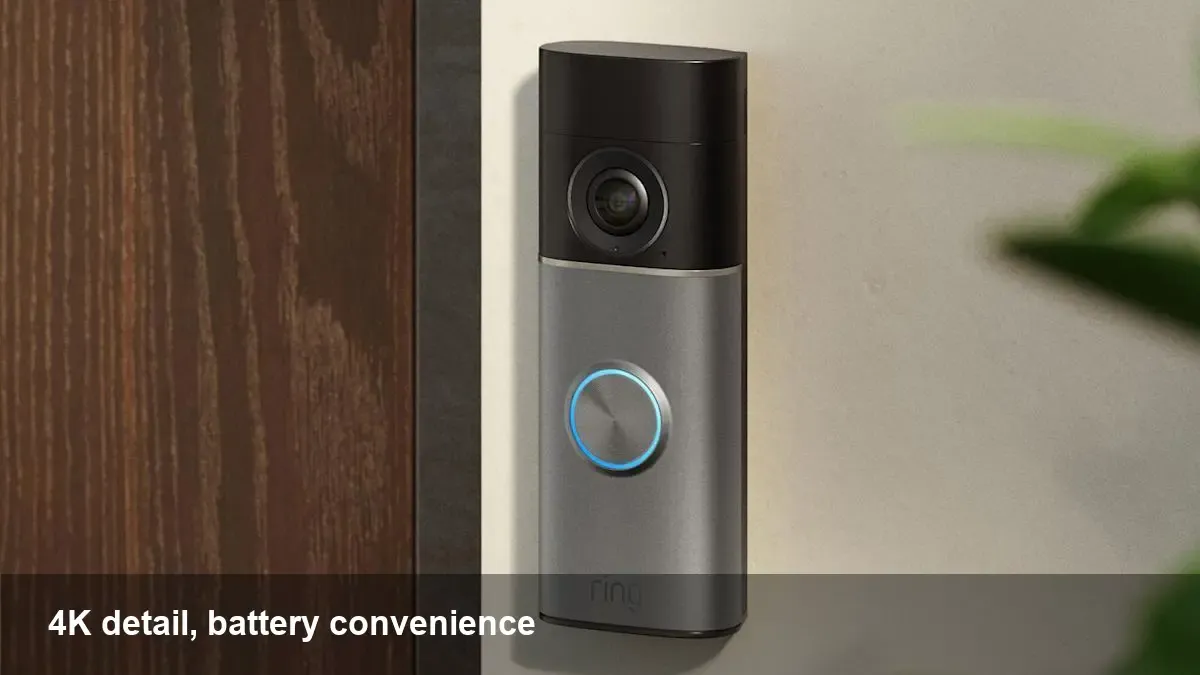
Ring has introduced 4K capture to its battery-powered video doorbells — a notable step for a category that has traditionally traded resolution for portability. Higher resolution on a wireless, battery-run product unlocks clearer evidence for deliveries, incidents and license plates, but it also forces trade-offs around power, bandwidth and privacy.
Quick background: Ring and the product evolution
Ring, the Amazon-owned maker of consumer security cameras and doorbells, pushed the market toward easy-to-install smart doorbells. Early battery models prioritized simple setup and multi-week battery life at 720p–1080p resolution. Wired models gradually advanced to higher resolutions. Adding 4K to a battery-powered model signals both hardware improvements (more efficient image sensors, better compression, power management) and software advances (smarter motion detection, adaptive streaming).
Why 4K matters in the real world
Higher pixel counts are not just vanity: they materially improve the ability to read small details at a distance.
- Package theft or damage: fine text on shipping labels and small logos are clearer in 4K, which helps when filing insurance claims or reporting theft.
- Faces and license plates: if a camera view includes a sidewalk or driveway, 4K increases the chances of capturing usable details at greater ranges.
- Evidence quality: police and insurance agencies are more likely to accept higher-resolution stills and clips as actionable evidence.
Those benefits come with conditions: 4K footage helps only if the camera angle, distance, lighting and motion detection are configured properly.
Battery life and power trade-offs
Adding 4K to a battery-powered device forces design compromises. Higher resolution increases sensor workload, which can draw more current. To compensate, manufacturers use several strategies:
- Smarter triggers: record in 4K only for verified motion events or when the user manually requests a high-res live view.
- Lower-power modes: keep most operations at a lower resolution or frame rate and ramp up only when needed.
- Efficient codecs: newer compression like HEVC (H.265) or AV1 reduces bandwidth and storage for 4K, but can increase processing needs.
- Optional wired or solar power: many buyers will still prefer to wire the doorbell or buy solar chargers to maintain 4K availability.
Expect battery runtime when defaulting to continuous high-resolution recording to be shorter than with older 1080p models. For many owners, the practical balance will be a mix: battery convenience with targeted 4K capture.
Bandwidth and storage: plan ahead
Streaming and uploading 4K clips requires noticeably more upload bandwidth. Even with HEVC, a 4K clip can demand several megabits per second during upload and will consume more cloud storage if you keep extended clip histories.
- Home network: aim for consistent upload bandwidth (8–15 Mbps or more per 4K camera) and a stable 2.4 GHz or 5 GHz Wi‑Fi connection near the doorbell.
- Router and mesh: a modern Wi‑Fi 5/6 router or a quality mesh system will help maintain reliability for high-res uploads.
- Cloud plans: higher-resolution recording often pushes users toward paid cloud subscriptions (Ring Protect or similar) for clip retention and review. Check whether 4K clips are stored at full resolution, or downsampled for archiving.
Use cases beyond the front door
While consumer doorbells focus on homes, several small business and property-management scenarios benefit from battery 4K:
- Small retail or pop-up shops: installing a battery 4K doorbell near a back entrance can create a tamper-proof, high-detail record without running wires.
- Landlords and property managers: clear evidence of property damage, trespassing, or parked vehicles is useful for claims and notices.
- Delivery and logistics hubs: improved label and barcode legibility can simplify dispute resolution with carriers.
These uses often justify wiring the device or using external power to maintain continuous 4K capability.
Integration, developer considerations and platform limits
Ring’s ecosystem integrates tightly with Amazon services like Alexa and the Neighbors social feature, but developers and integrators should be aware:
- Limited third-party APIs: Ring historically offers limited open APIs for camera access, so deeper integrations often require using official Alexa skills or approved partner programs.
- Edge processing opportunities: the jump to 4K makes a case for on-device AI (face blur, local plate detection) to reduce cloud transfers and protect privacy.
- Codec and platform support: if Ring adopts HEVC or AV1 for 4K, third-party systems and NVRs may need updates to ingest and display clips correctly.
If you build automations or provide managed services, plan for tighter platform constraints and expect to rely on sanctioned integrations.
Security, privacy and community impact
Higher-resolution residential cameras raise new privacy and policy questions.
- Neighbor privacy: 4K can capture incidental detail across property lines. Use privacy zones and careful camera placement to limit exposure.
- Data requests: higher-quality footage is more useful to law enforcement, so users should know how Ring handles subpoena or warrant requests and review local regulations.
- Account security: as with any connected camera, enable two-factor authentication and keep firmware up to date to reduce misuse risks.
Ring’s public controversy history around police access and data sharing means buyers should be proactive about privacy settings.
Practical buying checklist
If you’re considering a battery 4K Ring doorbell, ask these questions:
- Will you wire it or rely on battery/solar power? Continuous 4K favors hardwiring.
- Does your internet upload speed reliably support 4K uploads during events?
- What are the cloud storage terms — are 4K clips retained at native resolution and does that affect monthly fees?
- Can you position the camera and set motion zones so the extra resolution translates into usable detail?
Answering those will help you balance performance, cost and convenience.
Looking forward: three implications for the market
- Edge AI will move from novelty to necessity. To keep battery life and cloud costs manageable, expect more on-device processing — automatic blur, plate detection and selective high-res capture.
- Codec adoption will accelerate. Wider use of HEVC and emerging codecs like AV1 will be required for 4K to be practical on consumer networks.
- Regulatory and social pushback will grow. As residential cameras capture ever more detail, cities, HOAs and lawmakers will ask for clearer rules around placement, usage and data access.
Upgrading a battery doorbell to 4K is a practical win for users who need detail without running wires, but it also changes the setup and ongoing management expectations. If you’re planning to buy one, treat it like installing a small security system: verify power and network readiness, configure privacy controls, and consider a subscription to retain the higher-quality evidence when you need it.