Repairable laptops vs closed designs: Framework takes on MacBook Neo

A quick background
Framework is a small, hardware-focused startup that made a name by selling laptops designed to be repaired and upgraded easily. Its approach contrasts with long-standing industry trends toward thinner, sealed devices. Apple, of course, is known for tight vertical integration and heavily optimized systems; its new $599 MacBook Neo joins a crowded, budget-conscious laptop segment while keeping many of Apple’s signature design choices.
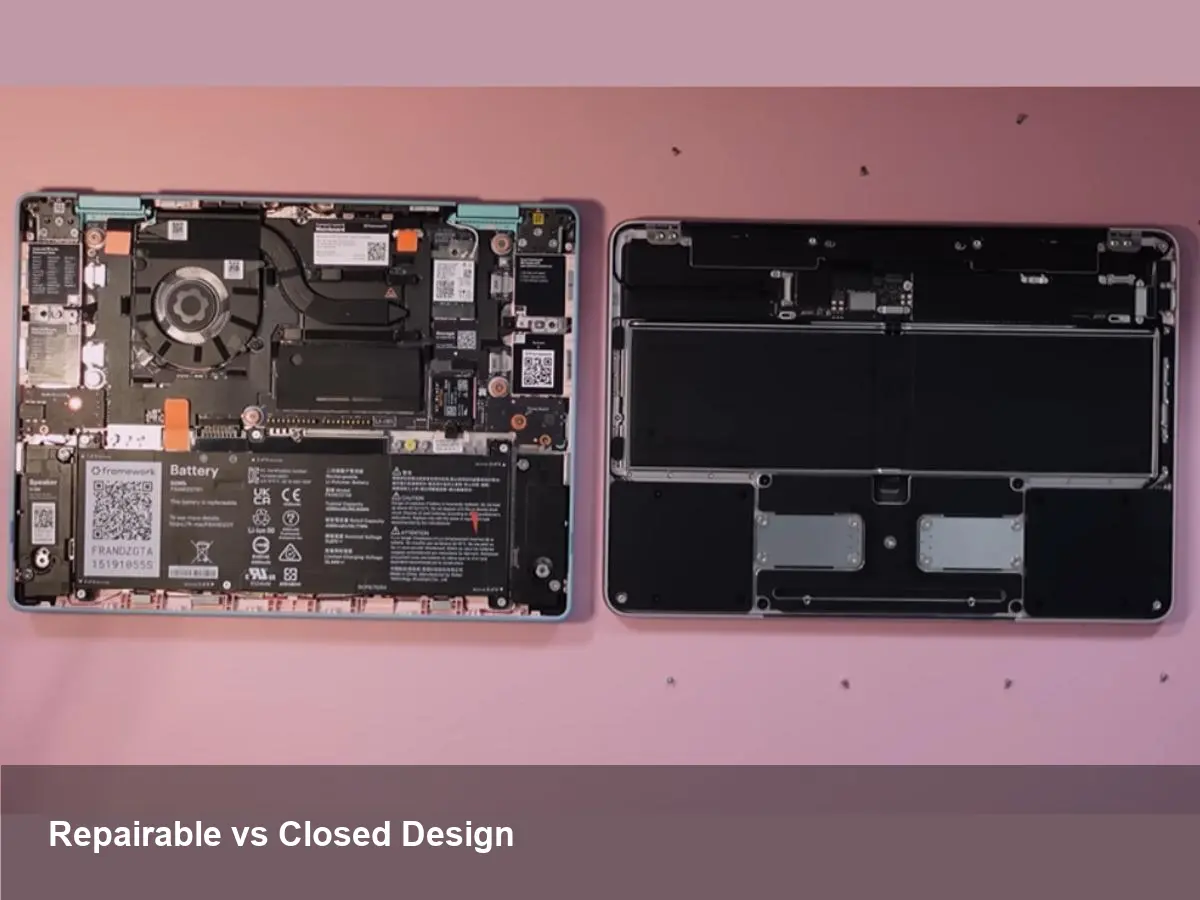
Recently Framework’s founder and CEO, Nirav Patel, posted a hands-on teardown comparing the MacBook Neo to the Framework Laptop 12. The comparison pinpoints two different philosophies: one that prioritizes easy access to replaceable parts and field serviceability, and one that leans into integration and compactness even at the cost of long-term user maintenance.
What each approach delivers today
- Framework Laptop 12: built for swap-in parts. Batteries, ports, and many modules are intended to be removed or replaced by users. The workflow assumes repair shops, power users, or IT departments will extend device life through part replacements and upgrades.
- MacBook Neo (Apple): targets mainstream buyers with a polished, tightly integrated package. Some elements are more accessible than previous Apple models, but core components like RAM and certain storage options remain soldered. Display repairs can be costly and may require specialized service.
These design choices affect cost of ownership, upgrade paths, and the device’s environmental footprint.
Use cases that bring the differences into focus
- University IT fleet Universities replace laptops on a schedule, juggling budgets and varying student needs. A school buying the Framework Laptop 12 can repair broken displays, swap batteries, or upgrade storage locally without sending devices to a brand repair center. That reduces downtime and per-device lifecycle costs. A university choosing MacBook Neo might benefit from Apple’s software ecosystem and centralized support, but will face higher repair bills for non-modular failures and fewer in-house upgrade options.
- A freelance developer who changes workloads Developers often need more RAM or a faster NVMe drive as projects grow. With a repairable, upgradeable platform you can incrementally spend: start with a base configuration and upgrade the memory or SSD later. On a Neo with soldered RAM, initial spec choices lock your future performance, pushing you toward higher upfront spend or entire-device replacement.
- Repair cafés and independent shops Communities that run local repair events can replace batteries or I/O modules from a Framework device in a volunteer session. For Macs, independent repairs can be more involved and occasionally blocked by proprietary screws, glued assemblies, or parts only available through official channels.
What this means for developers, IT teams, and businesses
- Total cost of ownership (TCO): Modular machines tend to show lower TCO over a typical 3–5 year period because small fixes and incremental upgrades cost far less than swapping an entire laptop.
- Inventory and spare parts: IT teams can stock fewer complete units and more common modules (batteries, SSDs, screens). That reduces capital tied up in surplus hardware and speeds repairs.
- Compliance and security: Corporations may worry about non-standard parts or third-party repairs creating security gaps. Framework’s model supports managed refurb programs and enterprise servicing models, but companies will need policies to validate replacement parts and firmware integrity.
- Developer experience: For engineers who tinker with hardware or rely on faster builds, the ability to add RAM or swap storage without replacing a machine can speed workflows.
Trade-offs and limitations to remember
No design is perfect for every buyer. Apple’s integrated approach delivers benefits:
- Efficiency and performance tuning: tightly coupled hardware and software can squeeze more battery life and performance from lower-power components.
- Reliability of a single-vendor warranty and centralized diagnostics.
- Slimness and weight: increased integration often enables thinner designs.
Conversely, modular laptops may sit at a slight cost or weight penalty and can put more responsibility on users and IT for part selection and quality control.
Environmental and market implications
Design choices ripple beyond individual users. A machine that’s easy to repair encourages longer lifespans and reduces electronic waste. For startups like Framework, that’s both an ethical stance and a business differentiator—appealing to customers who equate longevity with value.
Apple’s gradual improvements to serviceability in some components—seen in more accessible batteries and ports in recent models—suggests the company is responsive to repairability criticism. Still, soldered memory and integrated storage choices keep a lot of upgrade power with Apple.
Three practical takeaways for decision-makers
- Match device policy to lifecycle goals: If your organization values low replacement frequency and cheap field repairs, favor modular machines. If you prioritize a uniform, optimized environment with blanket vendor support, integrated designs may be acceptable despite higher long-term service costs.
- Forecast component costs, not just sticker price: A low entry price can be misleading if critical repairs or upgrades become expensive or impossible without full replacement.
- Plan for supply-chain realities: Sourcing third-party modules requires verification processes to ensure compatibility and security. Building that capability can unlock the long-term savings of repairable hardware.
What’s likely next
Expect more friction in two directions: customers and regulators are pushing for better repairability, while manufacturers balance that against design and margin goals. Smaller vendors that commit to modularity may grow in niche markets—education, government, and developer-focused segments—while larger incumbents may continue to nudge toward better serviceability without abandoning closed ecosystems.
For people choosing a new machine today, the debate boils down to control versus convenience. If you want a laptop you can fix, customize, and keep for years with modest investment, repairable designs like Framework’s offer a clear advantage. If you prefer a tightly integrated, out-of-the-box experience with vendor-managed servicing, Apple’s Neo remains an attractive option—just be mindful of the upgrade limits baked into the hardware.
Whether repairability becomes the dominant expectation or stays a specialized preference will depend on consumer demand, enterprise purchasing policies, and regulation. Either way, the conversation Nirav Patel sparked highlights a meaningful choice in laptop design that matters to budgets, sustainability, and who gets to own the future of their device.