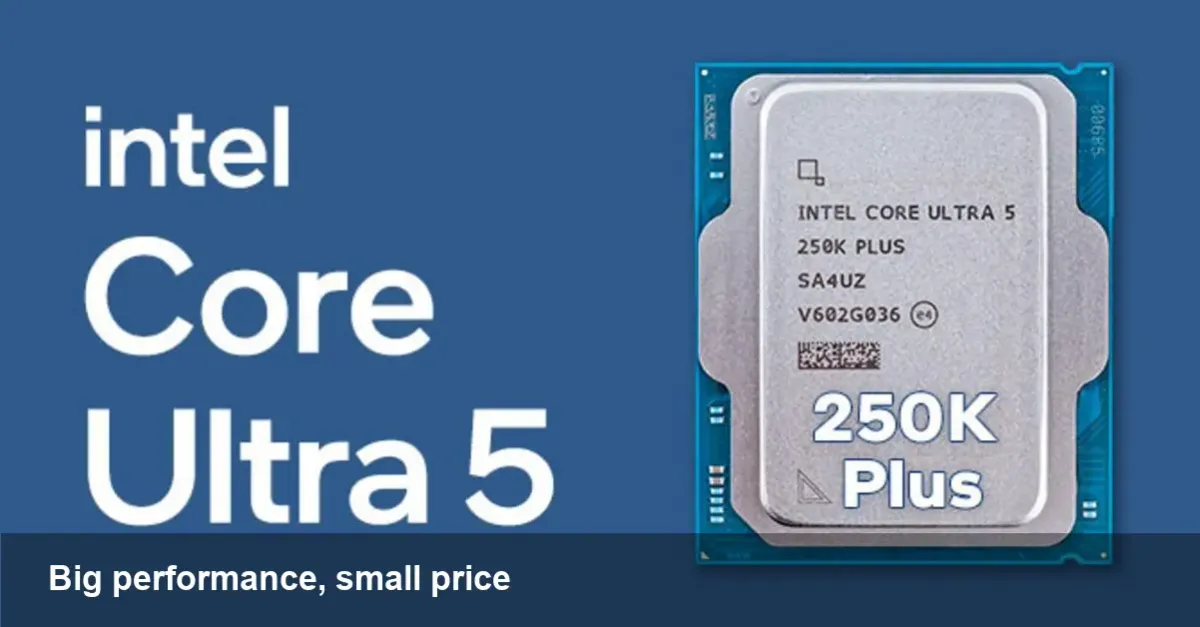
Intel Core Ultra 5 250K Plus: A $200 CPU That Upsets Value Expectations

Why this release matters
Intel's latest entry in the Arrow Lake family, the Core Ultra 5 250K Plus, arrives at a disruptive price point: about $200. For builders and small businesses balancing budget with capability, that MSRP changes the calculus. Historically, buying down into the sub-$250 tier meant accepting weak multi-threaded performance, limited upgrade headroom, or poor integrated graphics. The 250K Plus promises competent application performance, playable gaming without an expensive GPU, and room for modest overclocking — a combination that challenges AMD's value propositions.
Quick background: Core Ultra and Arrow Lake in plain terms
Intel's Core Ultra branding represents newer silicon based on the Arrow Lake roadmap. Compared with older mainstream chips, this generation emphasizes improved efficiency and stronger single-threaded performance, along with better integrated graphics and some AI acceleration in silicon. The Core Ultra 5 250K Plus slots into the lower mainstream: not the flagship but not a stripped-down budget part either. It’s aimed at people who want a snappier PC than last-gen budget chips could deliver without spending a premium.
Real-world scenarios where the 250K Plus shines
- Home office and productivity: If your daily work is browser-heavy, Office suites, Zoom, and occasional multitasking, the 250K Plus makes the system feel snappier than typical entry CPUs. Faster task switching and shorter compile times for small to medium codebases are tangible wins.
- Light content creation: Hobbyist photo and video editing benefit from the stronger application throughput. You’ll see quicker previews and faster export times for short 1080p clips. Serious 4K timelines or heavy stabilization still favor more cores or discrete GPUs, but for social media creators the chip is a solid fit.
- Budget gaming builds: Paired with a modest discrete GPU or even relying on the integrated graphics for esports titles at 1080p, the 250K Plus reaches playable frame rates. Don’t expect ultra-high settings in demanding AAA titles, but for Valorant, CS2, Rocket League, and similar games it’s enough to get enjoyable play without breaking the bank.
- Small form-factor PCs: Because you can get good performance at a $200 CPU price point, mini-ITX builders can create powerful compact systems without overspending on cooling and power. This is ideal for living-room PCs or thin desktop workstations.
Where it still makes sense to spend more
If your workflows include sustained 3D rendering, heavy multithreaded builds, professional-grade video rendering at high bitrate 4K, or large machine learning model training, higher-tier CPUs with more cores (and likely more expensive platforms) remain the better option. The 250K Plus is intentionally a compromise between cost and general capability.
Performance and tuning: what to expect
Out of the box, the chip targets a balance: decent single-thread speed for responsive apps and middle-of-the-road multi-core throughput. Enthusiasts will appreciate headroom for modest overclocking. With a better cooler and a supportive motherboard, users can extract extra clock speed and improve sustained performance under heavy load. The trade-offs are typical: higher clocks raise thermals, so thermal management becomes the limiting factor in small enclosures or budget coolers.
Practical tip: If you plan to overclock, budget for a mid-range air cooler and a motherboard with a robust VRM for stable voltage delivery. That investment often yields better long-term results than chasing the highest turbo bins on a stock cooler.
Platform considerations and total build cost
A CPU’s price is only part of the total. Motherboard choices, memory, storage, and cooling push the budget upward. That said, the 250K Plus lets you allocate more of your budget to other components (GPU, NVMe storage, or a higher-capacity SSD) while keeping CPU costs low. For DIY builders, the overall value proposition is strong: invest the saved $50–100 in a faster GPU or a better monitor and the user experience improves immediately.
Ensure BIOS compatibility and check motherboard vendor support for Arrow Lake-family chips; early adopters often face BIOS updates before chips run optimally.
Downsides and practical constraints
- Platform fragmentation: Intel’s recent platform changes mean motherboard compatibility and upgrade paths can be confusing. Buying a budget motherboard now could limit future upgrade options.
- Thermal ceiling: Despite better efficiency, when pushed hard the 250K Plus still needs adequate cooling to maintain performance under extended loads.
- Gaming ceiling without discrete GPU: For high-fidelity AAA gaming, integrated solutions still lag discrete GPUs. The 250K Plus makes integrated gaming viable for less demanding titles, but intense modern games will require a dedicated GPU for higher settings.
What this means for AMD and the market
A $200 chip that narrows the gap in applications and offers solid gaming capability pressures AMD’s entry-level lineup. Expect competitive pricing responses, refreshed SKUs, or bundled motherboard promotions from rivals. For consumers, competition is good: it pushes down prices and raises baseline performance across the board.
Strategic implications (two to three forward-looking insights)
- Value-tier renaissance: If Intel continues to deliver competitive silicon at low price points, the whole budget PC segment could see its performance floor raised. That accelerates the obsolescence of older budget parts and pushes OEMs to build more capable pre-builts without a big price bump.
- Integrated graphics matter again: Improving integrated GPUs changes how people think about entry PCs. Casual gamers and mainstream users can postpone buying discrete GPUs longer, shifting aftermarket GPU demand and affecting the secondary market.
- Platform buying decisions will be more careful: With frequent platform changes from major vendors, DIY builders and SMBs will prioritize longer-term upgrade paths over minimal up-front cost. Expect more buying guides and motherboard SKUs explicitly marketed for upgradeability.
Who should buy it?
- Buyers on a $600–800 total build budget who want the best CPU for that money.
- Creators doing light-to-moderate editing and streaming on a budget.
- Gamers focused on esports titles at 1080p without spending on high-end GPUs.
- Small businesses and power-conscious office setups that need reliable performance without large capital expense.
The Core Ultra 5 250K Plus won’t satisfy every high-end user, but for its price bracket it resets expectations. If your needs align with the scenarios above, it’s a compelling option that lets you spend budget where it matters most: more RAM, a faster SSD, or a better GPU.