Final Radeon Vulkan Benchmarks: RADV vs AMDVLK Dec 2025

• RADV (Mesa) now competes with — and often matches or exceeds — AMDVLK across tested Vulkan workloads. • AMD ended AMDVLK development in 2025, consolidating Vulkan support around RADV. • Benchmarks used AMDVLK 2025.Q2.1 vs RADV from Mesa 26.0-devel on Radeon RX 9070 and RX 9070 XT. • Test platform: Ryzen 9 9950X3D, Ubuntu 25.10, Linux 6.18; results emphasize improved RADV ray-tracing in 2025.
Overview
In late 2025 Phoronix contributor Michael Larabel conducted a final comparison of AMD's discontinued AMDVLK Vulkan driver against the community RADV driver in Mesa.
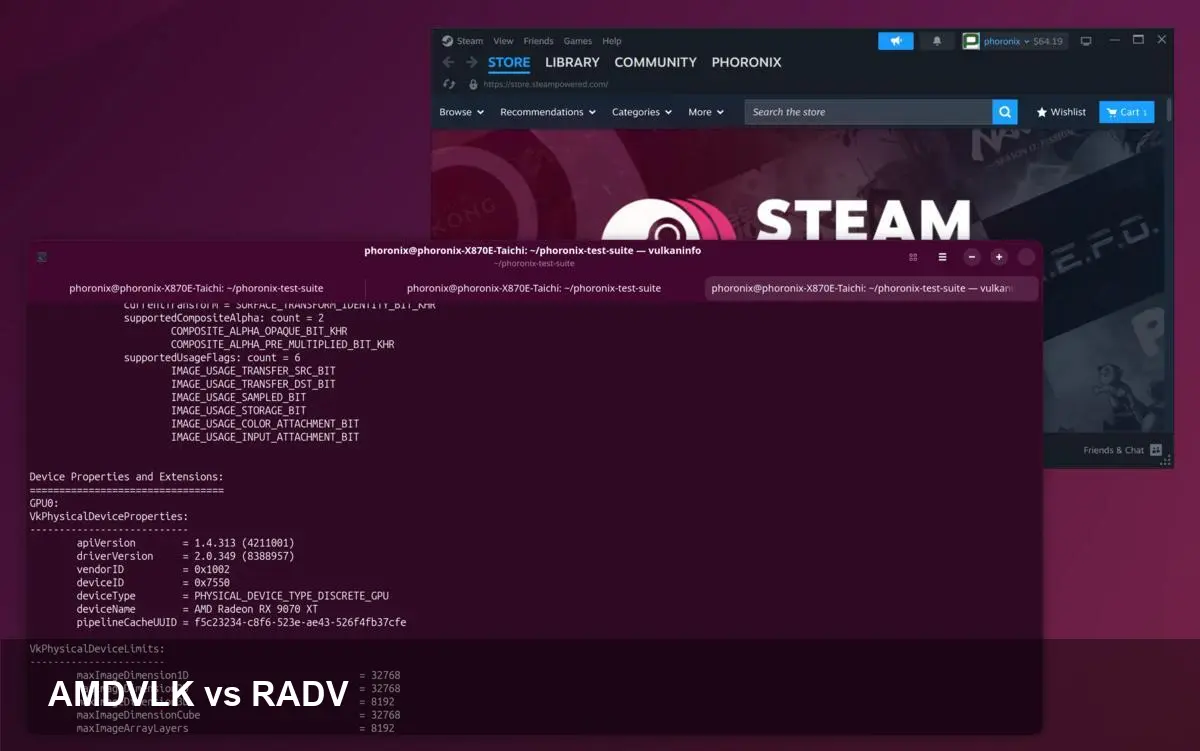
The tests targeted Radeon RX 9070 and RX 9070 XT cards using AMDVLK 2025.Q2.1 and RADV from Mesa 26.0-devel (via the ACO PPA) to show the state of Vulkan and ray-tracing performance as AMD shifted focus to RADV development.
Why this matters
AMD officially stopped AMDVLK development earlier in 2025 to concentrate efforts on RADV. Enthusiasts and Linux gamers have long gravitated to the open-source RadeonSI and RADV stack, but AMDVLK historically held advantages in some Vulkan ray-tracing workloads.
These final benchmarks evaluate whether RADV has closed that gap and whether users can fully migrate to the Mesa driver without sacrificing performance.
Benchmark setup
Hardware and software
Hardware: Radeon RX 9070 and RX 9070 XT graphics cards paired with a Ryzen 9 9950X3D test system.
Software: AMDVLK 2025.Q2.1 (final release) vs RADV as in Mesa 26.0-devel (20 Dec 2025) using the ACO PPA on Ubuntu 25.10 with Linux kernel 6.18.
Workloads tested
The comparison covered a range of Vulkan graphics and compute benchmarks, including modern ray-tracing tests where AMDVLK previously excelled.
Results summary
Overall, RADV showed strong gains throughout 2025 and in these final tests largely matched or outperformed AMDVLK across the sampled Vulkan workloads.
Notably, RADV's ray-tracing implementation — the last major area of AMDVLK advantage — improved significantly, reducing the performance gap and in many cases providing comparable frame-rates and compute throughput.
What this means for users
With AMDVLK discontinued, Linux users should feel confident moving to the RADV/Mesa stack for Vulkan gaming and workstation tasks on Radeon hardware.
Developers and gamers relying on Vulkan ray-tracing can expect continued improvements from the RADV community and AMD's focus on a single open-source pipeline.
Reproducibility
Phoronix published detailed results and charts from the test runs for those who want to reproduce or inspect specific benchmark scores.
Bottom line
RADV has closed the gap with AMDVLK in 2025. With AMD's official shift away from AMDVLK, RADV and Mesa are now the forward path for Vulkan on Linux Radeon GPUs.