Why building a robot helps explain the self

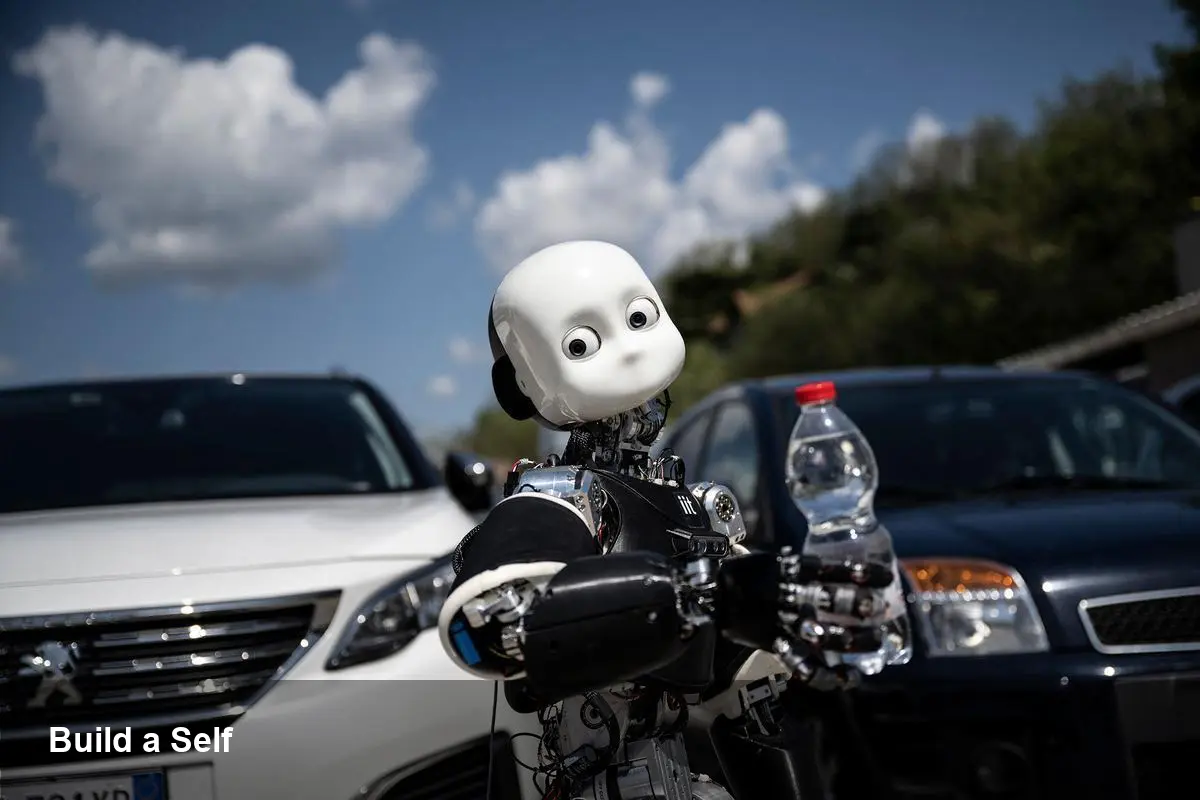
- Key takeaways:
- Embodied robots can model core features of the human ‘minimal self’: body ownership, agency and self/other distinction.
- Disembodied generative AIs (LLMs) may mimic self-talk but lack sensorimotor grounding needed for true selfhood.
- Robotic experiments (motor babbling, mirror tests, rubber-hand variants) validate neuroscience theories of body representation and agency.
- Integrating memory, prediction and narrative could let robots approximate an adult-like persistent self.
Why build a robot self?
Understanding the human self is made difficult by its dual role: it is both perceiver and perceived, as William James noted over a century ago.
Robotics offers a synthetic approach: build systems with bodies, sensors and actuators to test theories about how selfhood emerges from embodied interaction.
What the minimal self looks like in machines
Neuroscience distinguishes a ‘‘minimal self’’, based on body ownership and agency, from later narrative and reflective selves. These core features are experimentally accessible in robots.
Methods such as motor babbling let robots discover limb configurations and proprioceptive maps, mirroring infant sensorimotor development. Work by Josh Bongard and others shows robots learning morphology and adapting locomotion after damage.
Body ownership and illusions
Robots equipped with tactile skin and vision can replicate phenomena like the rubber-hand illusion: synchronous multisensory input leads a robot to incorporate external objects into its body model, supporting cortical theories of ownership (see iCub experiments by Yuxuan Zhao).
Agency, prediction and mirror tests
Agency theories propose the brain predicts sensory consequences of actions. Robotic implementations of comparator models allow machines to distinguish self-caused events from external ones.
Pablo Lanillos and colleagues used predictive learning to let a humanoid tell its mirror image from another robot by predicting its own reflection’s movements.
From minimal to persistent selves
Adult selfhood builds on episodic memory, time-binding and narrative. Robots have clocks and logs, but human-like persistence requires reconstructive memory and generative prediction.
Recent AI models applied to robotic memory can reconstruct past episodes from cues and simulate future scenarios, a step toward mental time-travel and a temporally extended self-model.
Limits and the question of subjectivity
Critics such as Anil Seth argue biological processes may underlie subjective experience in ways robots cannot reproduce. Others, including J. Kevin O’Regan, stress sensorimotor contingencies: experience arises in embodied interaction and could, in theory, be realized in robots.
Whatever the final verdict on “what it is like,” building synthetic selves forces precise theories, reveals gaps, and ties philosophy to empirical tests.
Video
https://youtube.com/embed/dv38Q_ZNNoY