Virginia Tech Shows Entangled Qubits Could Link Drones

• Key takeaways:
- Virginia Tech researchers developed eQMARL, an entangled quantum multi-agent reinforcement learning framework that links drones via quantum entanglement without relying on conventional networks.
- eQMARL showed performance gains over classical and non-entangled quantum baselines in simulations; research is published as an arXiv preprint (DOI: 10.48550/arxiv.2405.17486).
- The team demonstrated the concept publicly, but practical deployment for disaster response is likely 10–15 years away as hardware and field testing advance.
Overview
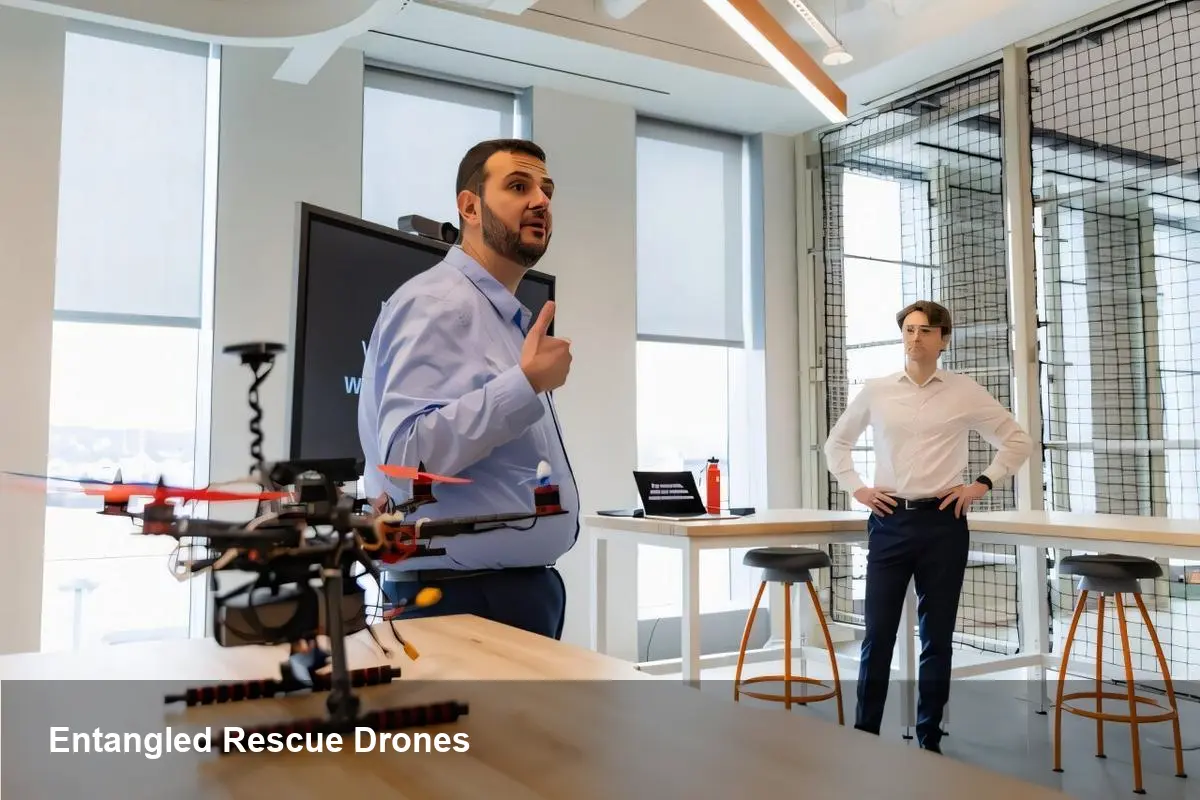
Virginia Tech Ph.D. student Alexander DeRieux and advisor Professor Walid Saad propose using quantum entanglement to coordinate swarms of drones in disaster zones where wireless and internet links fail.
Their framework, called eQMARL (entangled quantum multi-agent reinforcement learning), encodes sensor data and control signals into qubits so entangled devices can react to state changes without transmitting information over open networks.
What the researchers did
Working at the Institute for Advanced Computing in Alexandria, the team built a learning scheme that leverages entanglement between qubit pairs. They simulated multi-agent tasks—such as wildfire monitoring—and compared eQMARL to classical and non-entangled quantum approaches.
Results published on arXiv indicate marked improvements in coordination and task performance when entanglement is used. The paper (Alexander DeRieux et al., eQMARL: Entangled Quantum Multi-Agent Reinforcement Learning for Distributed Cooperation over Quantum Channels) is available with DOI 10.48550/arxiv.2405.17486.
How entanglement transmits information
Entangled qubits share correlated states: a change to one qubit instantaneously affects its partner's measurable state. In the eQMARL concept, drones encode observations—video, audio, telemetry—onto qubit states, and those state changes carry actionable information to entangled partners.
DeRieux explained, "When you look subatomically, atoms don't exist in isolation—they vibrate… Entanglement effectively leverages the fabric of the physical space around us." He added that the scheme cares that a change occurs, not necessarily the classical value it represents.
Applications, limits and timeline
Entanglement-based links could bypass fiber, cellular, or satellite backhauls to offer new modes of secure coordination and distributed AI—relevant for emergency response, hospitals sharing sensitive data, and federated learning.
Professor Saad noted their goal is co-design of quantum and classical systems: "…design learning and communication frameworks that move beyond classical limits while establishing principled co-design approaches."
Practical hurdles remain: robust field hardware, reliable entanglement distribution across mobile platforms, and scale. The team estimates real-world deployment for drone disaster response may be 10–15 years away.
Next steps
Researchers will refine the mathematics, test on physical quantum hardware as it shrinks and matures, and explore integrations with federated learning and energy-efficient AI approaches.
This work represents an early, experimentally grounded roadmap for using uniquely quantum effects to solve coordination and security challenges in disconnected environments.