Quantum computers retain memory: mapping time-linked errors

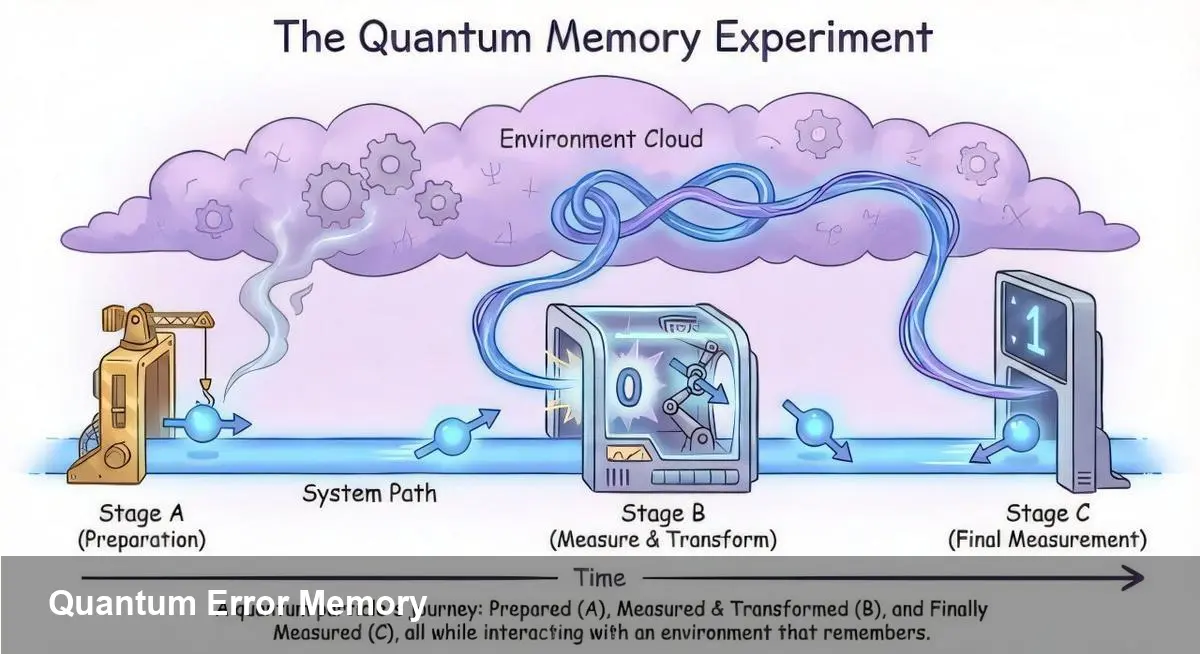
- Key Takeaways:
- Researchers led by Dr. Christina Giarmatzi (Macquarie University) reconstructed how quantum errors evolve and link across multiple times.
- Experiments used superconducting processors (University of Queensland lab and IBM cloud); data and code are openly available and published in Quantum (DOI: 10.22331/q-2025-12-02-1582).
- The team showed errors can carry “memory” (classical or quantum), contradicting the common Markovian assumption and complicating error correction.
What the team discovered
Dr. Christina Giarmatzi and collaborators created the first complete picture of how errors unfold over time inside a quantum computer. They found that noise does not appear purely at random; it can linger, evolve and become correlated across different moments.
"We can think of it as quantum computers retaining memory of the errors, which can be classical or quantum depending on the way these errors are linked," Giarmatzi said. This time-linked behaviour is a central barrier to practical, large-scale quantum computing.
How they mapped multi-time errors
The researchers performed multi-time quantum process tomography on superconducting qubits, combining experiments on in‑lab hardware at the University of Queensland with runs on IBM's cloud quantum processors.
They overcame a long-standing obstacle: after a mid-circuit measurement the system cannot be re-prepared without bias from the measured outcome. The team’s trick assumed, in analysis, a 50/50 distribution of mid-circuit results and then worked backwards with software to reconstruct the state evolution.
"We've been able to reconstruct the entire evolution of a quantum process across multiple points in time—something that hasn't been done before," Giarmatzi said. Co-author Dr. Fabio Costa (Nordita) added, "The hardware could do it. What we figured out was how to actually prepare the system after a mid-circuit measurement."
Why this matters for error correction
The experiments revealed subtle but important time-linked noise patterns, including quantum-type noise sourced by neighboring qubits on the same chip. Those correlations mean many error models that assume independence over time (Markovian models) are incomplete.
Understanding these patterns enables more accurate characterization and predictive models, which are essential inputs to advanced error-correction schemes and fault-tolerant architectures. As Tyler Jones, a Ph.D. student on the project, put it: "Robust characterization of time correlations in quantum systems is needed on the path to building powerful quantum machines."
Open data and next steps
The team published their paper in Quantum and made experimental data and code openly available to accelerate follow-up work. The methods apply beyond superconducting chips to trapped ions and spin qubits, guiding improved diagnostics and control strategies across quantum platforms.
Reference: Multi-time quantum process tomography on a superconducting qubit, Quantum (2025). DOI: 10.22331/q-2025-12-02-1582.