Pyrex glass for 10,000‑year data storage
Why long-term digital archives still matter
We create and rely on more digital information than ever: legal records, scientific datasets, cultural heritage, and critical source code. Much of that data must be preserved intact for decades or centuries, sometimes for millennia. Traditional solutions — magnetic tape, hard drives, optical discs — are optimized for cost and access speed, not geological timescales. That’s where permanent, write-once archival media attract attention.
The idea behind Microsoft’s Pyrex approach
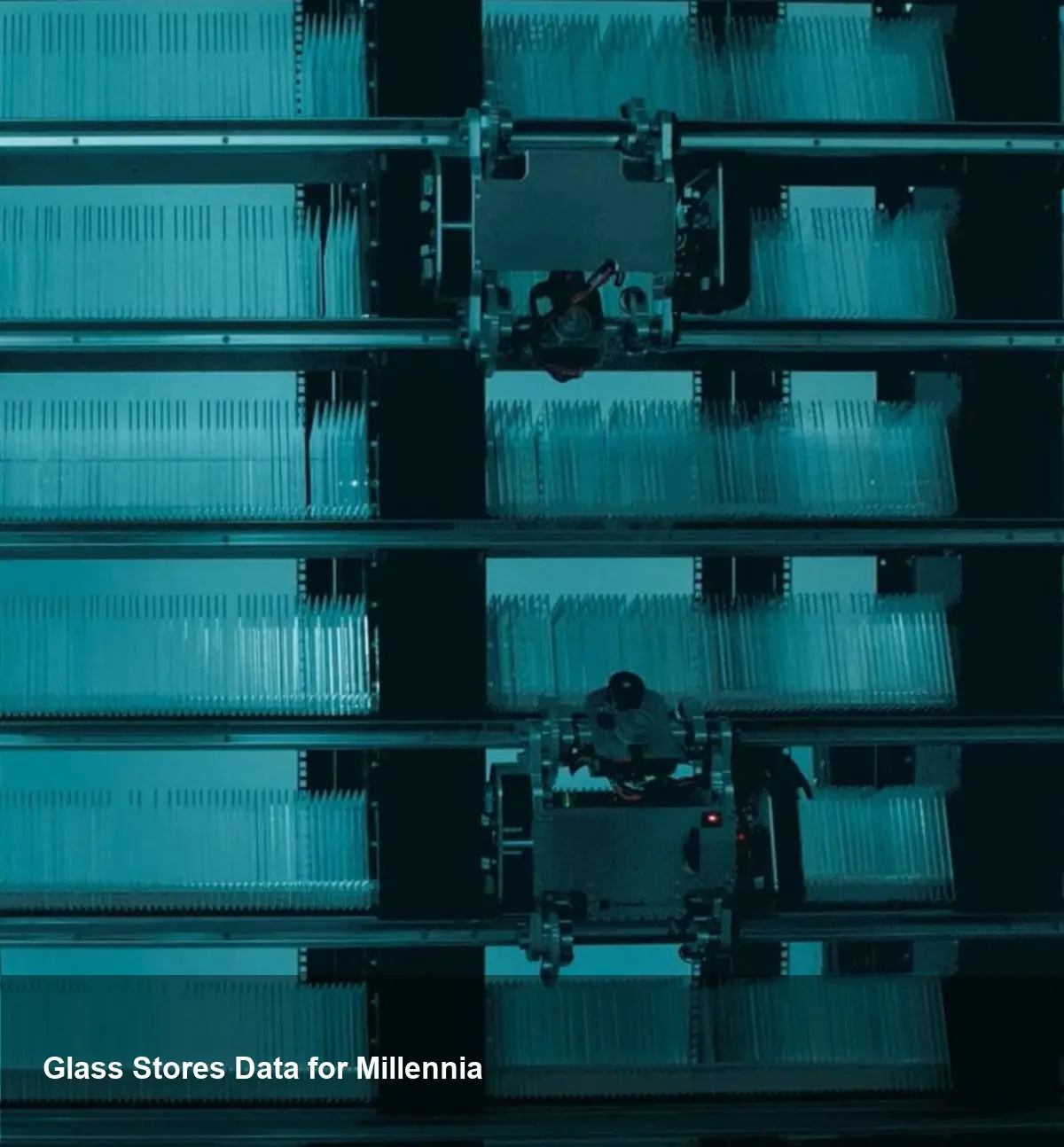
Microsoft researchers investigated using borosilicate glass (the kind sold under brand names like Pyrex) as a medium for long-duration archival storage. Instead of relying on magnetic or chemical states, this technique stores information by making extremely small, stable modifications inside the glass using ultrafast laser pulses. Those microscopic features act like 3D pixels (voxels); when you read them with the right optics and signal processing, they represent bits or higher‑order symbols.
Key trade-offs the team reported: the borosilicate glass option offers lower material cost and faster write throughput than the higher-end fused silica (quartz) used in some earlier glass-storage research, but at roughly half the raw volumetric capacity. Laboratory accelerated-aging experiments and analysis indicate the encoded structures can remain readable for very long time horizons — Microsoft projects survivability on the order of ten thousand years under favorable storage conditions.
How this differs from other long-term media
- Magnetic tape: cheap per GB and well-understood, but degradation and format obsolescence occur on the scale of decades. Periodic migration is required.
- Optical and archival discs: susceptible to delamination and environment damage over long spans.
- Fused silica glass: has demonstrated high stability and capacity but is a more expensive substrate and slower to write in some implementations.
Pyrex-style borosilicate aims for a middle ground: lower material cost, simpler manufacturing, and competitive write speed — making it attractive for applications that demand longevity but where budget and throughput matter.
Concrete use cases and scenarios
- Cultural heritage vaults: museums and national archives can encapsulate high-resolution scans, provenance metadata, and restoration records in a medium that won’t demand frequent migrations.
- Compliance archives: financial and corporate records that regulators require to be kept untouched for many years can be stored offline with strong tamper resistance.
- Disaster‑proof backups: a company could stash an immutable “golden image” of critical systems in glass as part of a long-term business continuity plan.
- Scientific data and observatory logs: datasets that must be preserved for future reanalysis (e.g., climate records, raw telescope data).
- Intergenerational and planetary archives: councils or organizations that want to preserve cultural snapshots or technical instructions across centuries.
Example scenario: A university stores its irreplaceable field recordings and research instruments’ calibration datasets on glass plates. Metadata, checksums, and a minimal open-reader specification are included to reduce the risk of future unreadability. The plates are kept in climate-controlled vaults with multiple geographically separated copies.
What developers and architects need to know
- Read/write model: Current implementations are optimized for write-once, read-many patterns. Random writes and frequent updates are not the intended use case.
- Throughput and latency: Writing can be faster than some fused silica methods but remains far slower than electronic storage. Plan for batch ingest pipelines rather than realtime data flows.
- Data formats and indexing: Because retrieval involves optical scanning, you’ll want simple container formats, embedded metadata, and robust error correction. Design for block-level checksums and manifest files that can be validated offline.
- Hardware dependency: Reading requires specialized optics and often signal-processing software. Budget for reader hardware, controlled reading environments, and vendor lock-in risks.
- Packaging and archival best practices: The glass itself is durable, but sealing, shock protection, and environmental control still matter. Redundancy across different materials and locations remains prudent.
Limitations and practical hurdles
- Capacity per volume is lower than the highest-density fused silica experiments, so very large archives will need proportionally more physical media.
- Upfront equipment cost and the need for precision lasers and optics mean initial setup is nontrivial for small organizations.
- Standardization is lacking: without broad, open specifications for encoding and reader formats, long-term accessibility is only as good as the longevity of the tools and documentation you preserve alongside the glass.
- Not a substitute for active backups: it’s cold storage by design — don’t rely on it for frequent restores or for workloads requiring immediate access.
How organizations might adopt this technology
- Identify truly archival data: only move immutable, irreplaceable, or regulation-bound datasets.
- Prototype a workflow: ingest -> encode with verified ECC -> store with multiple copies and descriptive manifests.
- Include reader specs, firmware images, and a reference implementation in multiple formats (text, audio explanation) to reduce future-compatibility risk.
- Combine glass storage with conventional cold tiers: e.g., tape for 30–50 year retention and glass for multi-century preservation.
Three implications for the next decade
- New tiering models will appear in enterprise storage architectures that explicitly include “century-grade” or “millennium-grade” tiers alongside hot, warm, and cold.
- Standardization efforts (open codecs, reader specifications, and archival metadata schemas) will become critical. Without them, the theoretical longevity of a medium is useless if no one can read it.
- Economics matter: lower-cost substrates like borosilicate could accelerate adoption beyond national labs and museums into industry archives if encoding workflows and reader ecosystems mature.
Glass-based archival projects won’t replace everyday storage, but they change how we think about permanence. For organizations weighing data longevity against migration costs, the Pyrex approach offers a compelling option: cheaper substrate, good durability, and pragmatic write speeds — provided you pair it with solid metadata practices and redundancy. If your institution has truly irreplaceable data, now is a good time to pilot strategies that include long-duration glass storage alongside conventional backups.