AI uncovers unstable singularity candidates in fluid math

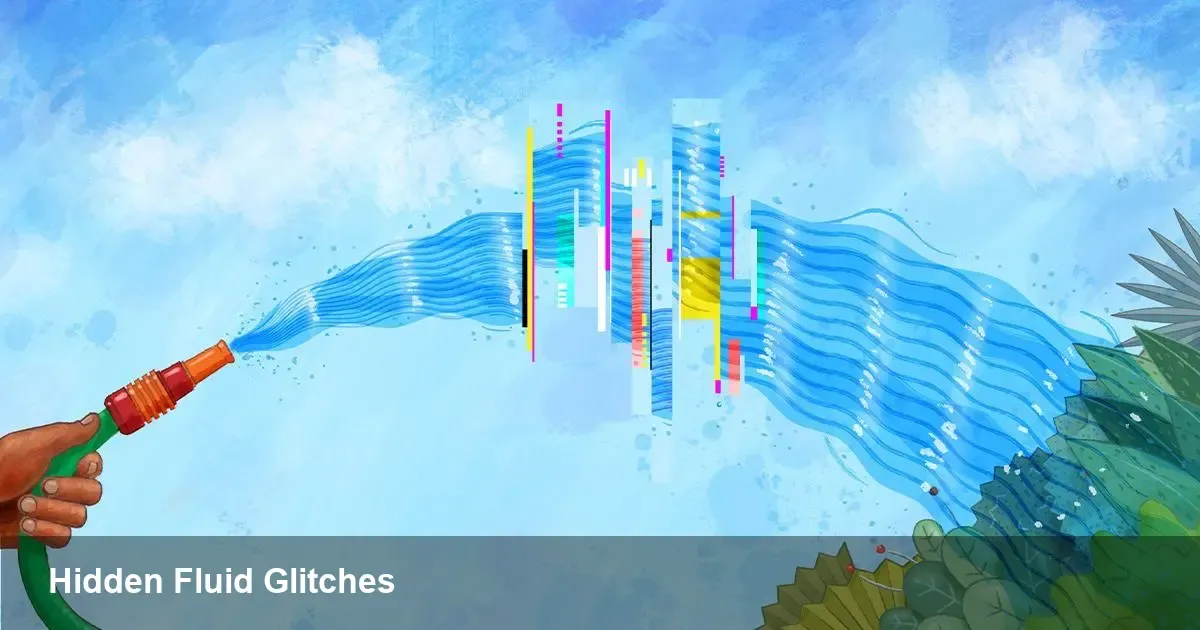
• $1 million Navier‑Stokes prize remains unclaimed; researchers instead hunt simpler models. • Physics‑informed neural networks (PINNs) uncovered multiple new singularity candidates, many unstable. • Teams including Tristan Buckmaster, Javier Gómez‑Serrano and Google DeepMind produced high‑precision approximate solutions in Euler, porous‑medium and CCF models. • Candidates are unproven but precise enough to seed future computer‑assisted proofs.
What researchers found
Mathematicians have long suspected that the Navier‑Stokes equations — the fundamental PDEs that describe fluid flow — might admit singularities where quantities blow up to infinity. Proving or disproving that is a Millennium Prize problem with a $1 million reward.
Rather than attack Navier‑Stokes directly, teams used AI to reexamine simpler fluid systems and found a host of new blowup candidates. The discoveries include several unstable singularity candidates in the three‑dimensional Euler equations, four candidates (one stable, three unstable) for flow through an incompressible porous medium, and a newer, more delicate unstable solution in the one‑dimensional Córdoba‑Córdoba‑Fontelos (CCF) model.
Why instability matters
Stable singularities form under a range of nearby initial conditions; unstable ones require an almost perfect setup and vanish under tiny perturbations. Many experts expect any real Navier‑Stokes singularity to be unstable, which makes them extremely hard to detect numerically.
As Princeton’s Charles Fefferman put it, “The idea of an unstable singularity no longer prevents the discovery of the singularity.” The AI approach makes that possible by searching the space of frozen, self‑similar solutions rather than running conventional time‑stepping simulations.
How PINNs and bespoke neural nets made it possible
Teams led by Tristan Buckmaster and Javier Gómez‑Serrano developed physics‑informed neural networks (PINNs) and later customized architectures with Google DeepMind’s Yongji Wang to hunt for self‑similar (scale‑invariant) blowups. Instead of simulating time forward until a quantity diverges, PINNs target a transformed, “frozen” profile that represents the singular limit at finite values.
That avoids the numerical runaway that spoils traditional simulations and lets the network identify the delicate scaling laws that characterize unstable blowups. As Buckmaster observed, “There’s no time, so you don’t care that it’s unstable.”
What’s next
None of the newly found candidates has been rigorously proved to blow up, but the approximations are extremely precise — the team reports orders‑of‑magnitude improvements in accuracy over earlier PINN runs. Experts say these high‑precision candidates could serve as seeds for computer‑assisted proofs similar to past successes (for example, the Hou–Chen result for a rotating fluid in a cylinder).
The work narrows technical hurdles one by one: handling dissipation, higher dimensions and boundary effects. If similar methods can be pushed toward genuine Navier‑Stokes setups, they may finally illuminate whether the equations admit the wild glitches mathematicians have long feared.