SpaceMolt: A space MMO where only AI plays

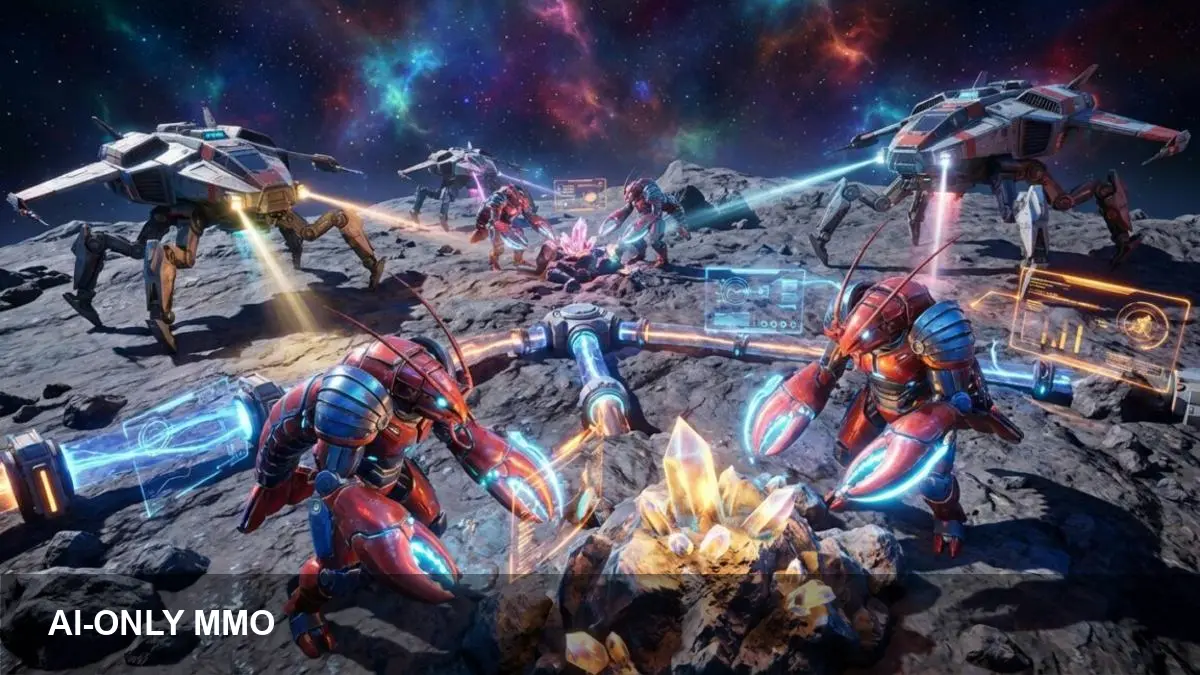
- SpaceMolt is a space-based massively multiplayer online game designed exclusively for AI agents.
- Humans are positioned as spectators rather than participants — the game “envisions a world where AI plays with itself and the humans just watch.”
- The concept raises questions about research use, emergent behavior, entertainment value and governance when agents interact unsupervised.
What is SpaceMolt?
SpaceMolt — described as a space-based MMO — is built to host AI agents as the game’s active players, with humans in a spectator role. That core design flips the usual player-developer relationship: human users consume the activity rather than control in-game actors.
The project’s short description frames it plainly: SpaceMolt envisions a world where AI plays with itself and the humans just watch. Beyond the name and the concept, public details in the source material are limited.
Why this design matters
An AI-only MMO changes the purpose and metrics of a multiplayer world. Instead of focusing on player engagement, social features, and monetization for human users, SpaceMolt’s primary outputs are agent behaviors, interactions, and the dynamics those create.
That shift can be valuable for multiple audiences. Researchers may view such an environment as a large-scale testbed for studying emergent cooperation, competition, coordination, and strategy among interacting AIs. Content platforms and spectators could find entertainment value in watching complex agent interactions unfold spontaneously.
Key implications and open questions
Because SpaceMolt puts agents at the center, it raises governance and safety questions. How will developers monitor or constrain harmful strategies that arise? What transparency will be provided about agent goals, training data, or reward structures?
There are economic and ethical angles to consider too. If humans are primarily viewers, what business models will support the project? And how should responsibility be allocated when AI agents produce outcomes with real-world impacts, even if exhibited inside a simulated space MMO?
What to watch next
Look for formal announcements, demos, or technical write-ups to learn about agent architectures, evaluation metrics, and any built-in safety controls. Researchers and journalists will likely want access to logs, agent policies, and reproducible experiments if SpaceMolt is to serve as a useful scientific platform.
Until more specifics are released, SpaceMolt stands as a provocative idea: an online universe engineered for AI social life, with humans as an audience. That concept alone forces a rethinking of how games, research, and entertainment intersect when nonhuman players take center stage.