Indie Pass: 70 Indie Games for $6.99 a Month

Why indie games keep needing new channels
The indie games market is booming—tools like Unity and Godot lower technical barriers, and digital storefronts let anyone publish. That abundance is great for creativity but brutal for discoverability. Small teams can produce standout titles, but with storefronts crowded by thousands of releases each year, even well-reviewed games struggle to reach players.
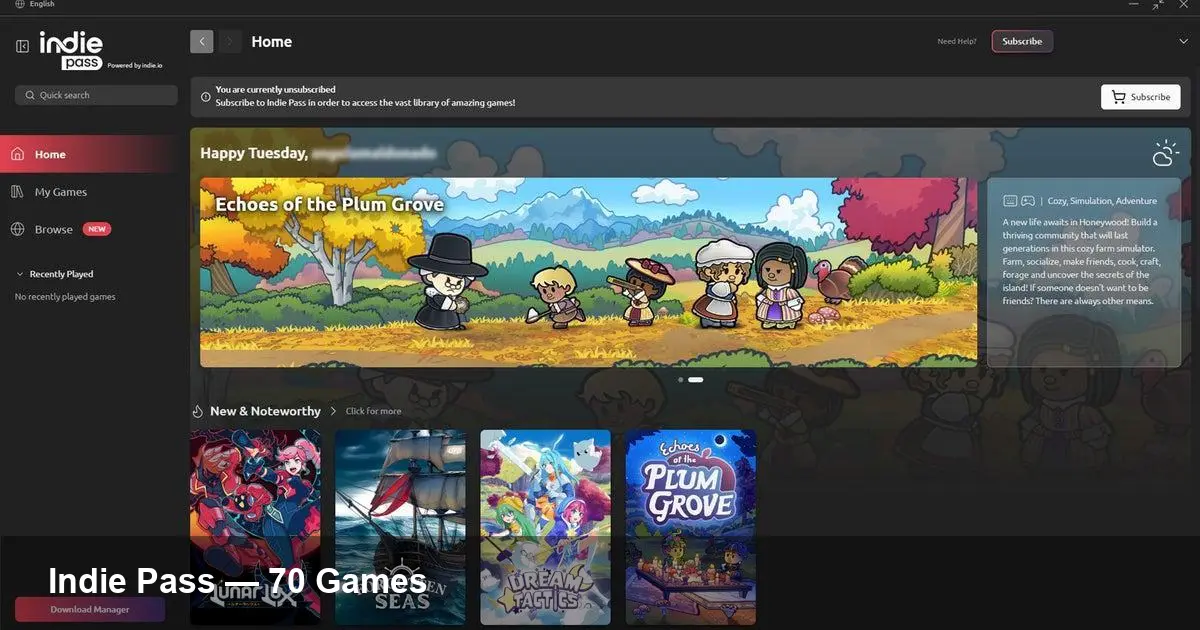
Enter Indie Pass, a new subscription service from Indie.io that bundles access to a curated set of independent games for $6.99 per month. The launch lineup includes 70 titles, and the platform is explicitly positioned to give smaller creators a dedicated route to players who want to explore beyond the biggest releases.
What Indie Pass is and how it works (practically)
Indie Pass is a consumer subscription—pay once, play multiple games from the catalog. For players it’s straightforward: discover a rotating or fixed catalog, try games you might not otherwise notice, and keep playing without per-title purchase friction.
For developers, the offering is two-fold: exposure to a subscriber base that’s already looking for indies, and a potentially steadier income stream compared with one-off sales spikes. Indie.io’s spokesperson Jess Mitchell has framed the service around helping creators increase visibility in a crowded marketplace.
The exact revenue mechanics (per-play payouts, time-based shares, or flat licensing fees) will matter a great deal and vary by platform; developers should review Indie.io’s terms before joining. But the core trade-off is clear: a developer can trade some upfront revenue per unit sale for recurring payments and exposure to new players.
Concrete scenarios: how developers and players might use Indie Pass
- Solo dev launching a niche puzzle game: Instead of spending heavily on paid user acquisition, the developer adds the game to Indie Pass. Subscribers who enjoy a short, satisfying puzzle experience may recommend it, driving community buzz and potential paid expansions or DLC.
- Small studio testing a new genre: A studio uses Indie Pass to test a stealth roguelike prototype. The subscription environment lowers the bar for players to try experimental ideas, giving the studio real-world player feedback without the pressure of hitting a specific sales number.
- Players hunting for variety: Someone tired of blockbuster games can subscribe to Indie Pass for $6.99 and discover hidden gems across genres—platformers, narrative adventures, experimental art games—without committing to buying each title.
Why this matters for discoverability and business models
Subscription models change incentives. In a storefront, algorithms and paid promotions often decide which titles are visible. With a curated subscription, curation and editorial picks can bring attention to games that would otherwise be buried.
For developers, subscriptions can reduce the boom-and-bust cycle of launch sales and instead provide a predictable income stream—provided the payout model compensates fairly. If Indie Pass delivers a reliable subscriber base and visible placement for participating games, it can function as both a marketing channel and a monetization route.
However, there are trade-offs. Revenue per player may be lower than direct purchases, and long-term value depends on retention—both of players and of the games in the catalog. Developers will need to weigh immediate exposure against projected lifetime earnings under the subscription’s payout system.
Potential gotchas and things to ask before joining
- Payout model: Is revenue allocated by playtime, number of unique players, or a flat licensing fee? Each favors different styles of games.
- Catalog churn and marketing: How often does the catalog rotate? Do games receive featured placement or editorial coverage?
- Data access: Will developers get analytics on player behavior, retention, and conversion? These insights are essential for future updates and monetization.
- Contract length and exclusivity: Are there exclusivity clauses that limit where else the game can appear?
Developers should treat Indie Pass like a business partnership—read terms, model expected revenue, and think about how being in a subscription complements other distribution channels.
Broader implications for the indie ecosystem
1) Curated bundles could shift discovery away from storefront noise. If curated subscriptions prove popular, editorial selection and human curation could reclaim some influence from algorithmic feeds.
2) Data becomes a competitive resource. Platforms that share robust analytics with creators will enable smarter post-launch support and increase developer loyalty.
3) Experimentation may increase. Lower barriers for players to try unconventional titles encourages risk-taking—designers can prototype weird mechanics or niche narratives with less fear of commercial failure.
What players and studios should do next
Players: If you enjoy exploring diverse, smaller titles, a $6.99 subscription that opens dozens of options can be a low-risk way to broaden what you play. Treat it as a discovery service—sample liberally and follow studios you like.
Developers: Model the numbers. Estimate revenue under different payout approaches and consider Indie Pass as part of a multi-channel strategy (store sales, bundles, direct sales, and subscriptions). Negotiate for data access and marketing support where possible.
Indie Pass isn’t a silver bullet, but it’s a practical attempt to re-balance discovery toward curated indie work. For players hungry for variety and studios seeking reliable exposure, it’s a development worth watching—especially if Indie.io follows through on terms that reward creators fairly and provide meaningful analytics.
Whether Indie Pass becomes a major alternative to existing storefronts will depend on how the platform executes on curation, developer economics, and community-building. For now, it’s a welcome addition to the indie ecosystem: a focused channel that aims to make small games bigger in front of the right audience.