DLSS 5: NVIDIA’s AI Leap for Higher-Fidelity, Higher-FPS Gaming

What DLSS 5 is and why it matters
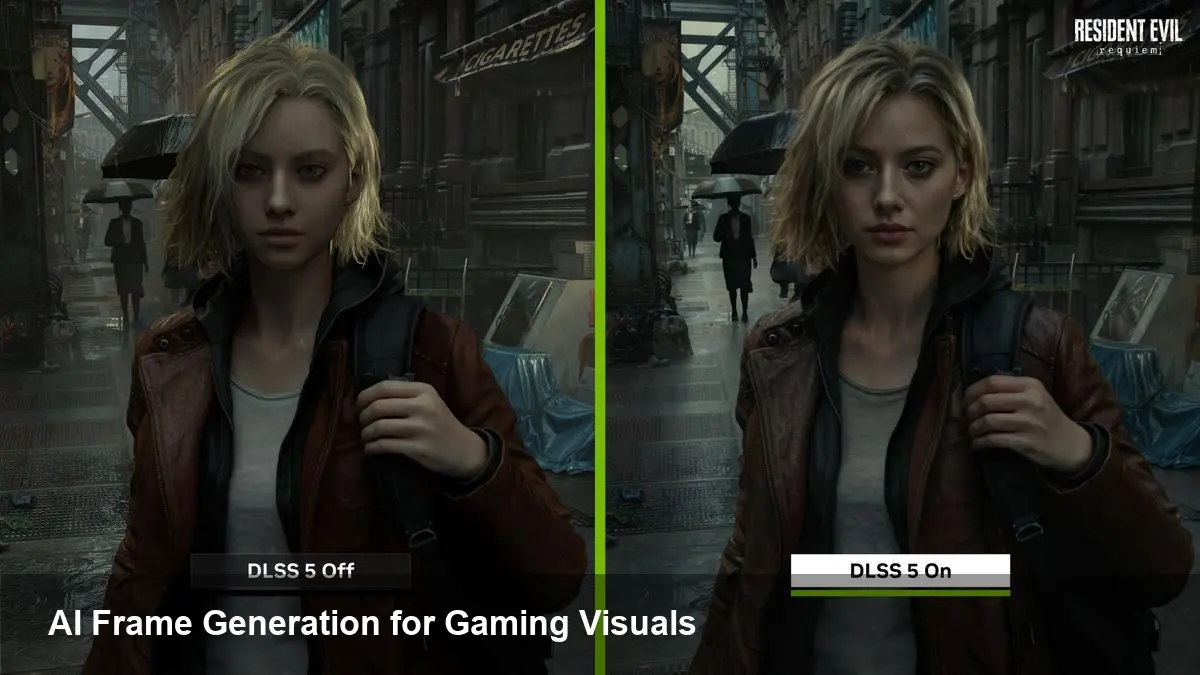
NVIDIA’s DLSS 5 is the latest step in the company’s long-running effort to use machine learning to reshape real-time graphics. At a high level it combines learned image reconstruction with AI-driven frame synthesis so games can hit higher resolutions and frame rates while preserving—or even improving—visual fidelity.
This release is being positioned as a milestone on par with earlier shifts such as the arrival of hardware-accelerated ray tracing in 2018. For developers and studios that juggle graphical ambition against frame-rate targets, DLSS 5 promises a new set of trade-offs: less brute-force sampling, more smart reconstruction.
Brief background: where DLSS started and how it evolved
NVIDIA’s DLSS family began as an experiment in using convolutional neural networks to upscale images rendered at lower resolution. Over successive releases the tech matured: temporal accumulation reduced flicker and ghosting, new quality modes refined detail recovery, and later iterations added AI frame generation to increase perceived frame rate.
DLSS 5 builds on that lineage. Rather than simply upscaling a single low-res image, it leans heavily on temporal information and learned priors to reconstruct motion-consistent pixels and synthesize intermediate frames where appropriate. The goal is to make high-resolution, high-frame-rate gameplay feasible on a wider range of hardware.
What developers will actually use
NVIDIA typically ships DLSS as an SDK with engine integrations and plugins for major engines like Unreal and Unity. For studios that have integrated prior DLSS releases, adopting DLSS 5 should feel familiar in broad strokes, but there are a few practical points:
- Integration hooks: DLSS requires access to motion vectors, depth buffers, and the current/previous frame render targets. Proper input improves reconstruction.
- Calibration: Developers can choose quality/performance presets and tune filters to balance artifact suppression against sharpness.
- Testing: Temporal algorithms are sensitive to edge cases—weapon-mounted cameras, cutscenes, and UI overlays need validation.
For indie teams using engine stores or middleware, look for updated plugins—big engines typically expose DLSS functions in the rendering pipeline so you don’t have to implement the core neural model yourself.
Real-world scenarios where DLSS 5 changes the game
- Competitive esports titles: When every millisecond matters, DLSS 5’s frame synthesis can push animations into higher perceived frame rates without the GPU hit of native rendering, helping players maintain a smoother experience on lower-cost hardware.
- Narrative single-player games: Cinematic fidelity benefits from DLSS 5’s reconstruction at 4K resolution. Developers can invest saved budget into better ray tracing, improved materials, or more complex lighting instead of raw rasterization samples.
- VR and AR: Latency and frame stability are critical in immersive systems. AI-driven frames and cleaner reconstructions reduce judder at high resolutions, making DLSS 5 an attractive tool for headset-targeted titles and XR experiences.
- Cloud gaming: On thin-client setups, server-side GPUs can use DLSS 5 to deliver higher-quality streams while keeping encoding and server costs lower.
Business impact and practical value
DLSS 5 extends the usable life of GPUs by shifting some rendering cost from brute compute to neural inference executed on dedicated tensor cores. For studios and platform operators that need to support multiple performance tiers, DLSS provides these benefits:
- Lower hardware barriers: Players with mid-range GPUs get closer to flagship visual quality, expanding the playable audience.
- Cost savings for cloud providers: Higher frames-per-dollar on server GPUs reduces per-session expenses or enables richer visuals at fixed cost.
- Faster iteration: Smaller teams can prototype high-fidelity scenes without requiring the latest silicon for every developer workstation.
These are practical business levers: broader market reach, lower operating costs, and shorter iteration cycles.
Limitations and risks to watch
DLSS 5 is powerful, but not a silver bullet. Expect these considerations:
- Game-by-game variance: Results depend heavily on how well a game supplies motion vectors, depth, and stable temporal history. Not every title will see identical gains.
- Artifacts and oddities: Although newer neural pipelines reduce typical ghosting and smearing, some motion types (rapid camera cuts, particle-heavy scenes) can still confuse the model.
- Integration cost: There’s engineering work required—QA, tuning, and potential changes to rendering order or post-processing to avoid brittle inputs.
Players should also be aware that frame generation can change perceived latency characteristics; many implementations mitigate this with motion interpolation that preserves responsiveness, but measurements matter.
How to approach adopting DLSS 5 (practical checklist)
- Audit your renderer: Ensure accurate motion vectors and depth buffers are available at the right points in the pipeline.
- Plan presets: Offer clear quality vs. performance modes and document expected behavior across GPUs.
- Automated tests: Add visual regression tests that cover high-motion scenarios, UI overlays, and camera cuts.
- Telemetry: Collect frame-time, artifact reports, and player feedback to iterate post-launch.
Where the industry heads next
- Rendering as inference: Expect more engines to treat rendering trade-offs as an inference problem—fewer samples plus smarter reconstruction will become standard.
- Edge and cloud-first experiences: Improvements like DLSS 5 accelerate the cloud gaming and streaming value proposition by lowering encoding costs per visual fidelity delivered.
- Cross-stack optimizations: Consoles and PC platform holders will likely follow with tighter hardware-software co-design, pushing specialized cores and APIs for learned rendering.
For studios and platform operators, DLSS 5 is another practical lever: it doesn’t eliminate rendering complexity, but it changes which complexity pays off. Teams that adapt will find they can deliver richer worlds without proportionally increasing hardware demands.
If you’re a graphics programmer or producer planning your next title, treat DLSS 5 as a design decision—one that can unlock higher-fidelity visuals, but one that must be validated across your most demanding scenes and player configurations.