Xteink X3: The Smallest E‑Reader and Its Big Compromise

Why a credit-card-sized e-reader exists
Small, single-purpose gadgets are back in fashion. The Xteink X3 aims to be the absolute extreme of that trend: an e‑reader you can slide into a wallet, stash in a back pocket or tape to a notebook. At face value it’s a compelling idea—if you carry a book, why not carry dozens without the bulk?
Xteink is a niche hardware maker that has focused on compact E Ink devices. The X3 is their headline product in the ultra-portable category: tiny, pocketable, and unapologetically single-minded. It delivers the core promise of an e‑reader—long battery life and a readable e‑ink display—inside a device small enough to qualify as a novelty. But there’s an obvious tradeoff, and it’s one you’ll notice on page one.
What you’ll actually experience
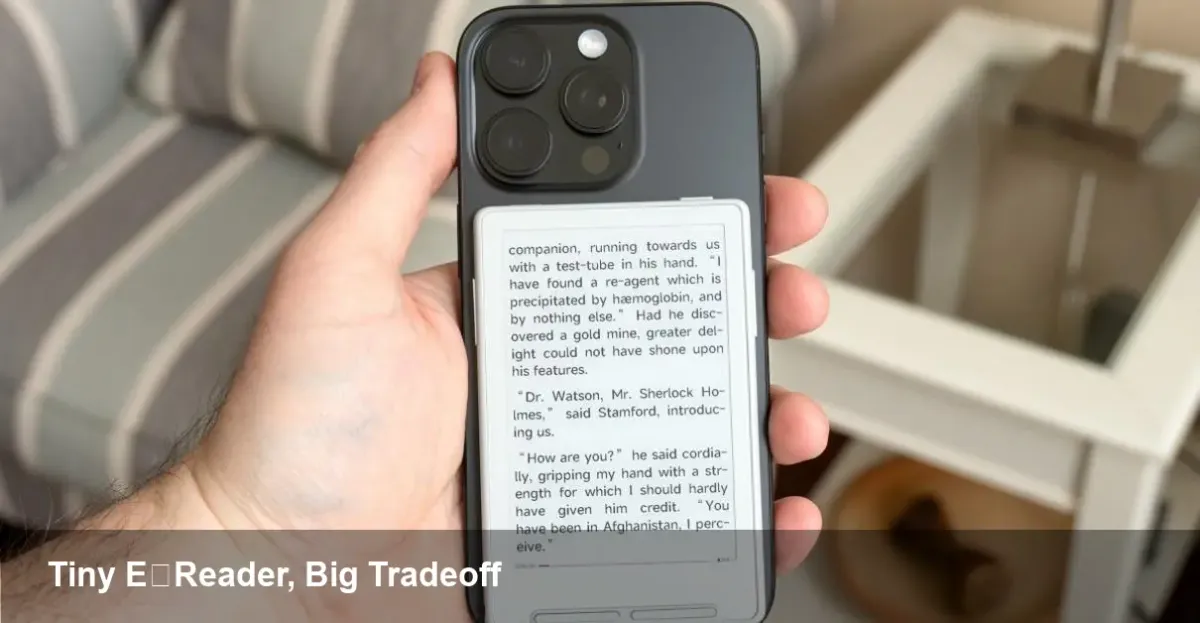
Think of the Xteink X3 as the difference between a postcard and a paperback. It’s never going to replace a 6‑inch e‑reader for long-form reading. The device prioritizes portability so heavily that the screen real estate becomes the defining constraint.
- Immediately readable: Short bursts—quotes, poems, microfiction, or reference snippets—work well. The X3 is great for quick checks and short-form reading.
- Poor for sustained reading: For novels, long non-fiction, or anything that relies on comfortable line length and paragraph flow, the tiny display forces tiny fonts or constant page flipping.
- Typographic compromise: Expect either very small type or extremely narrow lines. Both options degrade comprehension and slow reading pace.
The good news: E Ink still offers low power draw, so battery life should be solid compared with similarly tiny LCD devices. That makes the X3 convenient for long trips or for people who want a “backup library” in a wallet. The downside is the ergonomics—holding a device this small for extended periods is awkward and the reading experience becomes one of endurance rather than enjoyment.
How people might actually use it
Here are realistic scenarios where the Xteink X3 makes sense, and where it doesn’t.
Best use cases
- Commuters with short rides: If you read in 10–15 minute chunks, the X3 allows a few pages of disconnected reading without hauling a bigger device.
- Emergency or travel backup: Pack it as a lightweight fallback when you want to save luggage space but still have reading options.
- Reference card: Use it for bookmarks, recipes, checklists, language flashcards, or quick how‑tos you want offline.
- Novelty and conversation: It’s a fun gadget for people who enjoy talking about design extremities and minimal hardware.
Poor fit
- Long sessions: Nightstand reading or long-form focus work suffers badly.
- PDFs and fixed-layout documents: Anything that requires consistent line length or graphics is almost impossible to use comfortably.
- Accessibility needs: Small screens are inherently hostile to readers who need larger type or line spacing.
Developer and hacker opportunities
Tiny devices like the X3 can be fertile ground for creative repurposing. If the hardware and firmware are open enough, developers and hobbyists can turn the X3 into something else entirely:
- Glanceable notification display: Pair the X3 with a smartphone to show calendar items, messages, or a to-do list without needing the phone screen.
- Low-power status panel: Use it to show system metrics, server statuses, or build statuses in a home lab or small office.
- Pocket reference appliance: Install a stripped-down reader app focused on concise snippets—flashcards or summarized articles optimized for the small viewport.
Even if you’re not a maker, knowing that small devices can be repurposed may make the X3 more appealing—and extends its practical life beyond novelty.
Alternatives to consider
If you like the idea of pocketable reading but want better legibility, options at slightly larger sizes hit the sweet spot:
- 4–6 inch e‑ink devices: These keep portability while restoring acceptable line length and font size for sustained reading.
- Compact tablets: Small LCD or OLED tablets are thicker and heavier than the X3, but provide zooming and reflow for PDFs and fixed-layout content.
- Dedicated mid-size e-readers: Devices with 6‑inch displays remain the best balance for most readers—enough screen to read comfortably and still portable.
Buyers should ask: do I want to carry the smallest reader, or do I want a small reader that’s actually comfortable to use?
Business and product implications
The Xteink X3 highlights a recurring product design tension: extreme portability versus usability. For startups and product teams, three lessons stand out:
- User context drives value more than novelty. A gadget that solves real micro-problems—like a wallet-sized reference—can find a niche, but mass adoption requires satisfying the primary use case: comfortable reading.
- Software matters even more in tiny hardware. Because you can’t add pixels easily, smart layout, adaptive typography, and intelligent content summarization will determine whether a micro display is useful or frustrating.
- Accessory ecosystems extend value. Clip-on magnifiers, Bluetooth keyboards, or companion apps that push optimised content could meaningfully expand the device’s utility.
What the X3 means for the future of reading hardware
Small e‑ink devices are a reminder that the reading market can fragment into more purposeful, specialized products. Expect to see:
- More niche form factors catering to single-use workflows—think notification badges, dedicated recipe cards, or pocket dictionaries.
- A push toward better pairing between tiny displays and companion phones/apps, letting the handheld remain a glanceable endpoint while heavy interaction happens on a smartphone.
- Software-centric differentiation: as hardware converges at limits, UI and content handling become the primary battleground.
If you prize extreme portability and novelty, the Xteink X3 delivers exactly that. If your priority is comfortable, immersive reading, a slightly larger device will give you a much better experience. Treat the X3 as a specialist tool, not a general-purpose e-reader—its tiny footprint is its charm and its limitation.