Why the Quad Cortex Mini Matters for Guitarists

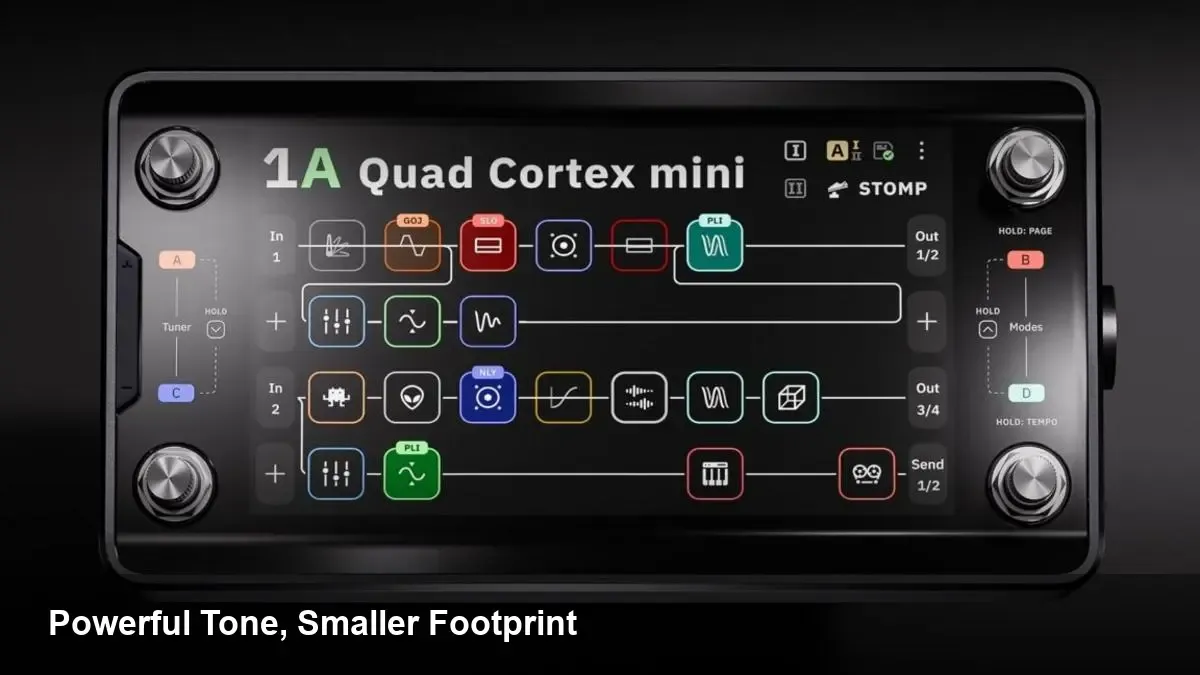
What the Quad Cortex Mini is and why it matters
Neural DSP's Quad Cortex established itself as a high-end, floorboard-grade amp modeler and effects platform — a powerful combination of amp profiling, cabinet simulation, and a flexible signal chain. The Quad Cortex Mini shrinks that concept into a smaller, more portable package without surrendering the core features that made the original attractive: accurate amp models, deep routing, impulse-response (IR) support and an ecosystem for sharing and editing presets.
For players who already value tone, the Mini represents a practical compromise: keep most of the Quad Cortex's sonic muscle while gaining a footprint that fits smaller pedalboards, studio desks and travel rigs.
Who benefits most — use cases
- Bedroom players and producers: The Mini makes it easier to get high-quality amp tones at low volumes. Use it as a desktop rig connected to monitors or headphones. Its compact size reduces desk clutter compared with a full floor unit.
- Gigging musicians with limited pedalboard space: If you need a cabless solution for smaller venues or want to combine the Mini with a small power amp or an active monitor on-stage, the device offers professional-grade tones without hauling a large unit.
- Session players and remote collaborators: Capture and share presets quickly. The Mini's profile/IR workflow enables consistent tone recall across different setups, which is useful when you must reproduce a sound for multiple sessions.
- Home studios and rehearsal spaces: Replace a mic'd amp with an IR-loaded DI signal directly into your interface. That reduces bleed and simplifies re-amping.
How it changes player and developer workflows
- Faster preset iteration: The Mini inherits the Quad Cortex’s graphical editing approach and preset architecture. That means developers and power users can tweak gain staging, EQ, and effects chains on the fly, then export or share snapshots. For session work this cuts setup time.
- Easier profile capture and auditioning: Capturing amp profiles and trying different IRs becomes less of a studio-only task. Players can profile amps in situ or audition third-party IRs from the road, compare them quickly and store favorites.
- Pedalboard-first rigs: Instead of rearranging a large floorboard, you can use the Mini as the centerpiece and add selected stompboxes around it. MIDI and expression routing still let you integrate hardware controllers for hands-on control during performance.
- Integration with DAWs and plugin ecosystems: The Mini's role as a hardware amp modeler is complimentary to plugin workflows. Record a DI track, run it through the Mini for monitoring, and later re-amp or apply the same preset inside the DAW using exported IRs or model parameters.
Practical considerations — features vs. size
What you gain
- Portability: Smaller, lighter and often bus-power-friendly, making travel and quick setups easier.
- Desk-friendly layout: A smaller footprint sits nicely next to an audio interface or amp head in a studio.
- Same signal-chain philosophy: Routing, effects order and IR loading remain familiar to Quad Cortex users.
What you trade off
- Fewer physical controls: Expect fewer footswitches or knobs. That pushes more interaction onto a touchscreen or companion app, which can slow hands-on adjustments live.
- I/O limitations: A compact unit typically means fewer ins/outs — fewer aux sends, loop options, or simultaneous outputs for multiple cabinet sims and monitor mixes.
- Potentially reduced I/O flexibility for complex rigs: If you run multi-amp setups on stage or need extensive loop integration, the Mini may require additional gear or creative routing.
Concrete scenarios — three quick setups
1) Small-stage gig
- Signal chain: Guitar -> Mini (amp model + IR) -> FOH via XLR direct out. Monitor with a small stage wedge or in-ear monitors. Use MIDI footswitch for preset changes.
2) Desktop recording
- Signal chain: Guitar -> Mini -> audio interface (line-in) / headphones. Record DI track for clarity and use the Mini’s preset for headphone monitoring and tracking feel.
3) Pedalboard hybrid
- Signal chain: Guitar -> pedals -> Mini -> power amp/small combo or PA. Use the Mini for amp/cab/board effects while keeping favorite analog pedals in the front.
Performance, tone and reliability
A compact amp modeler must balance compute power and thermal constraints. The Mini aims to preserve the sound quality of its larger sibling: accurate amp profiles, responsive dynamics and realistic cabinet/room simulations. For most players the difference between the full-sized Quad Cortex and the Mini will be imperceptible in real-world settings, especially when using high-quality IRs and well-configured presets.
That said, studio engineers and tone purists who demand simultaneous multi-amp splits, numerous isolated outputs or wall-of-rack routing may find the Mini limiting compared to larger rigs.
Price and value proposition
The compact form factor usually comes at a lower sticker price than the full floor unit, making advanced modeling accessible to more players. The real value comes from time saved in setup, consistent tone recall and fewer moving parts on the road. For touring acts on a budget or hobbyists who want pro sound without the bulk, the Mini is a pragmatic option.
What this means for the market — three implications
1) Democratization of pro tone: As compact units compress high-end modeling into smaller, cheaper boxes, more players can access studio-grade sounds without large investments in gear or truck space.
2) Pedalboard rethinking: Smaller modelers encourage hybrid rigs that combine digital modeling with a few choice analog pedals. That shifts design emphasis toward interoperability (MIDI, expression, loop sequencing).
3) Faster firmware-driven evolution: With fewer mechanical controls, manufacturers will lean on software updates and cloud profile sharing to add features. Expect the Mini to evolve more through firmware than hardware revisions.
Practical recommendation
If you value portability and want a professional-quality amp modeler without the bulk of a full floor unit, the Quad Cortex Mini-style devices are worth considering. They shine in rehearsal rooms, small stages and home studios — and they simplify getting a consistent tone across different environments. For those who need extensive I/O, rack-level routing or a large bank of footswitches, pair the Mini with a small I/O expander or consider a larger unit.
Whether you’re a gigging musician, session player or producer, a compact Quad Cortex-style amp modeler makes day-to-day tone work faster and lighter. It’s a practical tool that nudges more guitarists toward hybrid digital/analog rigs and streamlines how we capture, recall and share tones.