Why Samsung Just Sweetened the Galaxy S26 Ultra Deal

A quick change to Samsung’s pre-order playbook
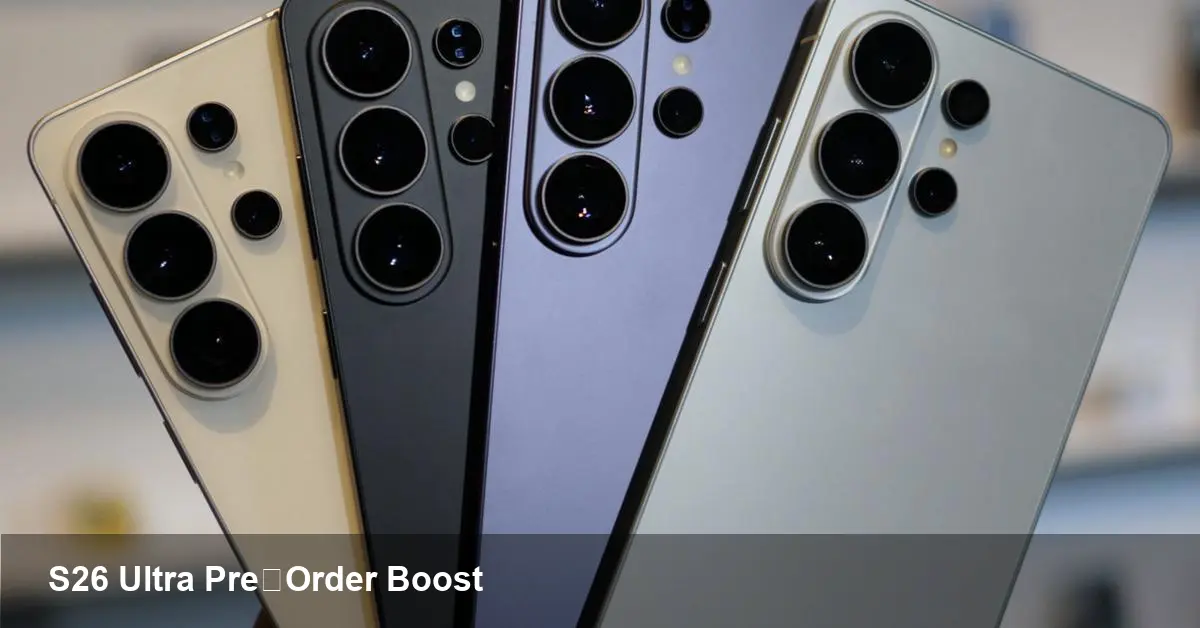
Samsung quietly improved its early purchase incentives for the Galaxy S26 Ultra by adding a $30 credit to existing promotions. The tweak increases some trade-in-backed discounts to as much as $980 off — a meaningful sum for shoppers weighing whether to upgrade immediately or wait.
This kind of rapid adjustment isn’t unusual in the flagship phone market, but it’s worth unpacking what the extra credit means for buyers, developers who test on flagship hardware, and businesses that buy devices in volume.
What the added $30 actually does
The $30 is an incremental credit on top of the trade-in and promotional bundles Samsung was already offering at pre-order. In practice that means: if you were eligible for a trade-in valuation and other qualifying promotions, the new credit can push the total discount up to a figure near $980.
Important to know:
- That headline $980 reduction typically depends on trade-in eligibility (model, condition) and any carrier or retailer activation requirements.
- The $30 bump may appear as an instant store credit, a billing credit with a carrier, or a promo card depending on where you buy.
- If you don’t have an eligible device to trade in, the maximum discount number won’t apply to you — you’ll still see smaller promotional savings.
Who benefits most
- Consumers with recent flagship devices: If you own a relatively new Samsung phone or another high-value device, trade-in values are high enough that this extra credit tips the math in favor of upgrading now.
- Early adopters: People who want the fastest access to the S26 Ultra’s camera, display, or chipset improvements will get a better price by pre-ordering with the promo.
- App developers and QA teams: Buying a flagship during a brief promotion reduces hardware costs for teams that need on-hand high-end test devices.
Real-world scenarios
- Upgrade scenario: A buyer with a qualifying trade-in can combine the trade-in value, carrier offers (if any), and Samsung’s new $30 credit to shave nearly a thousand dollars off the S26 Ultra’s list price — making the street price comparable to last year’s non-Ultra flagships.
- Developer purchase: An indie developer who needs an Ultra for camera-specific features or performance testing could buy during the promotion and defer equipment costs by claiming the trade-in and credit.
- Enterprise procurement: Companies standardizing on premium devices for executives or field staff should run the numbers — the short-term discount can lower capital outlay, but buyback and lifecycle management plans still matter.
How to avoid surprises when you pre-order
- Read the fine print on trade-ins. Condition, reset procedures, and receipts of ownership can affect final credit.
- Confirm how the $30 is delivered. Is it immediate, or a bill/statement credit over months? Accounting for this affects total cost of ownership.
- Compare carrier and retailer bundles. Sometimes a carrier will match or exceed manufacturer credits if you commit to a plan or trade-in there instead.
- Check return and repair policies. Promotions don’t always change standard return windows or warranty terms, but activation or trade-in steps can complicate returns.
What this says about the market
Flagship phone launches are as much about volume pacing and inventory management as they are about features. A quick promotional lift like this suggests a few possibilities:
- Competitive pressure: Apple and Google often respond to pricing and availability moves, and Samsung may be nudging demand before competitors launch summer promotions.
- Pricing elasticity: Samsung is testing how sensitive buyers are to small additional incentives — $30 is not huge, but packaged with a trade-in it can change borderline decisions.
- Services bundling: As hardware margins shrink, getting users into Samsung’s ecosystem (apps, cloud storage, subscriptions) becomes more important. Promotions can accelerate that onboarding.
Considerations for developers and product teams
- Device access: Lowered purchase costs make it easier to include the latest Ultra in device farms — beneficial for camera-heavy apps, AR experiences, or performance testing.
- OS and API timelines: Buying a day-one device doesn’t guarantee earlier access to long-term OS updates — check Samsung’s announced update commitments if that matters for longevity.
- Prototype parity: If your app relies on flagship-specific sensors (LiDAR-equivalent, enhanced telephoto modules), getting an Ultra at a discount helps keep testing environments representative of high-end user hardware.
Risks and limitations
- Conditional savings: The maximum discount assumes trade-in and often activation conditions. Not everyone will hit the $980 figure.
- Short-term promotions: These credits can be transient; waiting a week could mean different offers or carrier counters.
- Resale & depreciation: Even with a generous trade-in, consider how quickly the resale value of today’s flagship will fall in 12–18 months.
What to do if you’re on the fence
If you need the S26 Ultra for work or specific capabilities (advanced imaging, compute-heavy workloads, or display tech), the extra credit improves the upgrade ROI — proceed but verify trade-in details. If you’re a casual user whose current phone is meeting needs, holding off for reviews and longer-term price drops may be smarter; Samsung and carriers typically continue to offer competitive deals into the months after launch.
Promotions like this are part pricing strategy, part psychology: a small extra credit can close the decision for many buyers. If you’re chasing one of the best pre-order prices, read the terms, compare offers, and move quickly when the true total discount checks out for your situation.