Why Samsung Is Rethinking Ultra‑Thin Smartphones

A quick recap
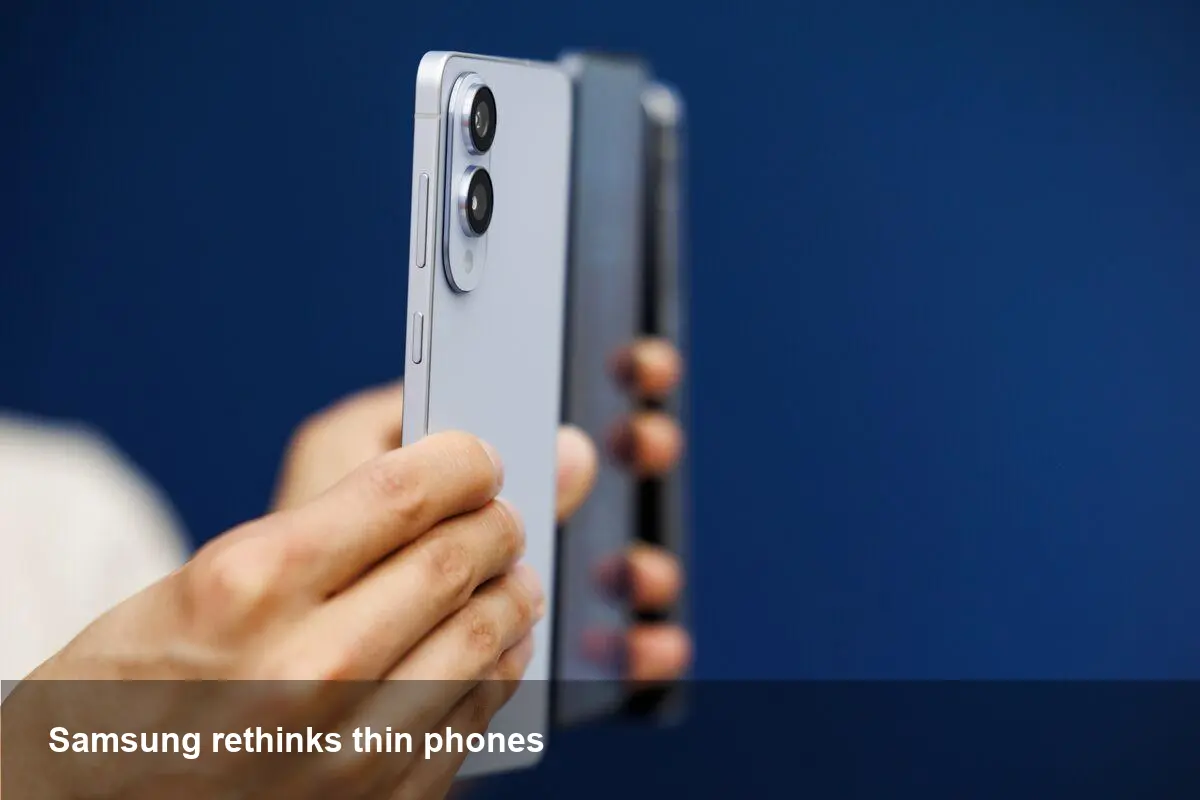
Last year Samsung shipped the Galaxy S25 Edge — an attempt to push mainstream flagship design toward an ultra‑thin profile. The model arrived into a market that’s also been watching rumors of an “iPhone Air” and experimental multi‑fold formats (sometimes called trifold designs). Samsung’s operations leadership has since signaled the company is not locked into repeating that exact experiment: it will weigh customer response, channel performance, and engineering trade‑offs before committing to another ultra‑thin handset.
That announcement matters beyond headline buzz. It reflects a larger pivot in hardware strategy at a time when manufacturers juggle design, battery life, component costs, and the rising momentum of foldables.
What the Galaxy S25 Edge taught Samsung — and the industry
The Edge was a technical showcase: sleeker bezels, a shallower chassis, and a focus on pocketability and premium finish. But thinner phones come with unavoidable compromises:
- Battery capacity shrinks or designers must accept unusual batteries that complicate repairs. Less thermal mass means higher risk of thermal throttling under sustained loads.
- Mechanical trade‑offs affect camera modules and optical stabilization, which either increases component cost or reduces performance.
- Structural rigidity and drop resistance become harder to guarantee without heavier frames or new materials.
Sales for the Edge were noticeably lower than some of Samsung’s other recent handsets, which has prompted internal reappraisal. Lower unit volumes can amplify per‑device costs because the bill‑of‑materials and development amortization don’t spread across as many phones.
Practical implications for developers and designers
If you build mobile apps, games, or hardware accessories, a shift away from ultra‑thin designs changes priorities.
- Battery and thermal budgets: Apps optimized for the S25 Edge’s thin form relied on aggressive power profiles. Expect future mainstream devices to prioritize larger batteries and software power efficiency instead. That means aggressive CPU/GPU scaling, adaptive refresh rates, and tighter background task policies will be the cross‑device norm.
- Camera expectations: For camera‑heavy apps, test across devices with different optical stabilization and sensor sizes. Ultra‑thin phones may rely more on computational imaging to make up for smaller sensors.
- Accessories and cases: Thinner phones drive a market for specialized slim cases and magnetic mounts. If manufacturers pull back from ultra‑thin builds, accessory makers should diversify tooling to fit both thin and slightly thicker form factors.
- Industrial design constraints for hardware peripherals: If you’re building external battery packs, clip‑on modules, or game controllers, don’t assume future Samsung flagships will maintain an ultra‑thin profile — design adaptable mounts and connection points.
Business and product strategy impacts
For Samsung and its competitors, a decision to pause or double down on ultra‑thin phones affects retail, channels, and product roadmaps:
- Product line layering: The S‑series needs to balance headline‑grabbers (slim or flashy designs) with pragmatic sellers (longer battery, lower replacement costs). Expect the company to treat ultra‑thin devices as niche or limited runs unless demand scales.
- Cannibalization with foldables: Foldables — especially clamshell and book‑style devices — are steadily maturing. If foldables continue to improve battery, durability, and price to performance, they could absorb the customer segment that values novelty and compactness more than extreme thinness.
- Supply chain economics: Lower volumes of a specialized thin model increase unit cost. Suppliers for thin batteries, ultra‑thin displays, and advanced mechanical parts need consistent orders to maintain margins; irregular demand signals will push pricing higher or cause suppliers to deprioritize those parts.
- Marketing ROI: Investing in a thin flagship with modest consumer uptake can be less profitable than incremental innovation in software services, camera features, or ecosystem integrations.
Concrete scenarios to plan for
1) An AR startup targeting high‑end Samsung phones: Focus on thermal and battery efficiency. Prioritize frame‑rate adaptive rendering and background CPU culling; validate on both slim and thicker flagship models.
2) An enterprise rolling out 10,000 devices for field workers: Durability, battery life, and repairability will likely outrank an ultra‑thin aesthetic. Make procurement decisions that favor serviceability over form.
3) An accessory maker: Invest in adaptable tooling and modular packaging so a case or mount supports a range of thicknesses and camera bump sizes.
Pros and cons of pursuing ultra‑thin flagships (for manufacturers)
Pros:
- Differentiates a line visually against rivals.
- Can attract media attention and loyal early adopters.
Cons:
- Higher engineering and manufacturing cost per unit.
- Potential lower mass‑market demand and increased returns due to fragility.
- Limits battery capacity and thermal headroom, which affects app performance and user satisfaction.
Three forward‑looking insights
1) Form‑factor innovation will be software‑driven as much as hardware‑driven. Improvements in computational photography, machine learning for power management, and adaptive display tech can deliver perceived gains without shaving millimeters off a chassis.
2) Foldables will capture the imagination — and likely the premium margin — if they continue to converge on durability and acceptable cost. That doesn’t kill slabs or thin phones, but it reshapes where OEMs allocate R&D and marketing dollars.
3) Sustainability and serviceability are rising decision factors. Regulators, enterprise buyers, and environmentally conscious consumers push manufacturers to favor designs that are repairable and have longer useful lives over ephemeral thinness.
What developers and product leaders should do next
- Expand test matrices to cover a range of battery sizes and thermal profiles, not just the slimmest models.
- Build flexible accessory strategies and avoid single‑form assumptions.
- Watch supply chain signals: consistent component orders and supplier commitment are precursors to more device variants.
Samsung’s cautious stance on a follow‑up to the Galaxy S25 Edge is a reminder that cutting millimeters doesn't always translate to mass appeal. For builders — from app developers to accessory makers — the sensible approach is to design for variability: optimize for power and thermals, validate camera features across a broad device set, and make products flexible enough to fit whatever form factors the market decides to favor next.