Why Lenovo’s Modular Laptop and Foldable Handheld Matter

New prototypes, old questions
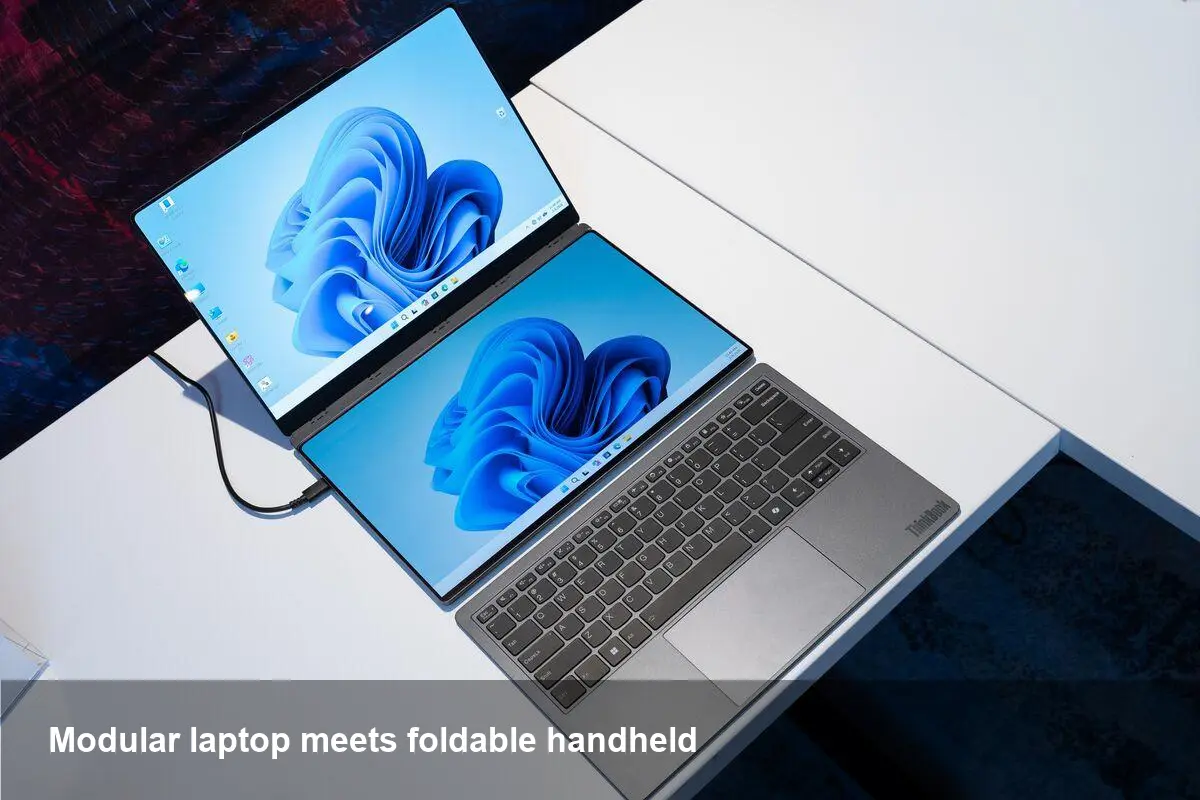
Lenovo recently released proof-of-concept hardware that pushes two familiar ideas forward: a modular laptop built around two displays and detachable I/O, and a portable gaming device with a folding screen. These aren’t products shipping to stores — they’re engineering statements that illuminate where laptop and handheld design could go next.
Beyond the headline aesthetics, both concepts address recurring trade-offs: flexibility versus complexity, repairability versus integration, and the software work needed to make novel hardware feel seamless. For anyone building hardware, writing apps, or planning a device strategy, these prototypes are worth studying.
What the prototypes show
The first concept pairs two displays in a single chassis and allows peripheral ports to be removed and reattached as modules. The second is a compact gaming handheld that uses a folding OLED to reduce footprint while preserving a large play surface when open.
Key characteristics:
- Detachable ports and replaceable external modules for the laptop concept, suggesting a path to easier upgrades and custom configurations.
- Twin-display layout that can be used as an extended workspace or as independent panels for different tasks.
- A folding display on the handheld that reduces device width for transport while offering a contiguous screen in play mode.
- Proof-of-concept status: these devices show engineering direction, but software and hardware refinement would be needed before commercial release.
Practical user scenarios
Think of how these concepts could change real-world workflows.
- A freelance video editor traveling light could carry a slim laptop shell and attach a high-speed Thunderbolt-style module when back at a client’s office for fast external RAID access.
- An enterprise field team could swap in a secure smart-card module or an extra Ethernet port for deployments that require local connectivity, then remove it for travel to reduce weight and attack surface.
- A developer testing multi-screen applications could treat the laptop’s twin displays as a compact testbed for window management, drag-and-drop workflows, or canvas-type apps that benefit from spread-out UI.
- A commuter gamer can fold the handheld for pocketable transit, then open it on the train to continue a session with controller accessories and a full-sized display.
These are small changes in isolation, but combined they can shift how people choose hardware: from monolithic laptops that try to be everything to configurable platforms optimized for specific tasks.
Developer and software implications
Hardware innovations only become useful when software adapts. These prototypes highlight a few engineering responsibilities:
- Adaptive UI frameworks: Applications must respond smoothly to changes in screen topology — splitting, folding, or moving content across two displays. Developers will need to test layouts in more device states and handle unexpected mid-session changes.
- Input and device discovery: Hot-pluggable I/O requires robust device enumeration and graceful fallbacks. Apps should tolerate sudden disappearance of external storage or network interfaces without data loss.
- Performance and power management: Swapping modules or changing display modes should trigger policies that rebalance CPU/GPU power, thermal budgets, and battery expectations without surprising the user.
- Game state persistence: For a foldable handheld, games must handle interrupted sessions (fold/unfold, short swaps to background tasks) while keeping controllers and touch input consistent.
For platform teams at Microsoft, Valve, or game engine providers, these prototypes suggest more testing matrices and new API surface for foldable and modular features.
Engineering trade-offs to watch
Modularity and foldables introduce fresh constraints.
- Reliability vs. replaceability: Detachable ports make upgrades and repairs easier, but each physical connector is a potential point of failure and adds mechanical complexity.
- Thermal design: Modular attachments could change airflow paths. Designers must ensure performance modules don’t cause throttling when attached or detached mid-session.
- Weight and cost: Additional connectors, locking mechanisms, and a reinforced chassis add weight and BOM (bill of materials) cost. That affects where a modular device sits in the market.
- Software fragmentation: If modular capabilities are optional, developers may need to support multiple hardware configurations — increasing QA time and potential compatibility issues.
Any company shipping such devices will need to balance novelty with robustness; early adopters may accept quirks, mainstream buyers will not.
Market positioning: who benefits?
- Creatives and professionals who need targeted expansion (fast storage, dedicated I/O) could be early adopters of a modular laptop.
- Gamers and mobile-first users stand to gain from foldable handhelds that expand into larger displays without sacrificing portability.
- Enterprises that value secure, swap-in modules (for authentication or specialized radios) may appreciate modular designs for lifecycle management.
But both concepts will compete with a growing ecosystem of capable thin-and-light laptops, tablets, and single-piece handhelds like existing handheld PCs and console hybrids. Success will depend on delivering reliable software and clear, demonstrable value for the extra mechanical complexity.
Broader implications and what to watch next
1) Repairability and lifecycle economics: If modular ports truly make upgrades and repairs easier, OEMs could extend usable device life and reduce e-waste — a meaningful selling point for corporate procurement and environmentally conscious consumers.
2) New developer tooling and standards: Expect pressure on platform vendors to formalize APIs for foldable screens and hot-swappable modules so apps behave predictably across hardware variations.
3) A potential shift toward configurable hardware: If modularity proves viable at scale, we may see device lines that mix-and-match compute, I/O, and battery modules to create tailored systems — a middle ground between bespoke desktops and fixed laptops.
A pragmatic view for buyers and builders
These prototypes are valuable directions, not finished products. Companies should treat them as signposts: product teams need to plan for more dynamic hardware topologies, software teams must expand test coverage, and buyers should look for demonstrations of long-term reliability and software support before adopting modular or foldable devices at scale.
If you’re a developer, start thinking about resilient UI and input handling for changing screen states. If you manage hardware purchasing, ask vendors about serviceability, warranty implications of removable modules, and how firmware updates will be handled across configurations.
Lenovo’s concepts don’t rewrite the rules overnight, but they push conversations about upgradeability and portable gaming forward. The real test will be how manufacturers resolve the inevitable trade-offs between convenience, durability, and cost as these ideas move from lab to store shelf.