Why Google’s Screenless Fitbit Band Matters for Wearables

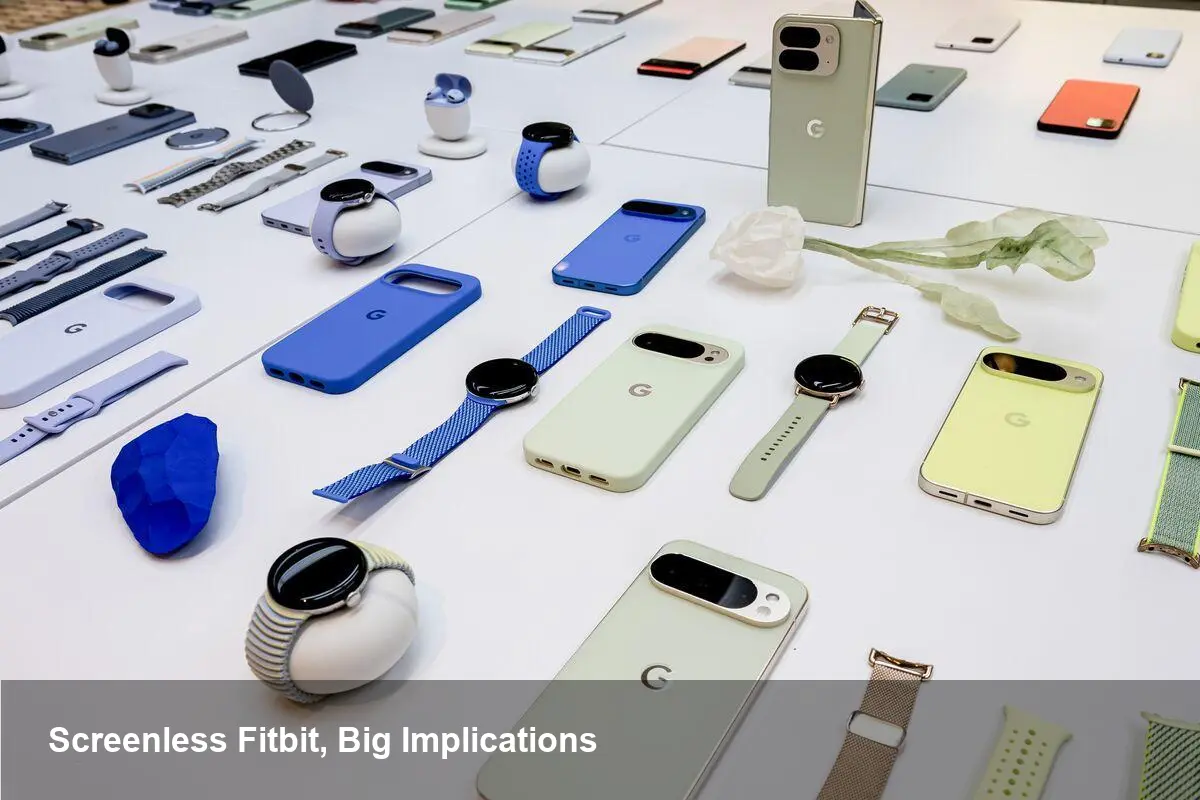
A quiet fitness band with loud implications
Google is building a screenless Fitbit-style band aimed at the growing class of biometric-first wearables popularized by Whoop and Oura. At first glance it’s just a slimmer form factor without a display; under the hood it’s a signal that Google intends to compete where long battery life, continuous health sensing, and subscription services intersect.
The backstory in a paragraph
Google finalized its acquisition of Fitbit in 2021, inheriting a recognizable brand, a hardware supply chain, and years of fitness-tracking experience. In contrast, Whoop and Oura focused on minimal hardware that collects physiological signals continuously and funnels insights through subscription apps. The new screenless Fitbit band blends Fitbit’s brand reach with that minimalist, sensor-first philosophy.
Why a screenless design now?
- Battery life and comfort: Removing a display reduces power draw and bulk. That enables multi-day battery life and a more comfortable 24/7 wear experience—crucial for sleep and recovery analytics.
- Sensor focus: Without UI constraints, the device can dedicate space and power to more accurate photoplethysmography (PPG) sensors, skin temperature channels, and algorithms for heart rate variability (HRV) and respiration.
- Market differentiation: Apple and Samsung compete on full-feature smartwatches; screenless bands carve a distinct niche focused purely on health tracking and coaching.
Who wins and who loses
- Users who prioritize recovery and sleep: Athletes and wellness users who need continuous HRV, sleep staging, and strain metrics benefit most. A screenless band is unobtrusive during sleep and workouts.
- Casual users: People who want notifications, maps, and apps will still prefer smartwatches—this product won’t replace devices that double as phones on the wrist.
- Competing startups: Whoop and Oura have been successful by pairing simple hardware with recurring revenue subscriptions. Google’s move ups the competitive pressure and may force price adjustments or feature parity efforts.
Practical scenarios
- Athlete recovery planning: A pro-cyclist wakes up, checks the app, sees HRV-based readiness scores, and chooses an easy spin instead of a threshold session—no display on the band was needed to collect the data.
- Remote employee wellness: A corporate wellness program issues bands to employees to track sleep consistency and stress patterns, feeding anonymized metrics into company wellness dashboards.
- Clinical trials and research: Universities recruit participants who wear the band continuously for weeks; the longer battery life lowers participant burden and improves data completeness.
What this means for developers and startups
- Opportunity: If Google exposes APIs to access raw or processed biometrics, third-party developers can build specialized coaching, mental-health, or clinical research apps that leverage continuous data streams.
- Technical expectations: Developers should plan for high-volume time-series data, privacy-preserving architectures, and on-device preprocessing to reduce upload costs and latency.
- Integration: Expect pressure to support major health ecosystems (Google Fit, Fitbit app, and possibly compatibility bridges to Apple Health). Apps that can fuse wearable data with context (calendar, location, workout logs) will deliver richer insights.
Data privacy and regulatory angles
Health data is sensitive and already attracted scrutiny when Google acquired Fitbit. A device that collects continuous physiological signals deepens those concerns. Businesses and developers will need to:
- Be transparent about data use and sharing.
- Implement local processing and allow users to opt out of cloud uploads.
- Anticipate regulatory attention—especially where biometric data is used in employment or insurance contexts.
Business model considerations
Whoop and Oura built recurring revenue through subscriptions that bundle coaching and analytics. Google can pursue several models:
- Hardware-first with optional subscription: sell the band at a modest price and offer premium analytics behind a paywall.
- Platform play: leverage Fitbit’s installed base to upsell integrated services within Google’s ecosystem.
- Enterprise sales: position the band for corporate wellness and clinical research contracts where volume sales are attractive.
Each choice impacts adoption. A low-cost hardware model with an optional paid tier can accelerate user growth; a subscription-only approach risks alienating consumers who value one-time purchases.
Limitations and trade-offs
- Accuracy vs. form factor: Smaller devices may still struggle with certain measurements (e.g., accurate SpO2 during movement) compared with bulkier devices or chest straps.
- Lock-in: If advanced metrics are gated behind proprietary cloud algorithms, users and researchers may face vendor lock-in.
- Competition from full smartwatches: Apple and Samsung keep adding health features. A screenless band must deliver clear, unique value to earn a dedicated audience.
Three implications for the next few years
- Consolidation of the wearable health market: Big platforms (Google, Apple) will continue to absorb niche players or replicate their features, squeezing smaller startups that can’t match scale.
- Smarter on-device inference: To preserve battery and privacy, expect more signal processing and preliminary analytics on-device rather than in the cloud.
- More regulated use cases: As wearables play larger roles in wellness programs and clinical studies, regulators will tighten guidance on biometric data handling and claims about health outcomes.
How to think about adopting one
If you’re a developer or startup: design for interoperability and express consent, and avoid dependencies on proprietary, closed analytics. If you’re a product manager: focus on the unique user journeys enabled by 24/7 sensing—recovery coaching and sleep-first experiences are natural fits. For employers and researchers: evaluate battery life and data export policies closely before rolling out at scale.
Google’s screenless Fitbit band is more than a new product category at the edges of the market; it’s a strategic push into continuous health sensing that will shape partnerships, privacy rules, and the kinds of applications developers build. Watch how Google positions pricing and data access—those choices will decide whether the device democratizes recovery-focused wearables or props up another walled garden.