What Apple’s Mac Pro Exit Means for Pros

A quick primer: the Mac Pro's place in Apple's lineup
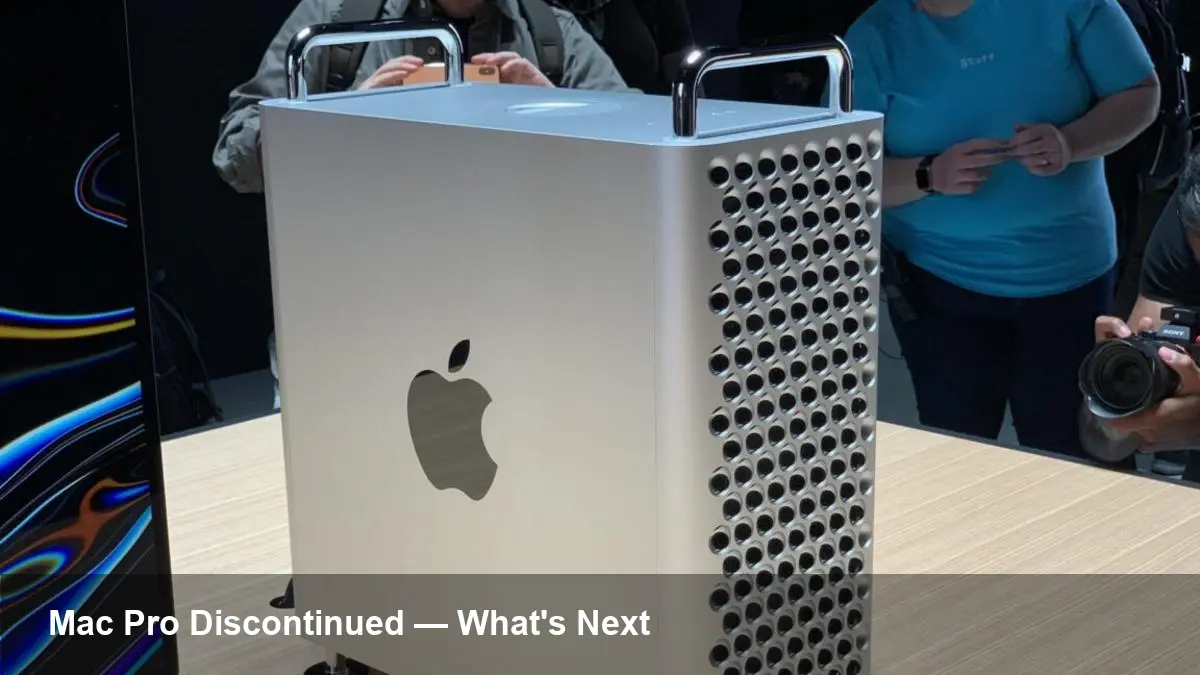
Apple's Mac Pro has long represented the company's answer to the high-end workstation market: a desktop built for video editors, 3D artists, audio engineers and engineers who need raw performance and expandability. Historically Apple has shipped tower systems with swappable components and lots of PCIe lanes; the transition to Apple Silicon and the company's focus on highly integrated systems changed that equation.
Recently Apple pulled the M2 Ultra Mac Pro from sale and said it does not plan a direct replacement. That move closes a chapter on the modern Mac Pro and forces teams that rely on Apple's top-tier desktop to rethink hardware, workflows and procurement.
Why this matters beyond fanfare
For many creative and technical teams the Mac Pro was more than a badge — it was a predictable platform that supported PCIe cards, multi‑GPU workflows (in the old Intel era), third‑party accelerator cards and massive local storage options. Even though Apple’s newer M-series machines (Mac Studio, Mac mini, MacBook Pro) deliver exceptional performance-per-watt, they trade modularity for integration: memory is soldered, PCIe expansion options are limited, and external accelerators are constrained by the platform.
Removing the Mac Pro from the product stack is significant because it signals Apple doesn’t see a large enough or strategic enough market to continue supporting a modular, upgradeable professional tower under the Apple Silicon design principles.
Practical impact: five scenarios to consider
- Video post-production studio with large ProRes projects: If your pipeline depends on multi-terabyte RAID cards installed internally, the absence of a new Mac Pro means either migrating storage workflows to network-attached storage (NAS) or external Thunderbolt chassis, or retaining older Intel Mac Pros for as long as possible.
- VFX and 3D shops with specialized PCIe accelerators: Many third-party accelerators haven’t been able to move from PCIe to native Apple Silicon form factors quickly. Studios will have to evaluate switching to Linux/Windows workstations for those workloads, or moving heavy rendering to cloud render farms that support non-macOS nodes.
- Independent audio professionals using DSP cards: Audio pros who rely on internal DSP cards face a tough choice: continue using legacy Intel-based towers, adopt external DSPs with compatible drivers, or shift to plug‑in and software-based DSP running natively on M-series chips.
- App developers and build farms: For teams that run macOS-based CI, Apple’s decision accelerates the move toward cloud-hosted macOS build agents (vendors offering M-series hardware or managed Intel hosts). Expect increased demand for hosted Mac infrastructure and for services that can emulate or test across architectures.
- Enterprises procuring fleets: Large buyers should pause any long-term Mac Pro refresh plans and map critical dependencies. Apple’s roadmap now favors sealed, upgrade-limited hardware — procurement policies and lifecycle replacement budgets must reflect that.
Short-term tactical steps for teams
- Audit dependencies: List all hardware and workflows that require internal PCIe, user-accessible RAM upgrades, or other modular features. Those are the components most at risk.
- Prioritize migration: For software that runs fine on Apple Silicon, plan migrations to Mac Studio or M-series MacBook Pros. For workflows tied to legacy cards, create a migration runway — either find external hardware equivalents or set up a mixed OS strategy.
- Evaluate cloud options: For bursty or massively parallel workloads (rendering, CI), compare the economics of on-prem Intel rentals vs cloud render/compute providers that support your toolchain.
- Extend lifecycles safely: If you have Intel Mac Pros, assess maintenance contracts and parts availability. These machines may become the critical stopgap for certain workloads for several years.
Developer and software implications
Apple’s move sharpens the need for developers to optimize software for Apple Silicon. That means ensuring binaries are universal or native M-series builds, validating performance on unified memory architectures, and testing across both architectures if customers still run Intel hardware. For teams building plugins or drivers that historically relied on kernel extensions or PCIe devices, this is a forcing function to re-architect toward user-space frameworks, cloud services, or cross-platform alternatives.
If your CI relies on on-prem Mac towers, you’ll see increasing pressure to move to hosted macOS CI services — particularly those offering M-series build agents. Expect the ecosystem of M-series device hosting and orchestration to grow quickly.
Alternatives worth evaluating now
- Mac Studio (M-series): Delivers a lot of the raw compute punch of M2 Ultra hardware with a smaller, sealed footprint. Many pros will pivot here for single-system performance.
- External expansion: High-performance Thunderbolt chassis for GPUs and storage can bridge some gaps, though performance and driver support vary compared to native PCIe.
- Windows/Linux workstations: For workflows that desperately need modular PCIe and native accelerator cards, a platform shift can be the most pragmatic approach.
- Cloud desktops and render farms: For episodic or scaling workloads, cloud providers or specialist Mac hosts can reduce upfront capital costs and give access to newer hardware.
Three implications looking forward
- Third parties and cloud providers have a role to play: As Apple cedes some aspects of the modular workstation market, vendors who provide hosted M-series Macs or external acceleration hardware will find demand.
- Software will tighten around optimization: Vendors of pro software will accelerate M-series optimizations and may pivot to cloud-rendered or hybrid architectures to bypass hardware fragmentation.
- A hardened split in pro markets: Organizations that prioritize modularity and internal expansion will increasingly standardize on Windows/Linux workstations, while Apple will continue to court creatives who value an integrated hardware–software experience.
Apple’s decision to stop selling the Mac Pro is less about eliminating performance and more about the company’s product philosophy: integrated, tightly controlled machines rather than modular, user-serviceable towers. For many pros, that creates friction; for others it’s an opportunity to simplify and modernize workflows. Audit your dependencies now and begin testing alternatives — the next few quarters will determine whether you refactor pipelines, adopt hybrid cloud, or keep aging Intel towers operational a little longer.