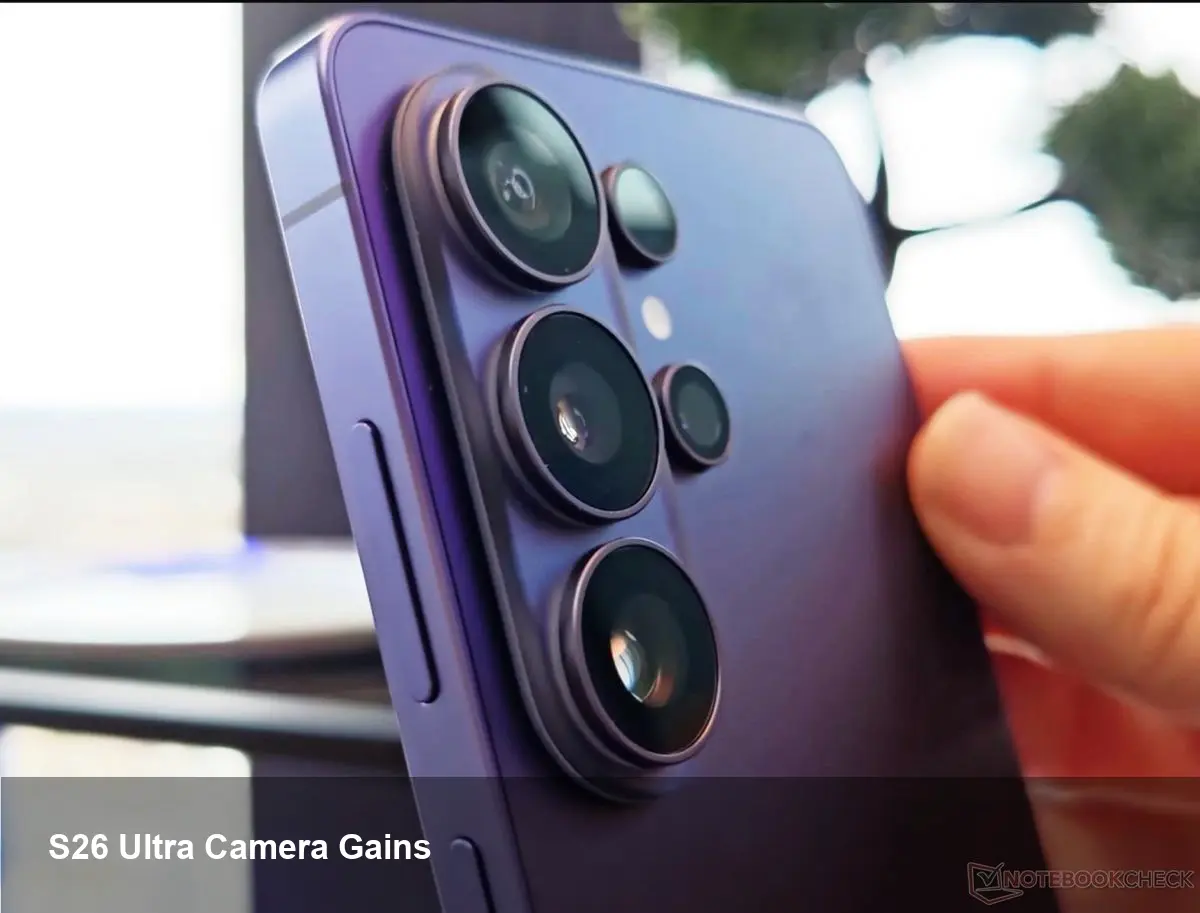
Samsung Galaxy S26 Ultra: Camera Step Forward, Not Leap

What changed — and why it matters
DxOMark's initial testing of the Samsung Galaxy S26 Ultra shows a meaningful improvement over last year's S25 Ultra in several shooting situations, but it still doesn't match the image quality of the iPhone 17 Pro. That summary sounds simple, yet it tells a more nuanced story about how incremental hardware changes plus smarter software tuning can shift daily photo performance without rewriting the competitive landscape.
Samsung's Galaxy S line has been a pace-setter for flagship Android imaging for over a decade. The S26 Ultra represents the company's latest attempt to close the gap with Apple's computational photography pipeline. On paper the S26 Ultra didn't introduce a wholesale redesign of sensors or lenses; instead most gains appear to come from refined image processing, per-scenario tuning, and modest optical/telephoto tweaks. DxOMark's verdict — stronger results in many real-world scenes but lingering weaknesses — aligns with that approach.
Real-world examples: where you'll notice the difference
Here are practical scenarios that illustrate what the S26 Ultra improves and where it still struggles.
- Low-light street photography: The S26 Ultra's night and low-light algorithms produce cleaner shadows and better subject separation compared with the S25 Ultra. Images retain more detail in shadowed areas and show reduced noise at higher ISO equivalents. For users who photograph nightlife or evening cityscapes, the new model will feel like an upgrade.
- Telephoto and zoom shots: Periscope-style zooms benefit from sharper contrast and fewer color shifts in mid- to long-range framing. While the hardware difference versus the S25 might be modest, improved stabilization and sharpening reduce blur on handheld shots at higher focal lengths.
- Portraits and subject isolation: Tuning improvements produce more natural skin tones and fewer edge-detection artifacts in many portrait captures, particularly in mixed indoor lighting. That said, occasional haloing or background handling still appears in complex hair or glass edges — showing there's more to solve at the algorithmic level.
- HDR and high-contrast scenes: Here the S26 Ultra makes gains over its predecessor in retaining highlights while rescuing midtones, but DxOMark suggests the iPhone 17 Pro remains better at consistent dynamic range handling across varied scenes. In practice this means some S26 Ultra shots still require a manual exposure tweak or post-processing.
- Video capture: Improvements in stabilization and noise control are noticeable, especially in handheld 4K clips. However, the color science and exposure consistency still lag the tight, filmic look that Apple often delivers out of the box.
What developers and content creators should care about
For app makers, image-processing tool developers and mobile creators, the S26 Ultra's changes have practical implications:
- Expect reliance on computational layers: Samsung's gains are heavily software-driven. Apps that perform heavy post-processing or use camera2/CameraX capabilities may need to adjust their pipelines to account for different RAW behavior and in-camera denoising.
- Revisit tone-mapping and editing presets: Presets tuned for S25 Ultra images may produce different results on the S26 Ultra because base JPEGs and default color science have shifted. Offer device-specific profiles in photography apps for better out-of-the-box editing.
- Test across focal ranges: With telephoto improvements, third-party apps that stitch panoramas, perform optical-character-recognition (OCR) or run vision-based inference on zoomed images should retest accuracy across closer and farther focal distances.
- Video stabilization assumptions: Improved stabilization changes motion profiles. If your app uses motion metadata for AR/VR features or sensor fusion, validate that drift and micro-jitters behave as expected on the S26 Ultra.
Business and product implications for Samsung
Samsung's strategy here looks pragmatic: improve user-observed scenarios without committing to a costly hardware overhaul. For the company, this brings a few advantages:
- Lower engineering cost for noticeable UX gains: Tuning and software can be iterated faster and cheaper than swapping sensors or optics.
- Marketing momentum: Showing measurable DxOMark improvements gives Samsung a credible talking point for campaigns and comparison charts.
- Competitive pressure on Apple… but only partially: While the S26 Ultra narrows gaps in certain shots, the iPhone 17 Pro still wins for consistency and end-to-end color/exposure handling. That means Samsung's uphill battle continues: more software wins are possible, but hardware and sensor-level integration still favor rivals.
Limits and remaining weaknesses
DxOMark's findings also highlight where Samsung still needs to invest:
- Edge cases and HDR consistency: Mixed lighting and tricky highlight retention remain problem areas.
- Sensor fusion and color science: Apple's integration of sensor and ISP continues to produce a more cohesive look across scenes. Samsung can match individual cases but not yet the full consistency.
- Predictability for professional workflows: Studio-style shoots or pro photographers who rely on consistent RAW output will still find Apple and some dedicated camera systems more predictable.
Three implications for the near future
- Computational photography will keep being the lever of choice. Expect future improvements to focus on multi-frame fusion, learning-based denoising, and better scene classification rather than purely larger sensors.
- Software and service bundling will matter. As image processing becomes the differentiator, Samsung may invest more in proprietary editing apps, cloud photo processing, or partnerships that emphasize a finished imaging experience.
- Third-party developers must treat device-specific photography pipelines as first-class testing paths. The variability between models — even within the same vendor — has material impact on app behavior and user satisfaction.
Who should upgrade?
If you own an S25 Ultra and rely on improved low-light performance, better handheld zoom, or care about incremental gains without buying into a different ecosystem, the S26 Ultra is an attractive step up. But if you prioritize the most consistent, out-of-the-box color and exposure — or you’re a professional who needs repeatable RAW files — the iPhone 17 Pro still sets the bar.
For developers and creators, the S26 Ultra is a reminder that camera improvements can come in subtle, software-first bursts. Update your device test matrix, refresh presets, and retest vision models; the gains are real, but they change the playing field rather than redraw it entirely.