Pixel 11 Pro Fold: Slightly Slimmer, Largely Familiar

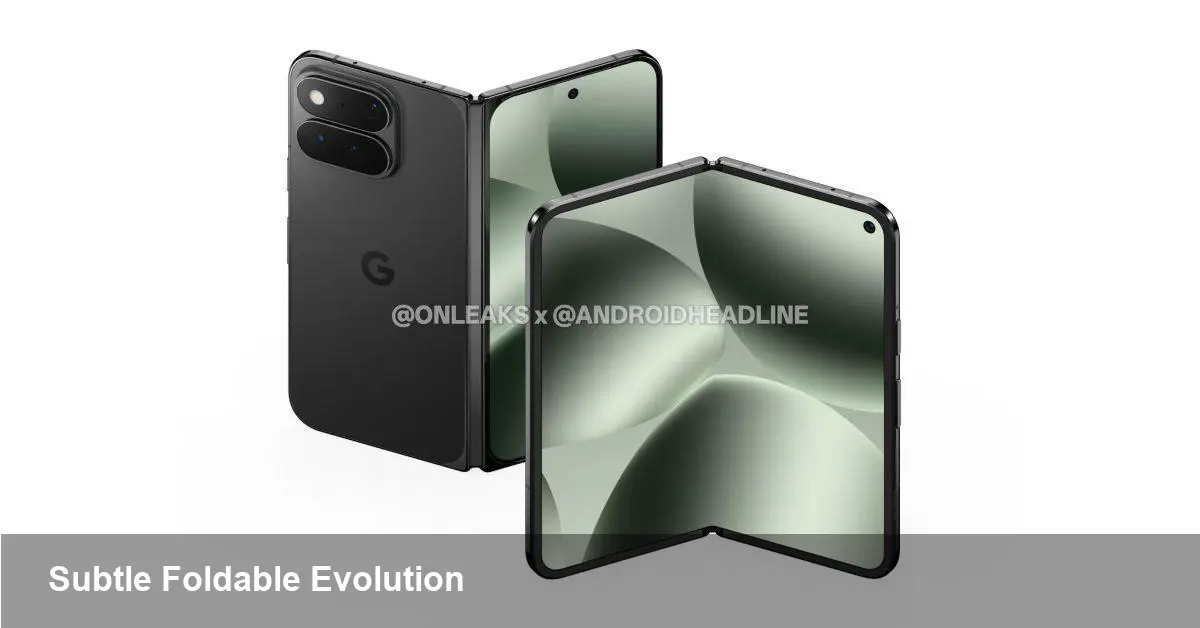
First look: a gentle design evolution
Recent CAD-based renders circulating online have given us a preliminary peek at Google’s next foldable, the Pixel 11 Pro Fold. The images don’t point to a dramatic redesign; instead they show incremental changes — a marginally reduced thickness and small styling refinements that keep the device recognizably in the Pixel family.
Leaks like these are an early stage of product visibility: they’re useful for spotting the broad direction a vendor is taking, but they rarely represent final materials, finishes or internal engineering trade-offs. Still, for users, app developers and product teams, even modest shifts can carry practical consequences.
Quick background: where this fits in Google’s foldable story
Google has been steadily moving into foldable hardware as Android’s multi-window, continuity and foldable APIs have matured. The company’s strategy has leaned toward bringing Pixel’s software polish—camera processing, Material You, adaptive UI—to a form factor that blends phone portability with tablet-sized screens.
The Pixel 11 Pro Fold (as referenced in the current renders) appears to follow that playbook: conservative industrial design changes, continued emphasis on a premium camera cluster and the same software-first approach that differentiates Pixel devices from many Android competitors.
What the renders imply for everyday users
- Practical pocketability: A slimmer foldable is meaningful. If the Pixel 11 Pro Fold is even a fraction thinner than its predecessor, it nudges foldables closer to everyday pocketability. That changes behavior: more users will be willing to carry a foldable as their primary phone rather than treating it as a novelty or a “weekend” device.
- Familiar user experience: The renders suggest Google is prioritizing continuity over reinvention. Expect the same Pixel UX features—strong camera software, adaptive theming and integrated AI features—to carry over, but optimized for a two-panel layout.
- Case and accessory ecosystem: Small dimensional changes can be a headache for case makers and accessory buyers. If the silhouette is only slightly altered, third-party cases might need minor tweaks, but a wholesale accessory refresh likely isn’t required.
A developer’s checklist for foldable readiness
If you maintain apps—especially productivity, media or social apps—now is a good time to run a quick audit against foldable best practices. The renders aren’t a spec sheet, but the device’s continuity with earlier Pixel folds gives several practical prompts:
- Responsive layouts: Verify layouts for stretched aspect ratios and larger interior displays. Use ConstraintLayout, Compose’s Box/Column/Row patterns, and resizable DP-based breakpoints.
- Multi-window and multi-resume: Test scenario handoffs between folded and unfolded states, and ensure your activity lifecycle handles configuration changes gracefully.
- Fold-aware UX: Consider seam-aware layouts for content that spans both panels (e.g., maps, editors). Avoid placing critical UI controls where the hinge could obscure them.
- Performance scaling: Larger canvas sizes mean heavier rendering workloads. Profile for memory and GPU usage on tablet or large-window configurations.
- Accessibility and large-surface controls: Bigger displays invite different interaction patterns—larger touch targets and reflowed navigation.
Coding against Android’s window-manager and Jetpack libraries will future-proof apps whether the device arrives with subtle or substantial hardware shifts.
Business and market implications
For Google, incremental iterations make strategic sense. A cautious design refresh reduces supply chain risk and keeps manufacturing predictable while allowing investment in software differentiation (AI features, camera, and OS optimizations).
For carriers and retailers, a familiar-looking foldable is easier to position to mainstream buyers. Marketing can emphasize improved pocketability and durability without needing to explain a completely new form factor.
Competitively, Google’s steady evolution keeps pressure on incumbents like Samsung and newcomers from the Chinese OEMs. This is good for the market because it maintains steady consumer interest in foldables while avoiding the boom-and-bust cycle that can follow more radical redesigns.
Limitations and trade-offs to watch
- Incremental hardware gains can disappoint buyers seeking a bold leap. If you want thinner bezels, radically different hinge mechanisms or major battery improvements, a small aesthetic update won’t satisfy.
- Durability and hinge engineering are still the key concerns for foldables. Renders can’t confirm long-term wear characteristics; real-world tests will be necessary.
- Battery behavior: Larger interior displays usually drive higher power draw. Slight slimming can limit battery capacity unless Google has found efficiency gains elsewhere.
Three implications for the next 12–24 months
- Software-first features will become the main differentiator. With hardware converging, Pixel’s edge is likely to come from AI-driven photography, on-device models and unique foldable UX tweaks.
- Accessory makers will adapt faster. Because the design changes look modest, expect a quicker rollout of compatible cases, docks and screen protectors compared with radically redesigned devices.
- Developer toolchains will further integrate foldable testing. Expect Android tooling—emulators, layout inspector, and testing templates—to add more foldable focused workflows as the category mainstreams.
Who should care and what to do next
- Consumers who already own a foldable and prioritize improvements in pocketability might find the Pixel 11 Pro Fold interesting—but hold off if you want revolutionary changes.
- Developers should begin or continue foldable compatibility testing now. Small hardware tweaks rarely require major rewrites, but they do require validation across lifecycle and layout edge cases.
- Product and marketing teams should prepare messaging around the practical benefits of a slimmer foldable: easier carry, better one-handed ergonomics and the same Pixel software strengths.
Leaks and renders are one piece of the story: they indicate direction, not destination. If Google’s approach here is representative of its strategy, we should expect a refinement-focused path that bets on software and polish to make foldables more broadly appealing. Whether that’s enough to move the needle for mainstream buyers will depend on pricing, battery life and durability—the three metrics most foldable skeptics watch closely.