MOFT’s MagSafe Wallet Gains Find My Tracking

What changed and why it matters
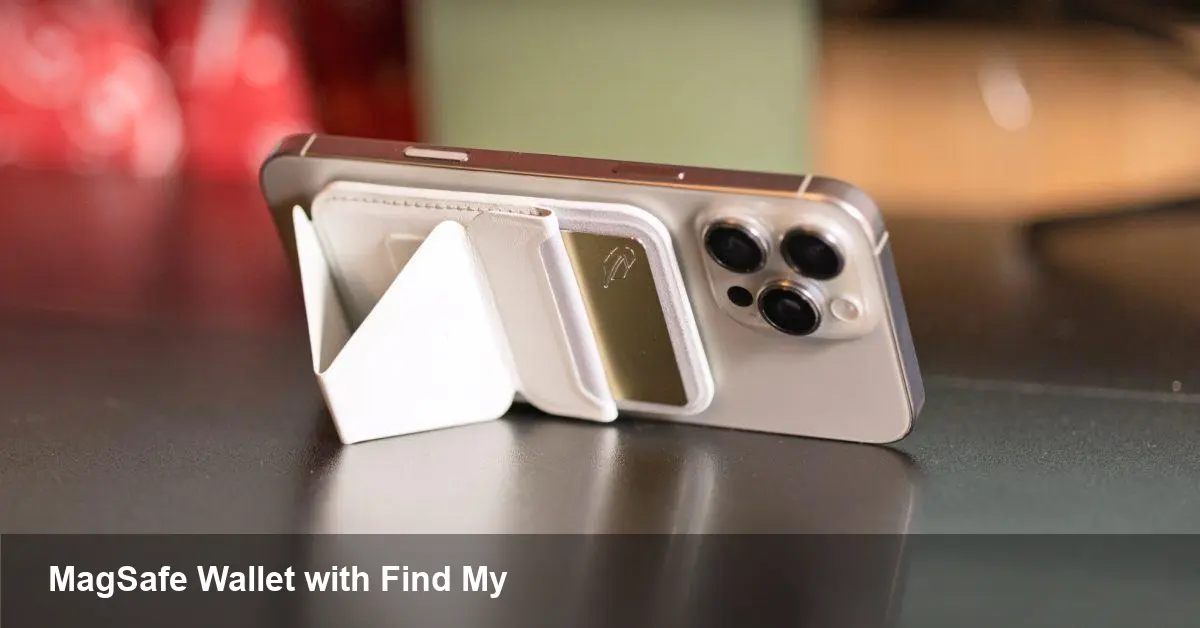
MOFT has released an updated version of its MagSafe-compatible wallet that now participates in Apple’s Find My network. The accessory keeps the original dual-purpose design—a magnetic wallet that doubles as a kickstand—while adding location-tracking capabilities that help you locate the wallet if it goes missing.
The product first appeared at CES 2025 and, after a long development cycle, is now available to consumers. For people who treat their phone, cards and small stand as a single on-the-go kit, the new Find My functionality addresses a common pain point: wallets and card holders are easier to misplace than phones, and integrating tracking into the accessory reduces friction in daily life.
Quick product snapshot
- Attaches to iPhone via MagSafe magnets for a secure, slim fit.
- Functions as a wallet for cards and cash while folding out into a landscape kickstand for hands-free viewing.
- Integrates with Apple’s Find My network so the accessory’s location can be seen in the Find My app.
Those three elements—magnetic attachment, physical utility, and networked tracking—are the combination that makes this update interesting to both consumers and accessory makers.
Real-world scenarios where Find My helps
- Commuters who move between home, transit, and office: If you forget the wallet on a train seat or in a cafe, Find My can show the last seen location, helping you go back and retrieve it faster.
- Hybrid workers and frequent presenters: The kickstand is useful for video calls or watching reference material at a desk. If you swap bags and momentarily leave the wallet behind, the tracking reduces the panic of losing payment cards.
- Travelers: Losing a wallet overseas is disruptive—being able to display a last-known spot or ask airport staff to check a gate area shortens the recovery window.
These use cases are exactly where accessory tracking provides measurable convenience: fewer disruption minutes and fewer replacement hassles.
How the Find My integration actually behaves
Apple’s Find My network lets compatible accessories report locations via the global network of iPhones, iPads, and Macs. That means if your MOFT wallet is near another Apple device, it can anonymously update its location to your Find My app. Typical Find My features that become available with this kind of integration include:
- Viewing last known location on a map in the Find My app.
- Playing a sound on the accessory (if the accessory has an onboard speaker) to aid short-range recovery.
- Marking an accessory as lost so other Apple devices can help locate it.
Note: The level of precision you get depends on the accessory hardware. Some Find My-enabled products support ultra-wideband Precision Finding on devices with a U1 chip; others use Bluetooth and the wider network to report location. If pinpoint, meter-level guidance is important to you, check the product’s hardware spec for U1 or ultra-wideband support.
For developers and product teams: what this signals
Third-party accessories participating in Apple’s Find My program are a meaningful channel signal. For product teams building physical goods that attach to phones—cases, wallets, mounts, trackers—this shows that:
- Adding networked tracking is a compelling product differentiator and can be integrated without forcing users into separate tracking ecosystems.
- There’s demand for multipurpose accessories that combine physical utility (kickstand, card storage) with digital safety (location tracking).
- Hardware partnerships and certification with platform providers (Apple’s accessory programs) are increasingly important; product managers should budget time for certification and firmware work.
If you’re a hardware startup, consider how a small radio, modest battery, and firmware stack could unlock Apple’s location network and raise the perceived value of a low-cost accessory.
Privacy, security, and limitations
Apple’s Find My framework puts a strong emphasis on privacy: location updates are encrypted and relayed anonymously through other users’ devices. Nevertheless, there are trade-offs and potential user concerns:
- Unwanted tracking protections: Apple includes safeguards that alert users if an unknown Find My accessory is moving with them. This is positive from a safety standpoint, but accessory makers should document how those alerts may be triggered to avoid customer confusion.
- Battery life: If the wallet includes an active radio, it will need power. That affects device lifetime and replacement cycles, and also what features (e.g., sound playing) are feasible.
- Precision limitations: As noted above, not every accessory provides ultra-wideband location accuracy. If exact distance-and-direction guidance is a requirement, check the spec.
Transparency about these limits and user-facing documentation will reduce support friction and build trust.
Business implications and positioning
For MOFT, folding Find My support into a popular MagSafe accessory is a way to climb the value chain without radically changing the product: the wallet still performs the same physical functions, but gains a digital safety net. That’s useful in marketing (sell convenience and security), in retail (higher perceived value), and in customer retention (accessories that tie into platform services can encourage ecosystem lock-in).
For Apple, more Find My-enabled accessories broadens the network effect: the value of the Find My service increases as more objects can be tracked through it. For accessory makers, joining that ecosystem can be a competitive differentiator—if you can make a case for reduced loss and better day-to-day convenience, customers will pay a premium.
What to check before buying
- Confirm whether the accessory supports Precision Finding or only Bluetooth-based location reporting.
- Check for any companion app and what extra features it provides (firmware updates, battery status, custom behaviors).
- Review materials and kickstand robustness—if you’ll use the wallet as a regular stand, hinge durability matters.
These questions will help you balance expected convenience against longevity and cost.
Broader implications
1) Expect more multifunction MagSafe accessories to include tracking. Vendors will mix functional hardware (stands, wallets, batteries) with small radios to add digital features.
2) Platform certification cycles will become a normal part of accessory roadmaps. Smaller brands need to incorporate firmware and compliance work early.
3) Privacy-by-design will continue to be a selling point. Consumers care about anti-stalking features and how location data is handled, so explicit documentation will be a differentiator.
If your daily carry includes a phone and a compact wallet, turning that wallet into a tracked device reduces friction and stress without changing behavior. For anyone prone to misplacing things, this is a subtle but practical upgrade—especially when the accessory still doubles as a useful kickstand.