iPhone Fold to Introduce Samsung CoE — Brighter, Thinner

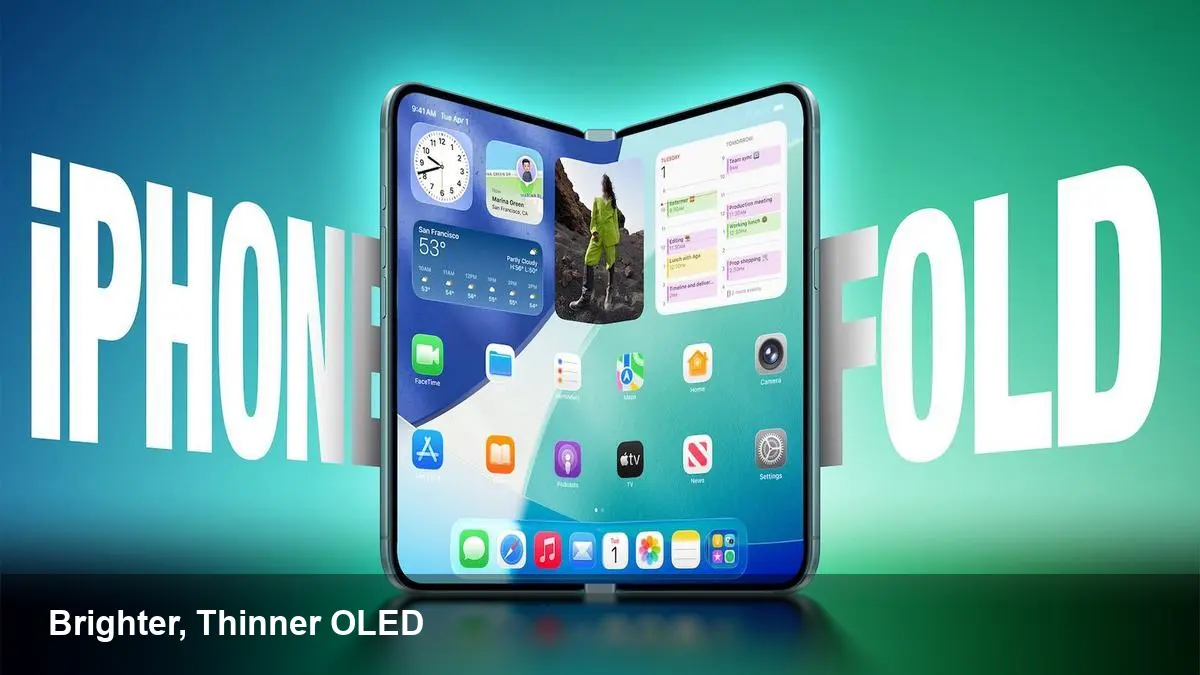
- Key Takeaways:
- Apple plans to adopt Samsung’s CoE (Color Filter on Encapsulation) OLED in its foldable iPhone, promising a thinner display stack and higher brightness.
- CoE removes the traditional polarizing film by applying color filters directly to the OLED encapsulation, improving light efficiency.
- The iPhone Fold could arrive as soon as late 2026; Apple may expand CoE to the iPhone Air 2 in 2027, with a decision expected by Q3.
What is CoE and why it matters
CoE, or Color Filter on Encapsulation, is an OLED manufacturing approach where the color filter is applied directly to the encapsulation layer above the organic emitters. That removes the need for a separate polarizing film used in conventional OLED stacks.
Because polarizers cut reflections but also absorb some emitted light, removing that layer increases panel efficiency and peak brightness without raising power draw.
How CoE makes displays thinner and brighter
By eliminating layers in the display stack, CoE reduces total thickness, which can translate into slimmer device profiles. The method also lets more of the OLED’s own light reach the viewer, boosting perceived brightness and contrast.
For foldable designs, thinner panels ease hinge engineering and can improve durability and feel, while higher efficiency helps battery life — important for larger, more power-intensive displays.
Apple’s rollout plan and timing
According to industry reporting by The Elec and subsequent coverage, Apple intends to debut CoE on the iPhone Fold, potentially launching in late 2026. The company is reportedly evaluating wider adoption for the iPhone Air 2 in 2027.
Sources say the business case — including whether to apply CoE and whether to proceed with the Air 2 launch — will be decided by the third quarter of this year. The Air 2’s timetable has already been shifted after weaker-than-expected sales of the first iPhone Air.
Samsung’s parallel plans and industry context
Samsung Display is pushing CoE (internally called OCF, or On-Cell Film) across its own line-up. The company plans to use it in Galaxy Z Fold and Z Flip foldables and reportedly on the Galaxy S26 Ultra — the first non-foldable to get the tech.
The move reflects a broader industry shift toward thinner, more efficient OLED stacks as manufacturers balance brightness, power consumption, and mechanical design constraints.
What this means for consumers
If Apple and Samsung follow through, upcoming smartphones could be noticeably slimmer and display brighter without a battery penalty. For users, that means better outdoor visibility, potentially improved battery life, and sleeker device designs.
Final specs and launch dates remain subject to supplier decisions and market performance, but CoE is shaping up to be a meaningful upgrade for high-end and foldable phones in 2026–2027.