Inside the MacBook Neo: A More Repair-Friendly Laptop

Why this teardown matters
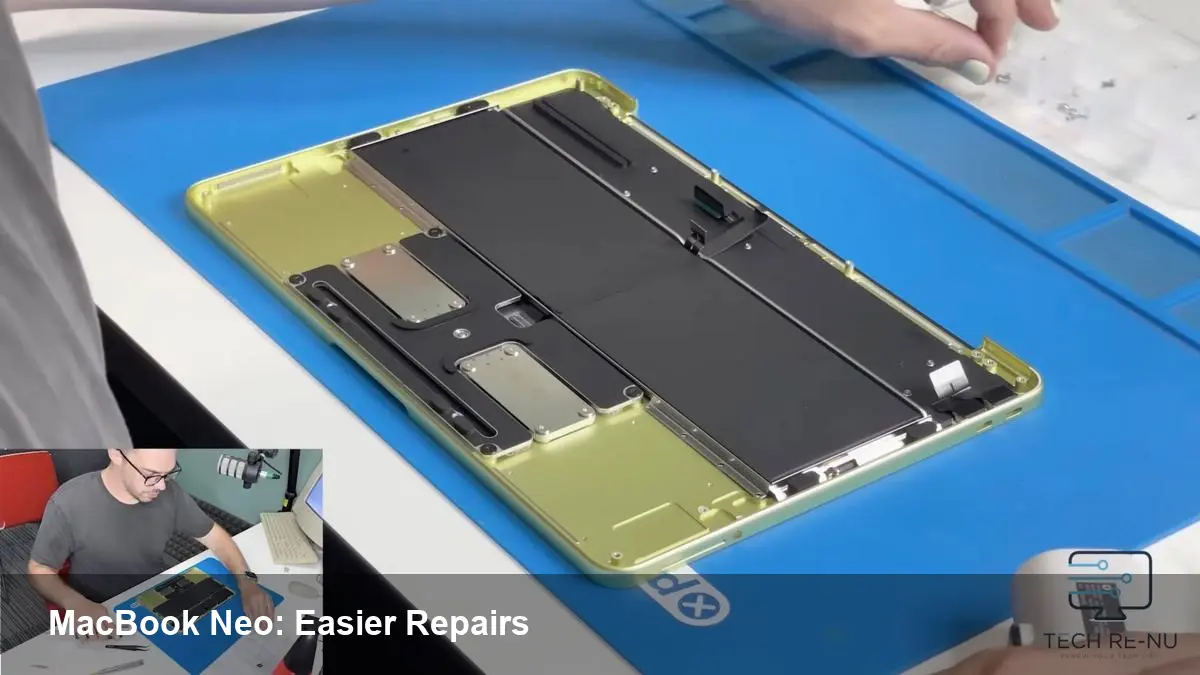
Apple’s MacBook Neo has just surfaced as one of the most accessible Mac laptops to service in recent memory. An Australian repair channel, Tech Re‑Nu, posted a teardown that makes it immediately clear Apple changed priorities at the hardware level: the Neo favors modularity, reduced adhesives, and widely available fasteners. For anyone who manages device fleets, runs a repair shop, or cares about sustainability, the Neo's design choices are practical, not just aesthetic.
What the Neo changed (short list)
- Exterior is removed with eight bottom screws, echoing the familiar Air/Pro approach but with cleaner internal routing.
- Internal fasteners are standard Torx (T3, T5, T8), lowering the tool barrier for independent technicians.
- Ports appear to be modular, allowing I/O assemblies to be swapped instead of desoldered.
- The battery is not heavily glued and there’s virtually no tape holding components down—making battery swaps quicker and less risky.
- Cable layout and connector placement are tidy, reducing accidental damage during disassembly.
Those who watched the teardown saw a full strip-down performed in about six minutes—an impressive demonstration of component-level accessibility. That number is a headline; real-world repairs will usually take longer, but the underlying design makes shorter, safer interventions more plausible.
Practical scenarios where Neo’s design helps
1) Small repair shop — faster turnarounds
An independent technician can replace a faulty USB-C or HDMI module without needing a micro-soldering bench. With modular port assemblies and Torx screws, the same replacement can be done with a compact toolkit, improving throughput and lowering labor cost per repair.
Example: A traveler arrives with a Neo that no longer charges because of a damaged charging port. Instead of booking days for a logic-board level repair, the shop swaps the port module and returns the laptop the same day.
2) Corporate IT — cheaper fleet maintenance
Companies managing hundreds of Macs will see value in component replaceability: a quick battery swap or port replacement keeps machines productive and delays buyout decisions. Lower mean-time-to-repair reduces downtime and total cost of ownership.
Example: A corporate IT team keeps a small stock of Neo port assemblies and batteries. When a device in a satellite office needs service, technicians perform an on-site swap and avoid shipping the laptop to a central depot.
3) Sustainability and resale value
Glue-less batteries and easier repairs can extend device lifecycles. When batteries are simple to replace, more devices stay in circulation longer, which reduces e-waste and increases resale value for used units.
Example: A refurbishment shop can test and replace batteries rapidly, certify devices for resale, and offer longer warranties because repairs are feasible without destructive procedures.
What still matters—and where trade-offs may exist
No laptop is entirely magic. The Neo’s improvements mostly target common failure points, but some elements are likely to remain complex:
- Logic boards and processors are typically densely integrated and may still require specialized tools or hot‑air stations if components are soldered.
- Display assemblies, trackpads, or keyboard membranes might still use adhesives or be fused in ways that are not as straightforward to service.
- Water resistance and ingress protection can suffer when moving away from permanent adhesives and seals; manufacturers need to balance serviceability against durability.
Another practical consideration is spare-part availability. Design for modularity is only useful if OEM-grade parts or high-quality third-party modules are accessible and reasonably priced.
What technicians should know before opening a Neo
- Bring a Torx set (T3, T5, T8) and a standard spudger. Those standard fasteners mean fewer obscure bits.
- Use anti-static precautions—component-level accessibility doesn’t remove ESD risk.
- Back up the device and disable firmware protections where applicable; Apple’s security features (T2-like chips, firmware locks) can complicate post-repair booting if not handled properly.
- Label cables and connectors as you remove them. Clean cable routing in the Neo reduces tangle, but careful handling is still important.
Broader implications: repair ecosystem and policy
Apple shifting toward more serviceable designs on a model like the Neo feeds several larger trends: 1) Right-to-repair gains momentum — when a mainstream vendor makes repairs easier, regulators see proof that serviceability is achievable without sacrificing product quality. 2) Aftermarket parts market expands — independent suppliers and refurbishers will respond with compatible modules and test equipment. 3) New business models — subscription-style hardware maintenance and regional swap-and-return services become more viable when common failures can be fixed quickly.
If Apple extends similar principles to more products, the economics of maintenance will shift. For consumers, it could mean lower repair bills and longer device lifetimes. For enterprises, it means better predictability in refresh cycles.
A few predictions for the next 18 months
- We’ll see certified third-party kits and training programs specifically for Neo repairs, from battery replacements to port module swaps.
- Corporate fleet managers will pilot in-office repair programs, measuring downtime savings against the cost of stocking spare modules.
- Regulators and consumer-rights groups will cite the Neo as an example in advocacy for broader repairability standards.
Apple’s hardware choices on the Neo won’t solve every repair headache, but they lower the barrier to practical fixes. For repair shops, IT teams, and sustainability-focused businesses, that’s the part that matters: fewer glued-down components, familiar screws, and replaceable I/O translate into real time and cost savings.
If you’re managing devices or running a repair business, start evaluating the Neo as a potential shift in your operational model—keep an eye on part availability, and test a battery and port swap to validate expected turnaround times before committing to a large fleet migration.