Inside Amazon’s rumored AI-first smartphone

Why Amazon is circling the smartphone market again
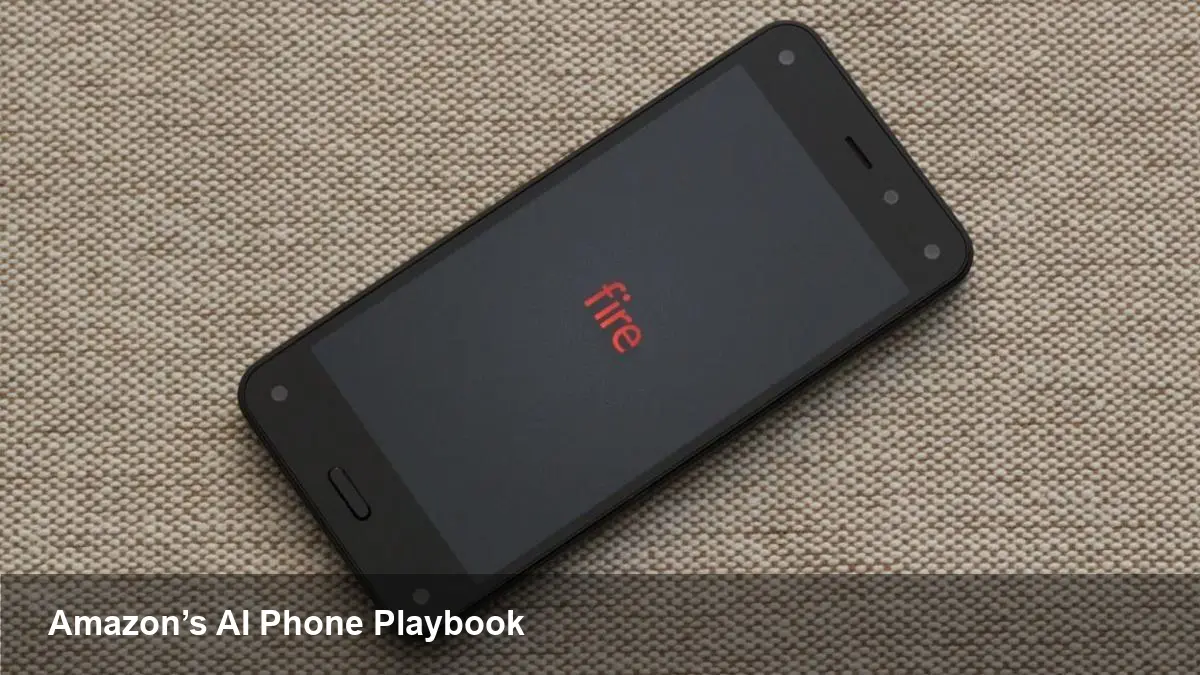
Amazon already has decades of experience building hardware — Kindle e-readers, Fire tablets, Echo smart speakers and Ring cameras. The company’s first attempt at a phone (the Fire Phone) didn’t catch on, but Amazon has quietly matured the pieces that matter for mobile: large cloud AI investments in AWS, conversational AI through Alexa, tight integration with retail and Prime, and an installed base of customers who trust Amazon for devices.
Recent reports suggest Amazon is working on a second smartphone with a radically different emphasis: built around generative AI and conversational interfaces rather than the classic app-and-icon model. The project is notable not just as another consumer device, but because it signals a rethink of how apps, services and interfaces might be distributed and monetized.
What an “AI-first” phone actually looks like
An AI-centric smartphone will change the interaction model in three overlapping ways:
- Assistant-first navigation: instead of launching apps by tapping icons, users engage the device through natural language and multimodal prompts. The assistant mediates actions, summaries, and cross-app workflows.
- Cloud-backed generative features: heavy lifting (model inference, personalization, retrieval) happens on remote services tied to the vendor’s cloud, with occasional on-device acceleration for latency-sensitive tasks.
- Context-aware surfaces: cameras and sensors feed the AI to produce situationally aware outputs — live translations, contextual shopping suggestions, or automated editing of media.
These shifts are technically achievable today because of advances in large models, lower-latency networking, and specialized silicon. But the user experience is only as good as the data pipeline, identity model, and privacy safeguards that connect the phone to cloud models.
No app store: what that could mean in practice
Reports that Amazon’s second phone might not use a traditional app store are the most disruptive detail. “No app store” doesn’t necessarily mean no third-party software; it suggests a change in distribution and invocation:
- Skills and actions: instead of downloading full apps, developers could publish conversational skills or cloud-hosted microservices that the assistant calls when relevant.
- Progressive, streamed experiences: apps become server-driven experiences rendered on demand, reducing the need for local installs and enabling instant updates.
- Web and API-first models: incentive to build web-native or API-backed services that integrate with Amazon’s assistant and identity systems.
For users this could reduce friction — no installation, fewer storage issues, seamless interoperation. For developers it means rethinking technical architecture and business models: move from one-off app purchases to subscription or usage-based APIs invoked through Amazon’s assistant.
Developer workflow: how to prepare and what to change
If you build mobile experiences, consider these practical shifts:
- Design for conversation: plan user journeys around prompts and assistant handoffs, not screens. Create fallback flows for multi-turn clarifications and confirmations.
- Separate UI from logic: server-side microservices become central. Keep client surfaces thin — they handle presentation and local state while business logic lives in the cloud.
- Instrument for context: collect (with consent) signals that help the assistant make better decisions — location, camera context, purchase history — but adopt granular opt-in and transparent handling.
- Use cloud models and tools: integrate AWS generative AI services for retrieval-augmented generation, moderation, and personalization. Build CI/CD around models as code so you can iterate quickly.
Concrete example: an expense-tracking startup could replace a standalone app with a cloud API that captures receipts via the phone’s camera, uses an LLM to classify expenses, and surfaces summaries through the assistant on demand. Monetization becomes a subscription to the API plus potential referral revenue through Amazon’s commerce ecosystem.
Business implications for Amazon and partners
For Amazon: the device is a powerful lever to increase customer engagement across retail, ads, Prime subscriptions, and AWS usage. An assistant that handles purchases conversationally could boost conversion rates and cross-sell.
For third parties: the tradeoffs are clear. You gain access to a direct pathway to users through the assistant, but you may lose control of presentation and monetization. Amazon could route commerce through its checkout, commission fees, or prefer first-party services.
Regulators and privacy advocates will watch closely. A phone designed to route much interaction through a single company’s cloud raises questions about competition and data portability.
Pros, cons, and realistic limitations
Pros:
- Faster discovery: users access capabilities by asking, not searching through stores.
- Unified experience: a single assistant can orchestrate multi-app workflows, reducing friction.
- Potentially better personalization thanks to connected accounts and cross-service signals.
Cons:
- Walled garden concerns: heavy reliance on a single assistant/cloud could limit competition and developer independence.
- Edge limitations: latency, offline capability, and expense of large-model inference are real constraints.
- Monetization uncertainty: if Amazon controls commerce and billing, third-party revenue splits could be unfavorable.
Technical limitations matter too. On-device model performance will dictate how much can run locally; otherwise every assistant query may cost cloud compute and network round-trips. Battery life, privacy, and user consent design will be primary engineering challenges.
What this means over the next few years
- Distribution will fragment. Traditional app stores will coexist with assistant-driven “skills” and streamed apps, forcing developers to support multiple entry points.
- Backend-first development wins. Companies that treat their service as an API and invest in robust cloud logic will adapt faster than UI-centric mobile shops.
- Policy debates will intensify. Regulators will probe data flows, app distribution fairness, and whether a single vendor can tilt the market by privileging its own services.
For startups, this is both a threat and an opportunity: the barrier to getting into user workflows might drop (no install required), but product strategy must become more platform-aware.
How to start experimenting now
- Prototype a voice-first flow for your core use case; measure completion rates versus tap-driven interfaces.
- Move critical business logic into APIs and treat your UI as one of many presentation layers.
- Run privacy audits: map data collected by sensors, who can see it, and how long it’s retained.
- Explore AWS generative AI tools and build small proof-of-concepts for multimodal features.
Whether Amazon’s new phone becomes mainstream or remains a niche experiment, the direction is clear: conversational AI will reshape how mobile experiences are discovered, delivered and monetized. Companies that start designing for that reality now will be better positioned than those who wait for the app store to tell them where to live.