Galaxy S26 Preview: AI, Cameras, and Developer Opportunities

A quick orientation
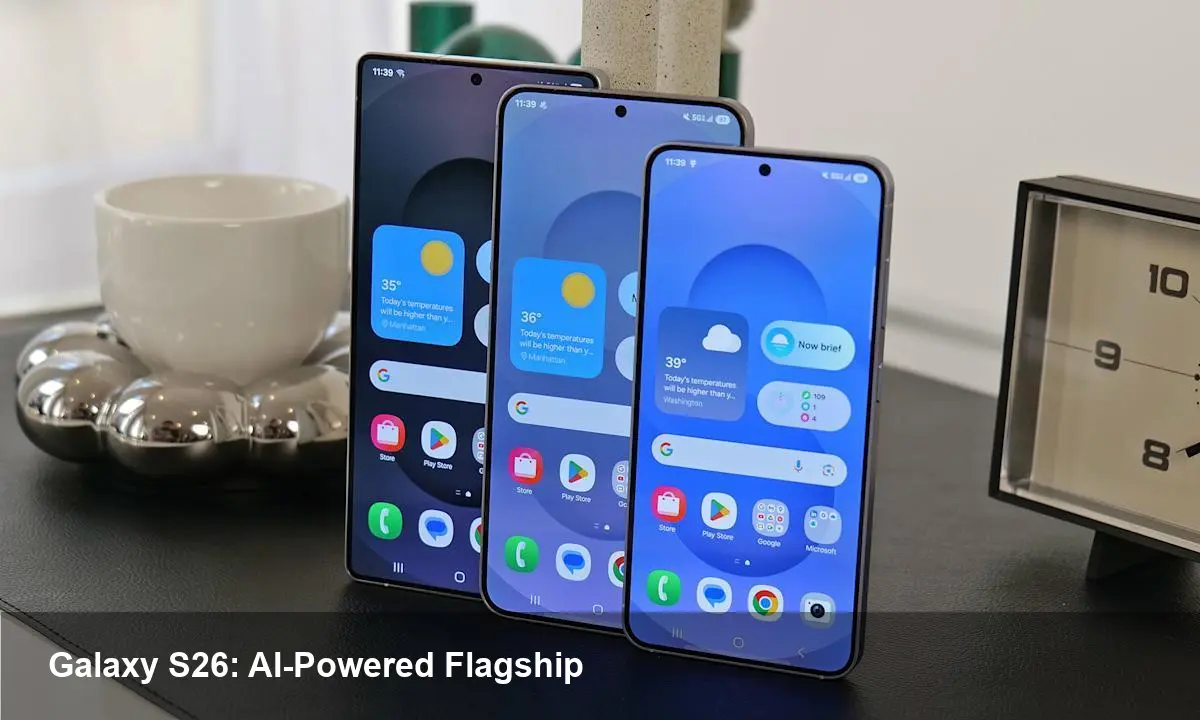
Samsung’s next Unpacked event is scheduled for February 25, 2026 — and all eyes are on the Galaxy S26 family. Over the past several years Samsung has pushed the Galaxy line beyond pure hardware refreshes, folding software intelligence, new imaging tricks, and ecosystem moves into flagship launches. This edition looks likely to double down on AI-led features and developer hooks that could change how people use phones for work and creativity.
What Samsung could unveil (and why it matters)
Samsung typically launches three flagship variants: a baseline model, a mid-tier Plus, and an Ultra version with the biggest screen and camera hardware. Expect the S26 series to follow that pattern. The headline this cycle isn’t just higher megapixels or faster charging — it’s how on-device and cloud AI are integrated into the core user experience.
Why that’s important: AI features change the value proposition of a flagship. When a phone can auto-summarize meetings, enhance photos intelligently, or safely process sensitive data on-device, it becomes not only a communications device but also a productivity and content-creation platform.
AI features to watch
- Ambient intelligence: anticipate more system-level AI that adapts to your context — incoming call routing, battery optimizations, and camera presets that adjust automatically for sports, night, or low-light portraits.
- Generative imaging tools: expect deeper computational photography where AI can remove obstructions, reconstruct missing details, or restyle images to match a specified aesthetic while keeping natural textures.
- Live text, translation, and transcription: on-device speech recognition and language translation that work faster and with better privacy guarantees than cloud-only solutions.
- AI assistant evolution: a more capable assistant that can summarize long messages, suggest message replies tailored to company tone, or provide actionable briefings from a single tap.
These features aren’t just flashy demos — they influence daily workflows. A salesperson on the road who can get a one-tap summary of a recorded call or a marketer who can generate multiple visual concepts from a single shot are concrete productivity wins.
Real-world scenarios
- For creators: imagine shooting a short video and using baked-in generative editing to change the background, stabilize shaky footage, and extract a cinematic still — all without exporting to a desktop editor.
- For knowledge workers: record a meeting, get an AI-derived summary with action items, and export those to your calendar or task app via a quick share sheet.
- For front-line teams: retail, delivery, or field service workers can use instant translation and image-based annotations to solve language and documentation gaps on-site.
What developers and startups should consider
- New surface for apps: If Samsung exposes APIs for on-device AI features or Galaxy AI workflows, third-party apps can integrate directly into capture pipelines, assistant prompts, or the share sheet.
- Performance and fragmentation: On-device models improve latency and privacy, but require careful optimization. Developers will need to account for multiple hardware configurations and decide when to fall back to server-side inference.
- Monetization and distribution: Samsung’s Galaxy Store and preloaded app partnerships can offer distribution advantages, but will probably come with stricter UX and privacy requirements. Think productized microservices that augment Samsung’s AI — e.g., specialized translation models, industry-specific summarizers, or premium creative filters.
Concrete actions: developers should review Samsung’s SDKs (watch for new AI or camera SDKs post-unpacked), prototype with lightweight on-device models, and plan for hybrid architectures that leverage cloud for heavy tasks.
Enterprise and business implications
- Security and privacy: On-device AI can reduce sensitive data leakage by keeping voice/video processing local. This is attractive to enterprises handling customer data or internal meetings. IT teams will want clear controls for model updates, data retention, and consent.
- Device differentiation: For businesses procuring fleets, an S26 device that can automate tasks (expense capture, form recognition, reporting) could lower operational costs. Expect verticalized value propositions — logistics, retail, healthcare — where device-level AI replaces or augments dedicated hardware.
- Competition with Apple and Google: Samsung’s push into Galaxy AI signals an acceleration of the platform arms race. Companies building cross-platform solutions must account for divergent capabilities between ecosystems.
Practical limitations and things to watch
- Battery and thermal trade-offs: running advanced models locally increases power draw. Samsung will need to balance performance and battery life — or offload selectively to the cloud.
- Real-world accuracy: AI-based camera edits and transcription can still produce errors. Users and enterprises must verify outputs, particularly where legal or regulatory accuracy matters.
- Privacy policy clarity: More on-device processing doesn’t automatically mean fewer privacy concerns. Model updates and analytics telemetry still create edge cases — organizations will need transparent controls.
Looking ahead: three implications for the market
- Mobile-first AI will push compute to the edge. Expect a growing split between devices that can do meaningful on-device inference and those that can’t — shaping purchasing decisions for power users and enterprises.
- Developer ecosystems will fragment and specialize. Companies that rapidly expose modular AI APIs will attract partners; those who don’t will cede ground to startups building middleware and cross-platform layers.
- Device features will become service hooks. Samsung (and competitors) will increasingly use hardware as a gateway to subscription services: high-quality generative imaging, premium assistant capabilities, or prioritized cloud inference.
What to watch on February 25
Look for three announcements: the S26 lineup specs and pricing, the details of Galaxy AI features and how they’re delivered (on-device vs cloud), and new developer tools or partnerships that make integrating with Samsung’s AI easier. The combination of these elements will tell you whether this Unpacked is an incremental refresh or a strategic inflection point.
If you’re a developer or product leader, start mapping the workflows in your apps that could be simplified with local AI: meeting capture, image editing, translation, or smart summaries. If Samsung delivers robust APIs, the S26 cycle could become a lucrative window to reach millions of users with smarter, faster experiences.