Galaxy S26: AI, Privacy Display, and Buds 4 Pro

What changed at Samsung's latest Unpacked
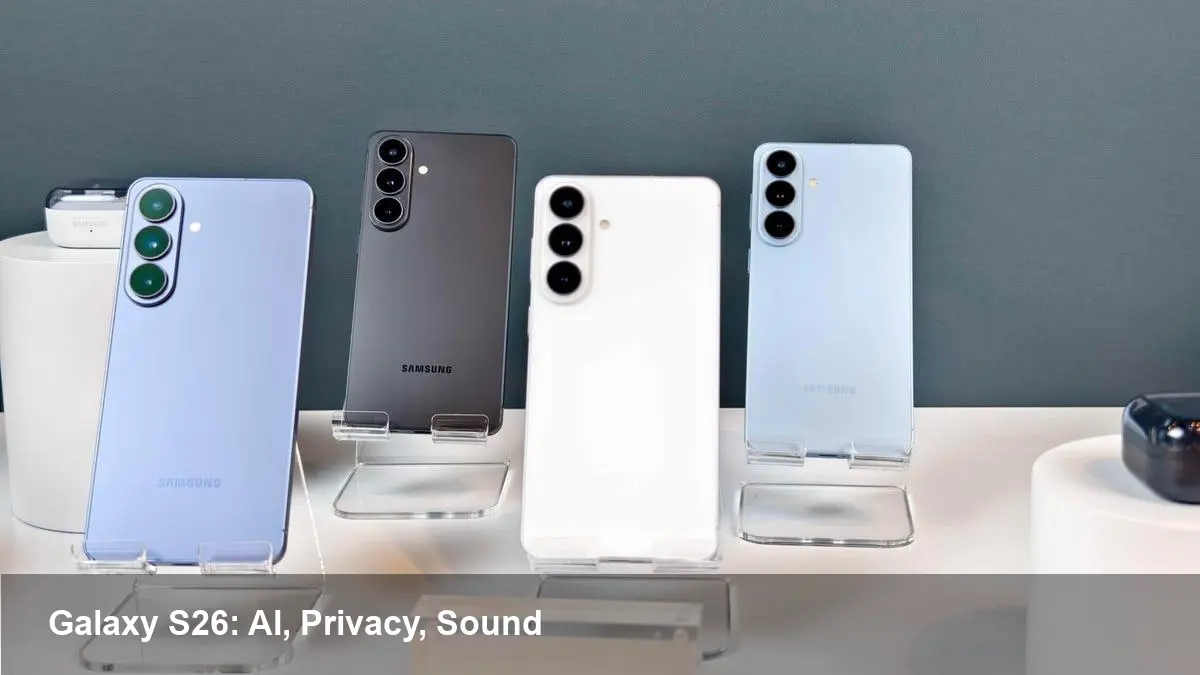
Samsung used its recent Unpacked event to reframe the Galaxy flagship story around three themes: smart, private, and immersive. The headline devices — the Galaxy S26 family and the new Buds 4 Pro — were paired with a push into what Samsung calls more 'agentic' on-device AI and a hardware-level Privacy Display. For developers and product teams this is less about raw specs and more about shifting where intelligence lives: increasingly on the handset itself, with tight integration across audio and display hardware.
Brief background: why this matters
Samsung's Galaxy S line is the company's showcase for new hardware and software capabilities. Over the past decade those phones became the testbed for features that later percolate into midrange models and other device categories. This time the company is doubling down on three converging trends: local AI that runs on-device, display-level privacy controls, and premium audio that ties into ecosystem features. The result is a platform opportunity for apps, accessory makers, and enterprises concerned about both user experience and data governance.
Practical user scenarios
- Travel and public spaces: With the Privacy Display, a commuter or traveler can catch up on email or sensitive documents without shoulder-surfers reading the screen. The display behavior can be toggled app-by-app, so a banking app can enforce stricter viewing angles while a video player remains wide open for media consumption.
- Photography and creative work: The flagship camera stack leans on local AI models to do heavy lifting — scene detection, multi-frame clean-up and subject-aware editing — without sending raw frames to the cloud. That speeds up turnaround for creators and reduces bandwidth and privacy exposure when working on sensitive shoots.
- Meetings and asynchronous workflows: The agentic AI features aim to perform tasks like summarizing long threads, drafting replies, scheduling, and extracting action items from documents. Instead of surfacing suggestions only, the assistant can take predefined steps on the user’s behalf — for example, proposing calendar slots and creating draft emails directly in the native apps, subject to user approval.
- Audio presence: The Buds 4 Pro are positioned for hybrid work and commuting. Expect improved noise cancellation that adapts to both voice calls and ambient noise patterns, lower latency for video calls or gaming, and better spatial audio when watching supported content across your Samsung devices.
Developer and product implications
- New integration points: App developers should watch for updated SDKs and One UI hooks that enable app-level control of Privacy Display modes and AI assistant permissions. This creates opportunities for business apps to enforce stricter on-device privacy policies or to request higher-priority AI processing when needed.
- On-device model constraints: Local AI reduces round-trips to cloud services but presents limits in compute, memory, and power. Developers will need to design multi-tiered workflows: quick, privacy-sensitive inference on device and heavier processing offloaded to cloud endpoints when user consent and connectivity permit.
- Extensibility and ecosystems: Audio accessory makers and app developers can exploit the Buds 4 Pro's capabilities (anc, spatial audio profiles, low-latency modes) to provide differentiated experiences — gaming optimizations, conference-call features, or immersive media apps that synchronize across devices.
Business value and operational impacts
- Reduced cloud costs and latency: Pushing inference to the phone lowers per-transaction cloud spend and improves responsiveness for latency-sensitive features like camera preview enhancements or instant message summaries.
- Differentiation through privacy: Hardware-backed privacy features can be a selling point for regulated industries (finance, healthcare) and enterprise buyers who want to keep sensitive screens and data shielded by default.
- New monetization vectors: Samsung’s platform-level AI and hardware features create room for value-added services — premium AI models, extended privacy services for enterprises, and bundled audio subscriptions — delivered directly through the device ecosystem.
Trade-offs and limitations to plan for
- Battery and thermals: Agentic on-device AI and continuous sensor usage (microphone, camera, display tweaks) increase power draw. Users and developers should anticipate more aggressive power management policies and consider offloading when battery is low.
- Consent and control friction: Handing the assistant the ability to act requires clear permission flows. UX design is critical to avoid surprises where the assistant performs actions users didn’t intend.
- Interoperability with non-Samsung hardware: Features tightly coupled to Samsung’s display or earbuds may not translate to competitors’ devices, fragmenting the developer experience unless cross-platform APIs emerge.
Two concrete developer examples
1) Finance app: A banking app disables screenshots and enables the Privacy Display automatically when showing account numbers or large transfers. It also calls a local NLU model to mask personally identifiable information before the assistant processes a transaction query.
2) Hybrid meeting tool: A conferencing app uses the Buds 4 Pro’s higher-priority audio channel to synchronize low-latency voice and spatial audio mixes. For meeting notes it triggers an on-device summarizer then optionally uploads encrypted excerpts to a cloud vault if the user consents.
What this signals about the near-term future
- Edge-first AI is becoming mainstream: Expect more apps to adopt a hybrid model where sensitive tasks happen locally and non-sensitive or compute-heavy tasks go to the cloud.
- Hardware privacy as a platform differentiator: Beyond software permissions, physical display and audio controls will be marketed more aggressively as enterprise and consumer privacy concerns grow.
- New developer responsibilities: As devices become more capable agents, engineers will need to design clearer consent models, audit trails, and fail-safe behaviors to keep user trust intact.
If you build apps, accessories, or services that touch the Galaxy ecosystem, the roadmap for the next year will be defined by balancing on-device intelligence, user privacy, and cross-device experiences. Start mapping which parts of your product benefit from local inference, where hardware-level privacy helps your customers, and how premium audio can raise perceived value—those are the levers Samsung just widened with its latest releases.