Galaxy Buds 4 leak: a return to simple, practical earbuds

Why these new images matter
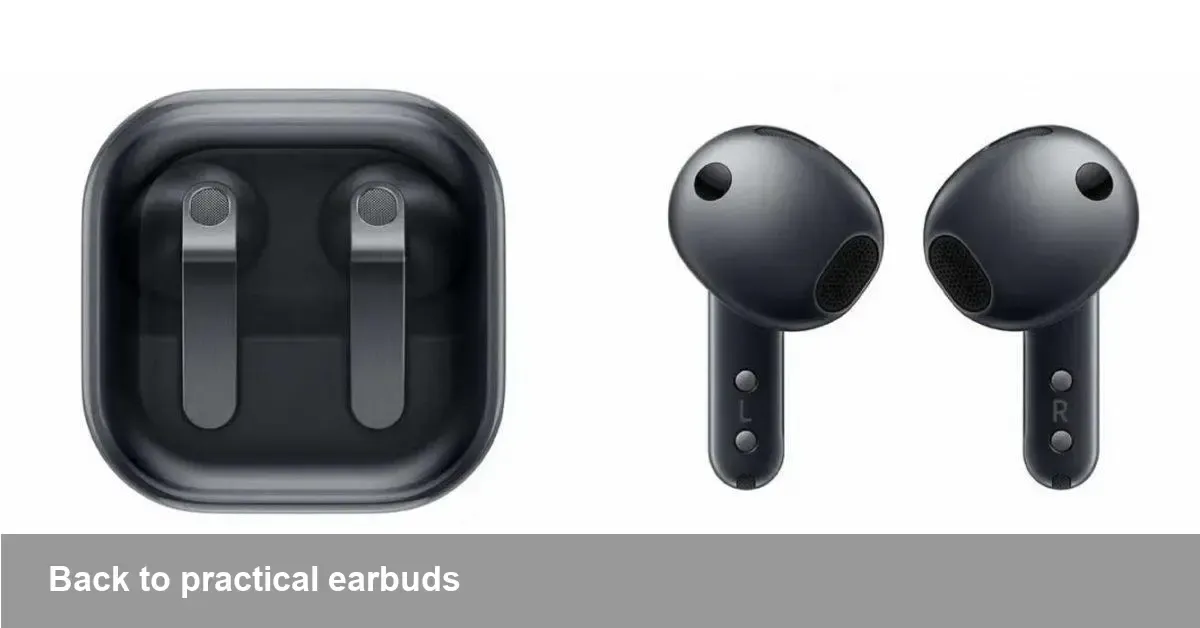
Leaked photos of Samsung's next true wireless earbuds — widely referred to as Galaxy Buds 4 — have begun circulating online just ahead of an expected product reveal. They don't show radical new hardware or flashy gimmicks. Instead the images point to a pragmatic redesign: smaller, more conventional-shaped earbuds and a compact charging case that emphasize comfort and everyday use.
For anyone watching the headphone market, the leak is a useful signal. Samsung has experimented with bold form factors (remember the bean-shaped Buds Live?) and premium feature stacking (Buds Pro, Buds 2 Pro). A pivot toward a simpler silhouette suggests Samsung may be optimizing for fit, cost, and broader user appeal rather than headline-grabbing innovation.
What the pictures appear to reveal
- A streamlined earbud shell with rounded edges and shorter stems. The design looks closer to the original Galaxy Buds and Buds+ than to the high-profile Buds Live.
- A compact, pebble-like charging case with a flatter profile—easier to pocket and less likely to roll.
- Minimal external touch surfaces, implying a focus on reliable tap/press controls rather than large touchpads.
Keep in mind these are leaks — not official specs. But the visible choices tell a story about priorities: comfort, low-profile wear, and mass-market friendliness.
Why “going back to basics” might be the right move
Over the last few years, wireless earbud makers have piled features onto devices: multi-mic arrays, active noise cancellation (ANC), three-dimensional audio, health sensors, and premium materials. That arms race produced excellent products, but it also led to higher prices and niche differentiation.
A pragmatic design can pay off in several ways:
- Better fit for more ear shapes, reducing returns and increasing daily comfort.
- Simpler internals that preserve battery life or reduce cost while keeping core features like ANC and transparency modes.
- Easier manufacturing and supply chain scaling, which matters if Samsung wants to compete aggressively on price.
For buyers, that trade-off can be a net gain. Not everyone needs audiophile credentials or advanced spatial features; many users want comfortable, reliable earbuds with solid call quality and a long battery life.
Practical scenarios: where these Buds could win
- Commuters: Improved passive isolation from a more conventional in-ear seal, paired with decent ANC, will make subway and bus rides quieter without drawing attention.
- Remote workers: Smaller, less conspicuous earbuds are more comfortable for all-day wear during video calls and the shorter stems are less intrusive for mask/helmet users.
- Fitness enthusiasts: A compact fit and secure seal can be better for workouts than elaborate shapes. If Samsung retains an IP rating, these could be ideal for runs and gym sessions.
What developers and accessory makers should watch
App and audio developers
- Codec support and latency: If Samsung keeps support for common codecs (AAC, SBC, and Samsung’s own optimizations), expect consistent cross-device experiences. Developers building low-latency music apps or multiplayer experiences should test with Samsung devices early.
- Spatial audio and processing: If the Buds 4 include spatial or object-based audio enhancements, app teams should look for SDK updates to leverage head-tracking and environmental profiles.
Accessory ecosystem
- New form factor means new third-party accessories (cases, ear tips, straps). Makers should monitor official measurements and release mockups quickly.
- Retail presentation: A compact case is easier to display and ship. Retailers can prioritize bundles (wireless chargers, cases) that favor everyday buyers.
Business implications and market positioning
- Competitive pricing strategy: A simpler design often signals a more aggressive price point. Samsung can target buyers who are priced out of flagship models or who don't need premium extras.
- Channel impact: Telecom carriers and large retailers favor products with broad appeal. These Buds could perform well in carrier subsidies and bundled offers with mid-range Galaxy phones.
- Brand strategy: Returning to comfortable, mainstream hardware reinforces Samsung’s mass-market strength—balancing its high-end audio line with practical, widely accessible alternatives.
Limitations and what we still don't know
- Performance trade-offs: A smaller case and simpler internals might reduce battery capacity or limit mic arrays, which could affect ANC and call clarity.
- Feature list: We don’t know the exact ANC quality, presence of wireless charging, precise battery life figures, IP rating, or pricing.
- Software support: Samsung’s software features (custom EQ, ambient modes, multipoint) will determine how these earbuds integrate into the Galaxy ecosystem.
Until Samsung publishes official specs and independent reviews are available, buyers should treat leaks as indicative but not definitive.
Broader implications and what to watch next
- Expect consolidation around practical designs: As the market matures, manufacturers may focus on refining comfort and battery life rather than experimenting with radical shapes.
- Software will increasingly differentiate earbuds: With hardware reaching parity, features like adaptive ANC tuned by machine learning, context-aware audio, and cloud-driven profiles will stand out.
- Price tiers will matter more than ever: Brands that offer reliable performance at multiple price points will capture the mainstream. Samsung is well-positioned to leverage its smartphone ecosystem to sweeten bundles and upgrade paths.
If you’re considering an upgrade, a sensible approach is to wait for the official announcement and hands-on reviews. For developers, now is a good time to ensure apps handle common codecs and to prepare for potential SDKs around spatial audio and adaptive listening.
Samsung’s possible move back to a simpler earbud design shows the industry’s subtle shift: consumers increasingly value everyday usability over headline features. Whether those trade-offs pay off will depend on the final specs, price, and real-world performance once Galaxy Buds 4 are confirmed.