Displace Hub Turns Your TV Into a Truly Wireless Screen

- Key Takeaways:
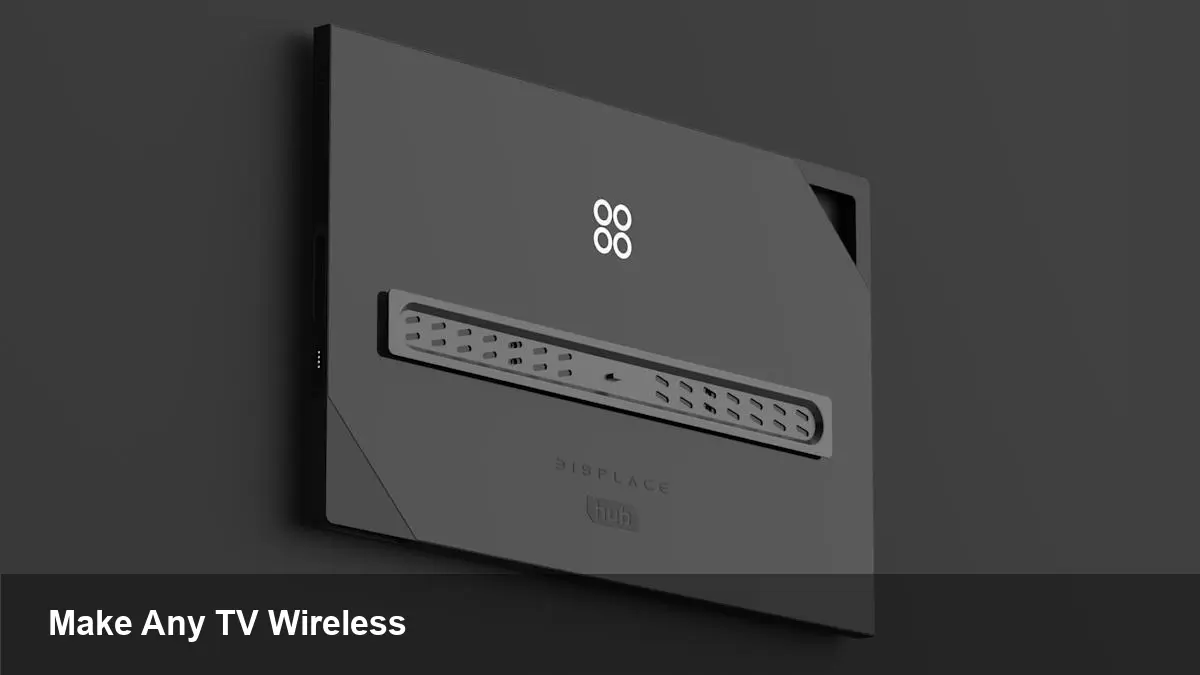
- Displace Hub is a wall-mount system that adds an Intel N‑150 PC and a 15,000mAh battery to make 55–100" TVs wireless.
- Specs include a 4‑core Intel N‑150 CPU, integrated GPU, 16GB RAM, 128GB storage, two HDMI inputs and Controller 2.0 support.
- Battery life is rated at 5–10 hours; Hub supports up to 150 lbs and costs $1,900 with pre-orders at CES 2026.
Overview
Displace’s new accessory, the Displace Hub, aims to remove power and data cables from conventional TVs by combining the company’s "active-loop suction" wall mount with an integrated PC and rechargeable battery.
The product is designed to mount 55–100" screens and can support up to 150 pounds, positioning the Hub as a retrofit option for many larger modern TVs rather than small or older sets.
Hardware and software
The Hub runs Displace’s ambient computing platform on an Intel N‑150 4‑core CPU with an integrated GPU. It ships with 16GB of RAM and 128GB of storage, providing local compute for smart features and apps.
Connectivity includes two HDMI inputs for external devices and support for Displace’s Controller 2.0, which acts as a secondary information screen and control surface for the system.
Battery and power
The Hub packs a 15,000mAh battery intended to power the mounted TV and the Hub’s internal PC, eliminating the need for a permanent power cable in many viewing scenarios.
Displace rates battery life between five and 10 hours, depending on the TV’s power draw and usage patterns. The Hub can be recharged while the TV stays mounted, but periodic charging may undercut the appeal of a cable-free setup for heavy viewers.
Limitations and trade-offs
The Hub’s mounting and weight limits mean it won’t work with every television. Screens outside the 55–100" range or heavier than 150 pounds are excluded.
Battery runtime is the clearest trade-off: high-brightness HDR content or large panels will drain the pack faster, requiring frequent recharges to maintain a cable-free wall display.
How it compares
Previous attempts to reduce cables include LG’s Signature OLED M3 and Samsung’s Neo QLED models, which use wireless breakout boxes to stream HDMI signals. Those approaches reduced visible cable clutter but didn’t eliminate power runs in many setups.
Displace’s pitch is more radical: a single wall-mounted unit that supplies both compute and battery power. That convenience comes at a premium and with real battery and compatibility trade-offs.
Availability and price
Displace hasn’t given a firm ship date but says the Hub will be available for pre-order during CES 2026 and priced at $1,900 at launch.
Expect further details and hands-on coverage as CES coverage continues in January 2026.