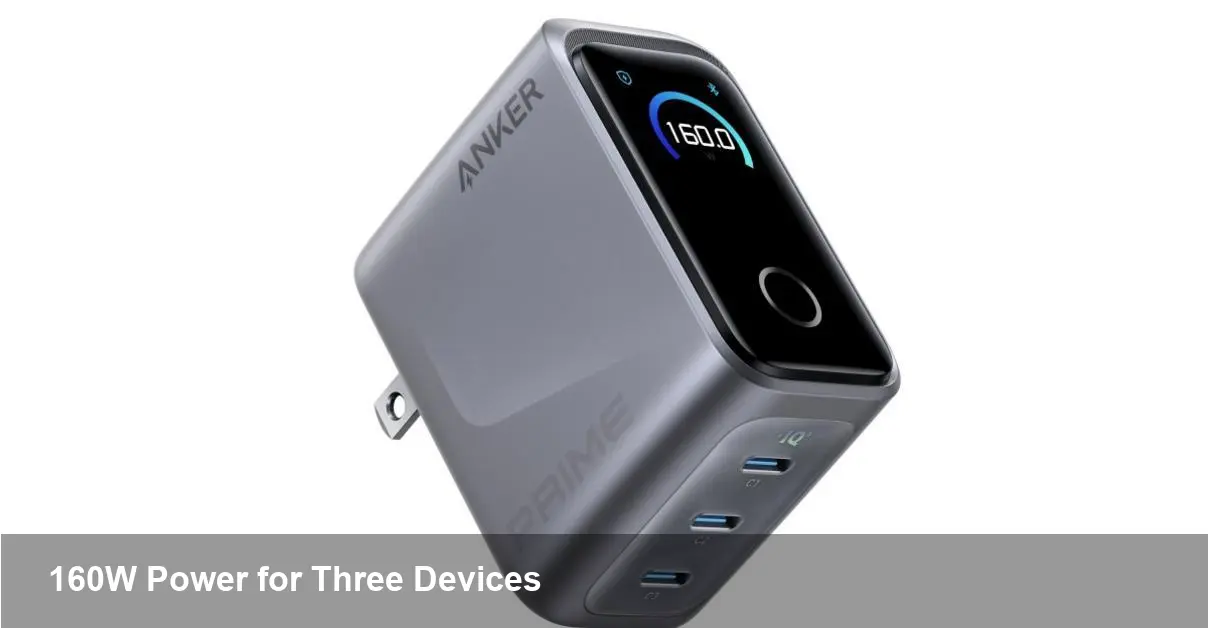
Anker 160W Prime Charger: Power Three Devices Efficiently

Why this charger matters now
Anker’s 160W Prime Charger is aimed at people who want to replace multiple bricks with a single, higher‑capacity unit. With more laptops, monitors and accessories adopting USB‑C power delivery, a compact, high‑wattage charger that can feed several gadgets at once is becoming a practical desktop and travel essential.
If you’ve been juggling a laptop brick, a phone charger and a spare power bank cable across a workday, a multi‑port 160W charger promises to simplify that setup. Right now the unit is discounted to $99.99 during Amazon’s Big Spring Sale — about $50 off — which puts a capable GaN‑based charger in reach for power users and small teams.
A quick look at Anker and the tech inside
Anker built its reputation on reliable, well‑engineered charging gear. The Prime line moves that into higher power territory by using gallium nitride (GaN) semiconductors, which allow for higher efficiency and smaller physical size than legacy silicon chargers. GaN chargers can push more current through less silicon area with lower heat generation for a given footprint — which is how Anker can pack 160 watts into a single brick.
Key benefits of the 160W approach:
- Consolidation: one physical charger can replace multiple lower‑wattage adapters.
- Headroom: plenty of power to fast‑charge a laptop while still feeding phones and accessories.
- Travel and shared desks: fewer cords and fewer outlets in use.
What it can realistically do for you
The promise is simple: power three devices at once. In practical terms, that might look like:
- A 14–15” productivity laptop drawing its usual USB‑C PD wattage (often 60–100W) while
- A smartphone receives fast charging and
- A set of wireless earbuds or a companion monitor gets powered.
For a developer with a laptop, external monitor, and phone, the 160W charger reduces clutter and dependency on multiple wall sockets. For founders sharing a hot desk, a single 160W brick can keep several personal devices topped up during calls and coding sessions.
Be aware: how much each device actually receives depends on USB‑C Power Delivery negotiation and the charger’s dynamic power allocation. That means a power‑hungry gaming laptop might pull a larger share, while the phone and accessories receive the remainder. Anker’s firmware typically manages that smoothly, but there are limits — you won’t get three laptops at their maximum rated wattage if the sum exceeds 160W.
Practical scenarios and examples
- Remote worker: One charger powers a 65–100W work laptop, a smartphone and noise‑canceling headphones. One outlet is all you need.
- Weekend traveler: Pack one charger instead of two or three bricks for your laptop, phone and tablet. Lighter luggage, fewer tangles.
- Small meeting room or startup desk: One brick serving a laptop and two mobile devices reduces the number of wall sockets used and speeds turnaround between users.
Each scenario benefits from fewer power adapters and simpler cable management, but success depends on using quality USB‑C cables rated for the wattage you need.
What to watch for before buying
- Cables matter: To get the full benefit, use USB‑C cables rated for high wattage (20V/5A) for laptop charging. Cheap cables can throttle charging or raise safety concerns.
- Heat and ventilation: High‑wattage charging generates heat. Even with GaN tech, give the charger breathing room and don’t stuff it under cushions or in tightly packed bags while charging at full load.
- Device negotiation limits: Some laptops and peripherals limit how much they will accept over USB‑C. The charger can only offer power the device agrees to take.
- Port layout and convenience: Check the port types and placements if you plan to plug and unplug devices regularly. A mix of USB‑C and USB‑A ports can increase compatibility.
Business, environmental and productivity angles
From a startup ops perspective, buying fewer, higher‑quality chargers can reduce capital and maintenance overhead. Instead of stocking different chargers for laptops and phones, a small office can standardize on multi‑port units.
Environmentally, consolidation reduces e‑waste: fewer single‑use bricks sold and eventually discarded. That said, the best impact comes from longer use cycles and buying durable gear from reputable brands.
On productivity, desk real estate and outlet availability are underrated. Freeing up an outlet or two and reducing the tangle of adapters can shave friction off everyday workflows — especially for multi‑device power users (developers, designers, product managers).
Who should and shouldn’t buy one
Good candidates:
- Travelers who want to carry one charger for laptop and phone.
- Remote workers who use multiple devices and want a cleaner setup.
- Small teams, startups, or shared desks where a single high‑capacity charger reduces infrastructure.
Think twice if:
- You need to charge three power‑hungry laptops simultaneously at full rated wattage — the sum may exceed 160W.
- You rely on older devices or proprietary chargers that don’t support standard PD negotiation.
- Portability at the absolute lowest weight is your priority — high‑wattage bricks can still weigh more than a 65W brick.
Two implications for the near future
1) Power consolidation becomes the norm: As more laptops and peripherals standardize on USB‑C PD, expect multi‑port high‑wattage chargers to replace many single‑purpose adapters in travel kits and offices.
2) Cable and standards maturity will matter more: With higher total output in one brick, the ecosystem of USB‑C cables and PD standards will need to keep pace. Expect stricter labeling and more 5A‑rated cables in the mainstream market.
Buying advice
If you’re upgrading from multiple low‑wattage bricks and want cleaner charging, the sale price of $99.99 for Anker’s 160W Prime Charger is compelling. Confirm the port mix, ensure you have high‑quality cables for the laptop port, and consider how often you’ll use full combined output — if you rarely need more than 65–100W total, a smaller charger may be lighter and cheaper.
A 160W multi‑port charger is a pragmatic purchase for a modern, multi‑device life: more consolidation, less clutter, and enough power for most workday scenarios. With the current discount, it’s a good moment to evaluate whether one reliable brick can replace the pile on your desk.