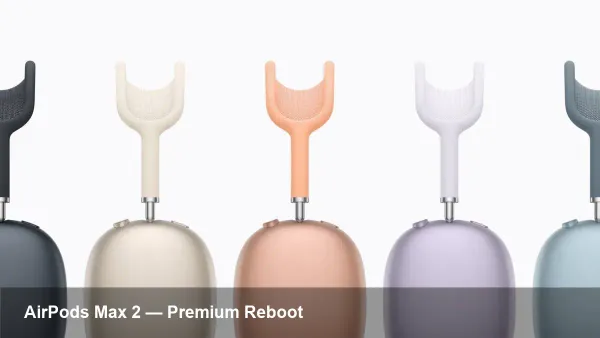
AirPods Max 2: H2 power and upgraded ANC at $549

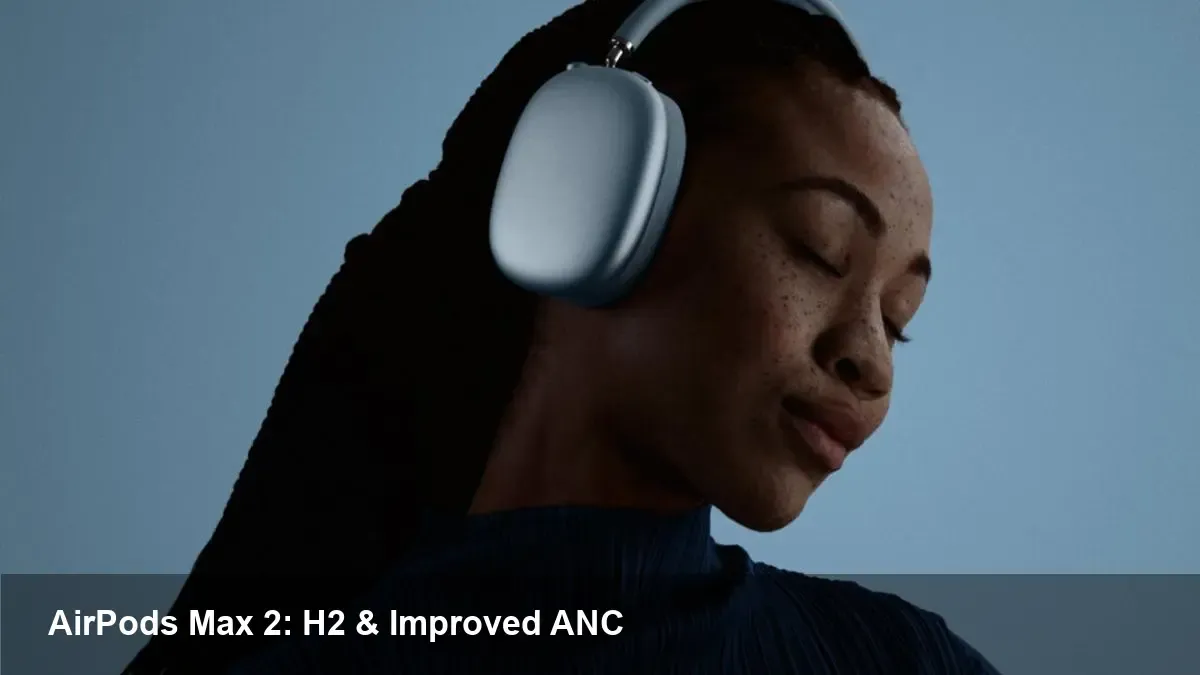
Apple’s high-end headphones get a meaningful refresh
Apple is updating its premium over-ear headphones with a new model that centers on improved processing and active noise cancellation. The AirPods Max 2 arrives in April priced at $549 and adopts Apple’s H2 audio chip — the same silicon that powers recent AirPods Pro — aimed at cleaner processing, smarter noise control and tighter integration with Apple’s ecosystem.
What’s different this time
At a glance the new model keeps the distinctive over-ear design Apple introduced with the original AirPods Max. The headline changes are internal: the H2 chip replaces the prior SoC and Apple promises stronger active noise cancellation (ANC). For buyers that already value the AirPods Max’s build and user experience, the update is focused squarely on audio performance and software-driven features rather than a redesign.
Why the H2 chip matters
- Latency and DSP: The H2 brings more headroom for digital signal processing. That translates into faster, more precise ANC algorithms and improved spatial audio rendering when using Apple’s head-tracking features.
- Battery and efficiency: Silicon upgrades also typically help performance per watt. Even if battery numbers don’t jump substantially, the H2 should allow more sustained complex audio processing without big power draws.
- Feature parity across the line: With H2 in the Max, you get the same generation of noise‑control and adaptive features found in Apple’s most advanced earbuds.
Real-world scenarios: where you’ll notice the difference
- Commuters and frequent flyers: Better ANC removes more low-frequency rumble from trains and planes. That turns long trips into quieter stretches for reading, resting or focusing on work.
- Open offices and shared workspaces: Improved noise rejection helps mask constant background chatter. Paired with a laptop, the AirPods Max 2 can become an effective attention-management tool during deep work blocks.
- Media consumption and streaming: Tighter DSP improves clarity and transient response, which benefits movie audio and spatial mixes in streaming apps that support Apple’s spatial audio standards.
- Remote meetings and creators: While professionals mixing audio will still trust wired studio monitors, content creators and podcasters who want accurate monitoring in a portable package should find the Max 2’s processing helpful for quick checks and editing on the go.
Integration and workflow benefits
If you’re already invested in Apple’s ecosystem, the AirPods Max 2 functions as more than headphones — it’s an extension of device continuity. Handoff, automatic switching, and spatial audio with dynamic head tracking work more smoothly when the headset can do the heavy lifting locally. For developers, that consistent audio platform simplifies testing spatial audio experiences across devices.
Practical example: a designer testing 3D audio scenes can use the Max 2 to validate spatial rendering without needing pro audio gear; the H2 chip keeps head-tracking and binaural processing stable during quick iteration cycles.
Competitors and pricing
At $549 the AirPods Max 2 remains in premium territory, unchanged from the price point Apple used for the original. Competing models from Sony and Bose still target similar buyers and often undercut on price, but Apple’s proposition is the tight hardware-software integration and features like seamless pairing with iPhones and MacBooks. For buyers deciding between brands, the choice becomes: is ecosystem convenience and Apple’s spatial audio worth the premium?
Where the AirPods Max 2 may fall short
- Value for money: At the same price as the first generation, the Max 2 is a selective upgrade. If ANC and processing are your only priorities, some rivals offer comparable or better noise cancellation at a lower price.
- Pro-audio limitations: Despite improvements, the Max 2 is still a consumer product. Professionals who need flat, reference-grade monitoring for mixing will prefer dedicated studio headphones and interfaces.
- Cross-platform gaps: Apple’s best features are most useful inside Apple’s ecosystem. Android and Windows users can use the Max 2, but will miss some convenience and advanced spatial features.
Who should buy it (and who can wait)
Buy the AirPods Max 2 if:
- You want the best Apple-made over-ear experience and are invested in iPhone/Mac.
- You frequently travel or work in noisy environments and rely on noise cancellation to be productive.
- You value spatial audio and head-tracking for media and casual creative work.
Consider waiting or choosing alternatives if:
- You’re price-sensitive and want top-tier ANC at a lower cost.
- You’re an audio professional seeking studio accuracy and wired reference monitoring.
- You prefer hardware-agnostic devices that expose more tuning and codec options for non-Apple devices.
Broader implications for audio and devices
1) Silicon-driven audio will be the norm. Apple’s move to put H2 into its over-ear flagship underlines an industry trend: advanced audio features increasingly depend on specialized chips rather than purely on transducer design. Expect competitors to similarly emphasize DSP and machine learning for ANC and immersive audio.
2) Ecosystem lock-in becomes more visible. Premium headsets will keep leaning on platform-specific features (spatial audio, seamless switching). For consumers this means better experiences inside a chosen ecosystem, but less parity across platforms.
3) Opportunities for content and app makers. Improved and more consistent spatial audio on mainstream hardware nudges streaming services, game studios, and AR/VR developers to invest in immersive stereo mixes and head‑tracked formats, since more listeners will have capable playback devices.
The AirPods Max 2 won’t redefine over-ear headphones, but it tightens Apple’s position at the high end. If the H2 chip delivers on its promise of smarter noise cancellation and cleaner processing, the upgrade will be especially meaningful for commuters, hybrid workers and Apple-heavy households who prize convenience as much as sound quality.