Intel Launches Core Ultra Series 3 — First 18A Chips

- Key takeaways:
- Intel is launching Core Ultra Series 3 (Panther Lake) laptop CPUs built on its new 18A process this month.
- 14 SKUs across five families will appear in 200+ designs; first units available Jan. 27, others through H1 2026.
- High-end X9/X7 chips include a 12-core Intel Arc B390 iGPU and LPDDR5x-9600 support; all chips use Foveros chiplets with a compute tile on 18A.
What Intel announced
Intel unveiled the Core Ultra Series 3 laptop processors at CES, codenamed Panther Lake. The company says these are the first client CPUs produced using its 18A manufacturing node.
The initial launch includes 14 SKUs across five product families and will be used in “over 200” PC designs. Intel expects the first models to be available January 27, with additional SKUs arriving through the first half of 2026.
Product lineup and key specs
Core Ultra X9 and X7 are the top-tier parts, packing Intel's latest CPU and GPU microarchitectures and a fully enabled 12-core Intel Arc B390 integrated GPU. They also support faster LPDDR5x-9600 memory.
Core Ultra 9 and 7 use the same architectures but with four GPU cores and memory options of LPDDR5x-8533 or DDR5-7200. They expose 20 PCIe lanes (up from 12 on the X-series) to better accommodate discrete GPUs.
The Core Ultra 5 family covers lower-tier models with fewer CPU cores and 4- or 2-core GPUs. One notable outlier is the Core Ultra 5 338H, which pairs 12 CPU cores with a 10-core Intel Arc B370 iGPU.
Panther Lake architecture
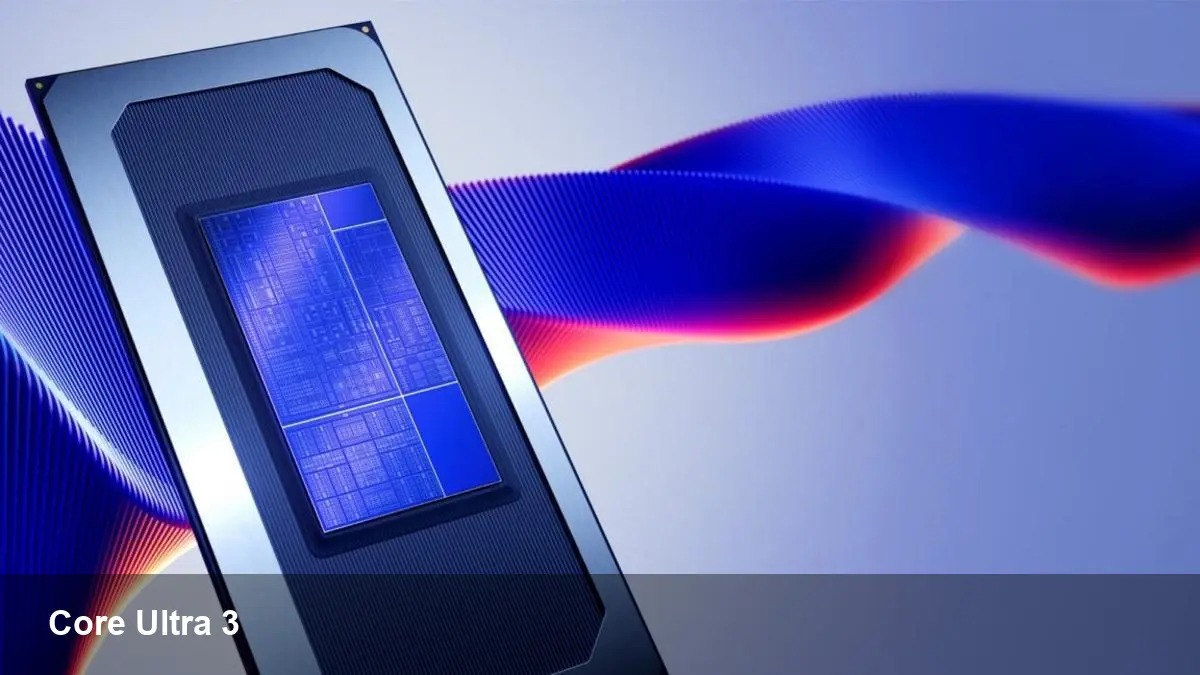
Panther Lake continues Intel's chiplet strategy using Foveros packaging. The design mixes a compute tile, graphics tile, and a platform controller tile on a base tile.
The compute tile — which houses CPU cores and the neural processing unit (NPU) — is manufactured on Intel 18A. Two compute-tile variants exist: up to 16 CPU cores and an 8-core option. The platform controller tile and the high-end 12-core graphics tile are produced at TSMC; a simpler 4-core graphics tile uses Intel 3.
Performance, AI, and connectivity
Intel claims up to 60% faster multi-core CPU performance and up to 77% faster integrated GPU performance versus the outgoing Core Ultra 200V chips. All Panther Lake parts include an NPU rated up to 50 TOPS.
That 50 TOPS rating comfortably exceeds Microsoft’s Copilot+ PC 40 TOPS threshold, though it trails AMD’s Ryzen AI 400 series (claimed 60 TOPS) and Qualcomm’s Snapdragon X2 (claimed 80 TOPS). Connectivity highlights include Wi‑Fi 7, Bluetooth 6.0, and up to four Thunderbolt 4 ports.
Battery claims
Intel showcased a Lenovo IdeaPad reference design using a Core Ultra X9 388H streaming Netflix at 1080p for 27.1 hours. Real-world battery life will vary by OEM design, display, and power settings.
Why this matters
AMD and Qualcomm have pressed Intel on process and AI performance; shipping Panther Lake on 18A signals Intel’s 18‑angstrom-era fabs are operating for client chips. The hybrid chiplet approach gives Intel flexibility to mix tiles from different foundries while bringing critical compute dies back to its own node.
Whether Core Ultra Series 3 marks a sustained turnaround or a single-step improvement depends on laptop designs, OEM execution, and how Intel scales 18A for future products.