How AMD's Olympic Ridge (Ryzen 10000) Will Change Desktop CPUs

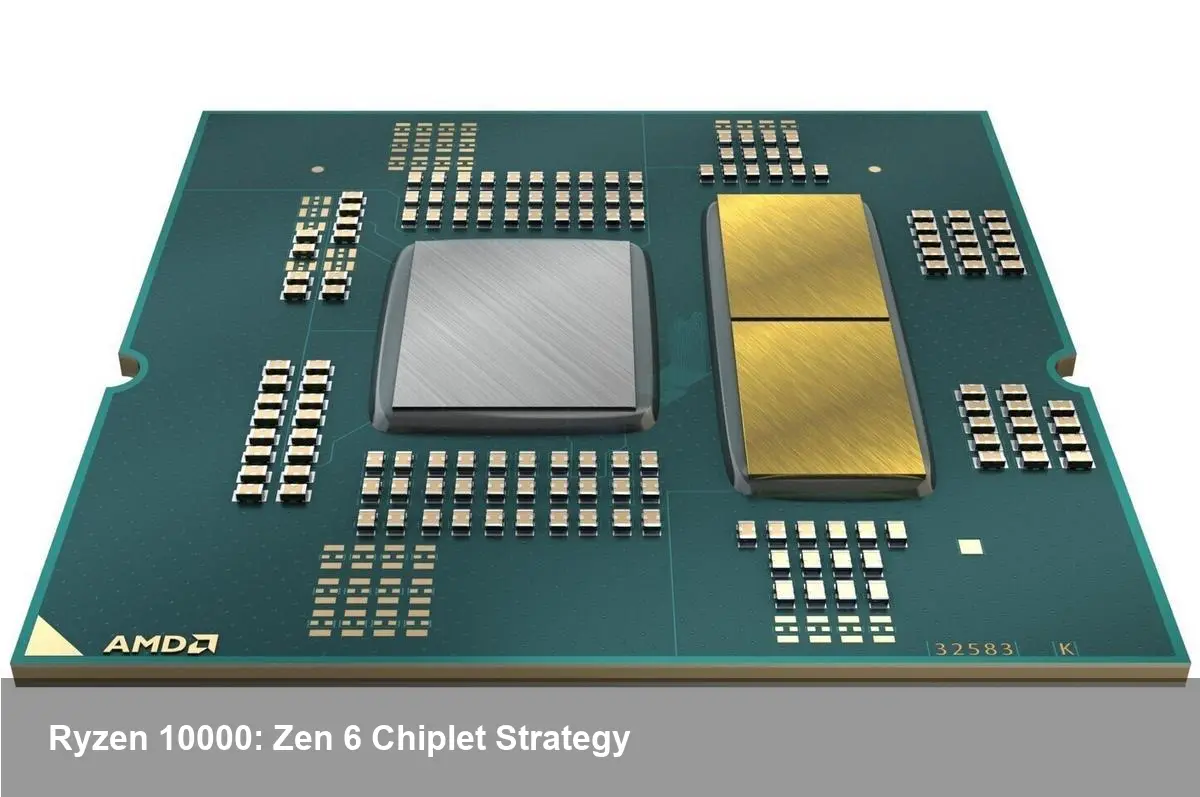
Where Olympic Ridge fits in AMD's roadmap
AMD's Ryzen 10000 family—branded internally as "Olympic Ridge"—represents the next desktop wave built around the Zen 6 core microarchitecture. After multiple Zen generations that leaned heavily on a chiplet (CCD) plus I/O die model, Olympic Ridge looks to refine that approach while delivering a broad spectrum of SKUs aimed at mainstream desktop users, enthusiasts, and workstation buyers.
If you follow CPU design trends, the takeaway is straightforward: AMD is continuing its chiplet-first strategy but tuning product segmentation to deliver more granularity in core counts and better yield economics.
What the SKU lineup looks like (and why it matters)
Early signals point to a Ryzen 10000 lineup that starts with single-CCD chips before expanding to multi-CCD parts. The range will include desktop SKUs with 6, 8, 10 and 12 cores from single-CCD designs, with higher-core parts—16, 20 and 24 cores—expected from multi-CCD configurations.
Why that matters:
- Single-CCD SKUs tend to have lower latency between cores and can be more power-efficient under many workloads. They also simplify pricing and binning for AMD.
- Multi-CCD chips enable higher core counts without the thermal and routing complexity of monolithic dies, but they bring inter-CCD latency considerations that software and OS schedulers must account for.
The way AMD maps cores across CCDs sets the product segmentation. By launching single-CCD 6/8/10/12-core parts first, AMD can cover the most popular desktop segments—gaming, content creation, and light workstation workloads—before moving into the high-core-count territory that targets heavier parallel workloads.
Real-world scenarios: who benefits and how
- Gamers: Most modern games still favor higher single-thread performance and fast cache/memory paths. Olympic Ridge's single-CCD SKUs can deliver snappier game responsiveness by minimizing cross-die communication for the threads the game uses most.
- Live streamers and content creators: A 10- or 12-core single-CCD Ryzen 10000 chip can handle streaming + gaming or editing + rendering more gracefully than previous-gen midrange parts. The extra cores keep background tasks off the main threads and reduce contention.
- Developers and build servers: For CPU-bound compilation workloads, the 16/20/24-core multi-CCD chips will provide strong throughput. But for single-job latency (e.g., dev debugging, interactive builds), the faster, lower-latency single-CCD options may feel more responsive.
- Small studios and prosumers: The new SKU spread allows better price/performance matching. Instead of overbuying a 16-core chip for occasional parallel jobs, buyers can pick a 10–12 core single-CCD CPU that balances responsiveness and threaded throughput.
Developer and system-level implications
- Scheduler awareness: Operating systems and hypervisors should keep topology-awareness (which cores share a CCD) to minimize cross-CCD traffic for latency-sensitive threads. App developers writing threaded workloads should prefer affinity strategies that favor intra-CCD scheduling when possible.
- Virtualization and cloud: Providers packaging Ryzen 10000 into VMs will need to present core and NUMA topology clearly. Single-CCD instances give simpler, predictable performance for latency-sensitive services; multi-CCD instances offer better density for batch processing.
- Thermal and power management: Single-CCD parts simplify cooling requirements for mainstream builds. For integrators and OEMs, this lowers BOM complexity for mainstream desktops and compact workstations.
Pros and trade-offs for buyers
Pros:
- More granularity in SKU choices reduces overkill: pick a 10-core for sustained productivity without stepping up to an expensive 16-core part.
- Single-CCD designs can offer better per-thread latency and slightly improved power efficiency in many real-world tasks.
- Continued chiplet approach keeps fabrication costs manageable and helps AMD bring competitive pricing.
Trade-offs:
- Multi-CCD high-core-count parts can have higher inter-core latencies for threads that span CCDs—software must be topology-aware to avoid performance regressions.
- The SKU breadth can be confusing for users who don't understand CCD topology; clear labeling and motherboard partner guidance will be important.
- Some workloads that require maximum memory bandwidth per core will still prefer higher-end workstation CPUs with different I/O or memory channel counts.
Practical buying advice for different user types
- If you’re a gamer who streams occasionally: aim for a 10–12 core single-CCD Ryzen 10000. It’s a pragmatic choice to keep streaming, encoding, and gaming responsive.
- If you do heavy parallel workloads frequently (render farms, large compilations, scientific compute): wait for multi-CCD 16/20/24-core SKUs or consider workstation-class parts for larger memory/channel needs.
- For small businesses or mixed workloads: the broader SKU mix allows IT buyers to standardize on a family of CPUs while right-sizing core counts to job profiles—reducing waste.
What to watch next (three forward-looking implications)
- Software and scheduler maturity will start to matter more: As CCD-based segmentation becomes the norm, OS-level scheduling and developer-side affinity strategies will be key to getting consistent performance across chip configurations.
- Pricing dynamics could tighten Intel competition: With a wider array of right-sized SKUs, AMD can undercut or match competing desktop offerings in more price bands, which may push rivals to rethink per-core pricing and features.
- Chiplet scaling beyond desktop: The lessons AMD refines with Olympic Ridge—balancing single-CCD responsiveness and multi-CCD density—will influence future mobile, HEDT, and data-center designs. Expect derivative parts that apply the same topology choices to laptops and servers.
Olympic Ridge looks like a carefully calibrated step: it keeps the architectural strengths of the chiplet era while offering more pragmatic choices for real-world buyers. If you’re planning a new build, think about whether you value responsiveness (single-CCD) or raw throughput (multi-CCD). That decision will probably determine which Ryzen 10000 SKU fits best.