3DFX Voodoo Reborn on FPGA

Why the Voodoo story still matters
In the late 1990s, 3DFX’s Voodoo chips changed how PC games rendered 3D scenes. The original Voodoo appeared around 1996, followed by faster descendants (Voodoo2, Voodoo3) through the end of the decade. Their Glide API and single-purpose 3D hardware made them a favorite among gamers and developers. After 3DFX’s assets moved to other companies around 2000, the chips themselves became artifacts: beloved for their visual quirks and historically important for the evolution of GPUs.
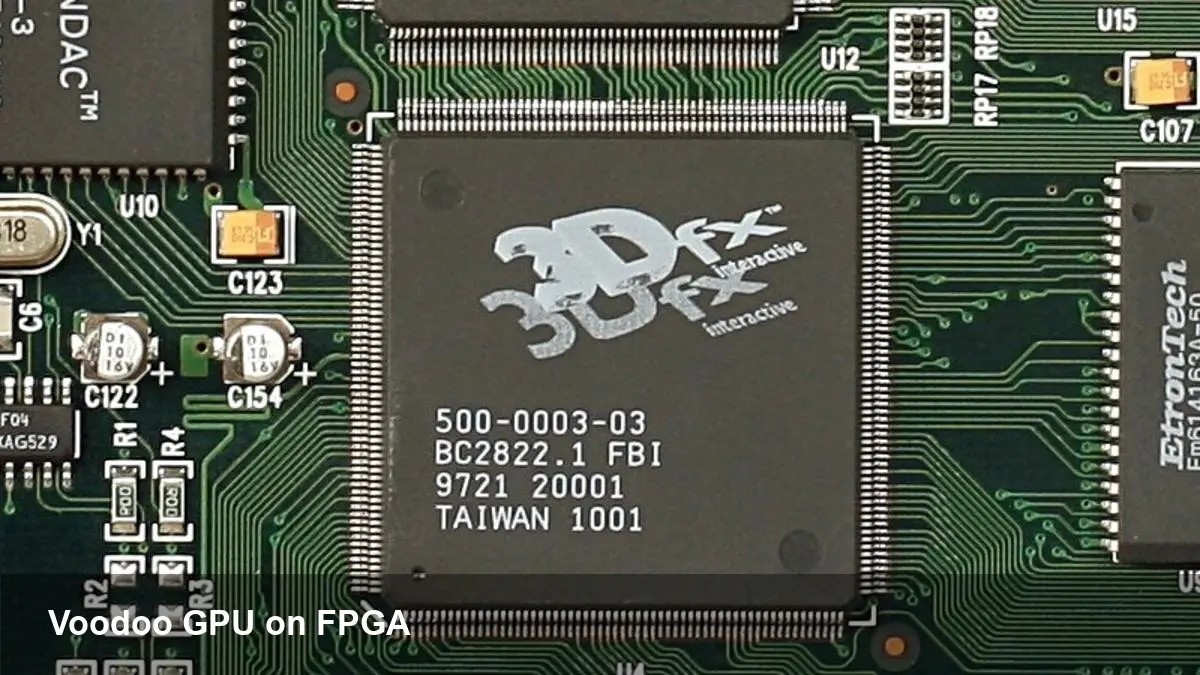
Today, FPGA recreations are bringing Voodoo-class hardware back to life. These projects go beyond software emulation to reproduce the logic and behavior of the original silicon in programmable hardware. For retro players, museum curators, and developers chasing pixel-perfect behavior, that shift matters.
FPGA vs software emulation: why hardware-level recreation
Emulators running on modern CPUs can reproduce the general look and functionality of old GPUs, but they often miss subtle timing, bus arbitration, and rasterization quirks that affect how some games behave. An FPGA implementation maps the original circuits (or functional equivalents) into logic gates on a field-programmable device, which can reproduce timing and data-path characteristics more faithfully.
Practical differences:
- Deterministic behaviour: FPGA cores often behave more like the original hardware for race conditions and frame timing.
- Lower latency: Implementations on dedicated hardware reduce input-to-display delay, important for arcade ports and competitive retro gaming.
- Real video outputs: Many FPGA platforms can drive VGA/SCART/HDMI using hardware signal processing, preserving the analog look or delivering crisp modern output.
What a Voodoo FPGA core looks like
An FPGA-based Voodoo core reimplements the GPU’s pipeline: triangle setup, rasterization, Z-buffering, texture filtering, and the bus interfaces used by the original cards (PCI or ISA glue logic). Supporting Glide compatibility is critical because many games used that API directly.
Common components in a Voodoo FPGA project:
- Core rendering pipeline (fixed-function, not programmable shaders)
- Texture memory emulation and texture DMA controller
- PCI/host bridge logic to accept commands from the PC or a soft CPU
- Optional scaler/scan doubler for modern displays
- Glide-compatible driver or translation layer
MiSTer FPGA, built around Terasic DE10-Nano boards, has been a major platform for retro hardware cores. Other FPGA boards (from Xilinx or Intel/Altera) are used by hobbyists and commercial labs.
Real-world use cases
- Retro gaming rigs: A Voodoo core on an FPGA lets you run period-correct builds of Quake, Unreal Tournament, or Tomb Raider with the exact raster quirks and Glide shading the developers targeted.
- Arcade and cabinet restoration: Operators restoring late-90s PC-based arcade machines can plug in FPGA hardware to recreate the original GPU behavior without tracking down aging boards.
- Preservation and research: Museums and archivists can run software in a reproducible environment that preserves hardware behavior rather than approximating it with software emulation.
- Development and modding: Hobbyists building hardware-accelerated retro consoles or creating hybrid systems (FPGA front-end + modern CPU) can leverage a Voodoo core for authenticity.
Getting started: hardware and workflow
If you want to experiment with a Voodoo FPGA recreation, here’s a typical path:
- Choose the FPGA platform: Many projects target the DE10-Nano because of MiSTer compatibility, while others use larger Altera/Xilinx boards for increased logic and RAM.
- Obtain a Voodoo core: Open-source and community cores exist, but maturity varies. Check project notes for which Voodoo generation is implemented (Voodoo1 vs Voodoo2, etc.).
- Configure memory and I/O: Texture RAM and PCI bridge must be set up; some projects use on-board SDRAM or external RAM modules to match the original card’s memory behavior.
- Boot and connect: The FPGA can be used in two ways — as an internal peripheral in a retro PC (via a physical PCI slot or a pass-through adapter) or as a co-processor attached via a custom host interface.
- Tune display output: Use built-in scalers or external converters to get the right resolution and scan rates for CRTs or modern screens.
Expect iterative debugging: timing issues, missing Glide features, or edge cases in memory transfers are common early hurdles.
Limitations and legal considerations
Technical limitations:
- Complexity: High-fidelity cores require detailed knowledge of the original chips; incomplete data sheets and unavailable microcode make perfect clones challenging.
- Resource limits: Voodoo pipelines were modest by modern standards, but mapping every nuance can still be demanding for mid-range FPGAs when you add PCI logic and video scalers.
- Integration headaches: Getting an FPGA card to behave exactly like an original when hosted inside a vintage PC can require careful electrical and protocol handling.
Legal and IP issues:
- IP ownership: The original designs and firmware are intellectual property; some projects carefully avoid distributing copyrighted BIOS images or drivers and require users to supply them.
- Glide and drivers: Some projects implement Glide-compatible layers; where original driver code or trademarks are involved, maintainers may need to tread carefully.
Business and community implications
For startups and small teams, FPGA remakes of vintage hardware reveal a business model: offering high-quality reproduction boards or turnkey FPGA retrofit kits for collectors and museums. There’s a market for low-volume, high-fidelity hardware for enthusiasts willing to pay for authentic behavior.
Open-source projects build community knowledge and serve preservation goals, but companies can add value by packaging tested hardware, warranties, and support for complex integrations (PCI cages, analog video boards, or FRAM replacements).
Looking ahead: three implications
- Preservation-first hardware will grow: As more emulation-critical hardware is lost to decay, FPGA-based preservation will become standard practice in museums and archival labs.
- Hybrid retro devices will multiply: Expect devices that pair FPGA-accurate GPU cores with modern CPUs for running vintage OSes with authentic graphics while providing HDMI output and modern peripherals.
- Legal frameworks may adapt: Growing demand for hardware preservation could push vendors or rightsholders to release driver code or documentation under archival licenses, easing high-fidelity recreation.
FPGA recreation of the 3DFX Voodoo is more than nostalgia; it’s a practical route to accurate preservation, better retro gameplay, and a niche market for builders. Whether you’re restoring a cabinet, building a period-accurate gaming rig, or experimenting with hardware design, the FPGA approach gives you a closer window into how 3D graphics looked and felt at the start of the GPU era.